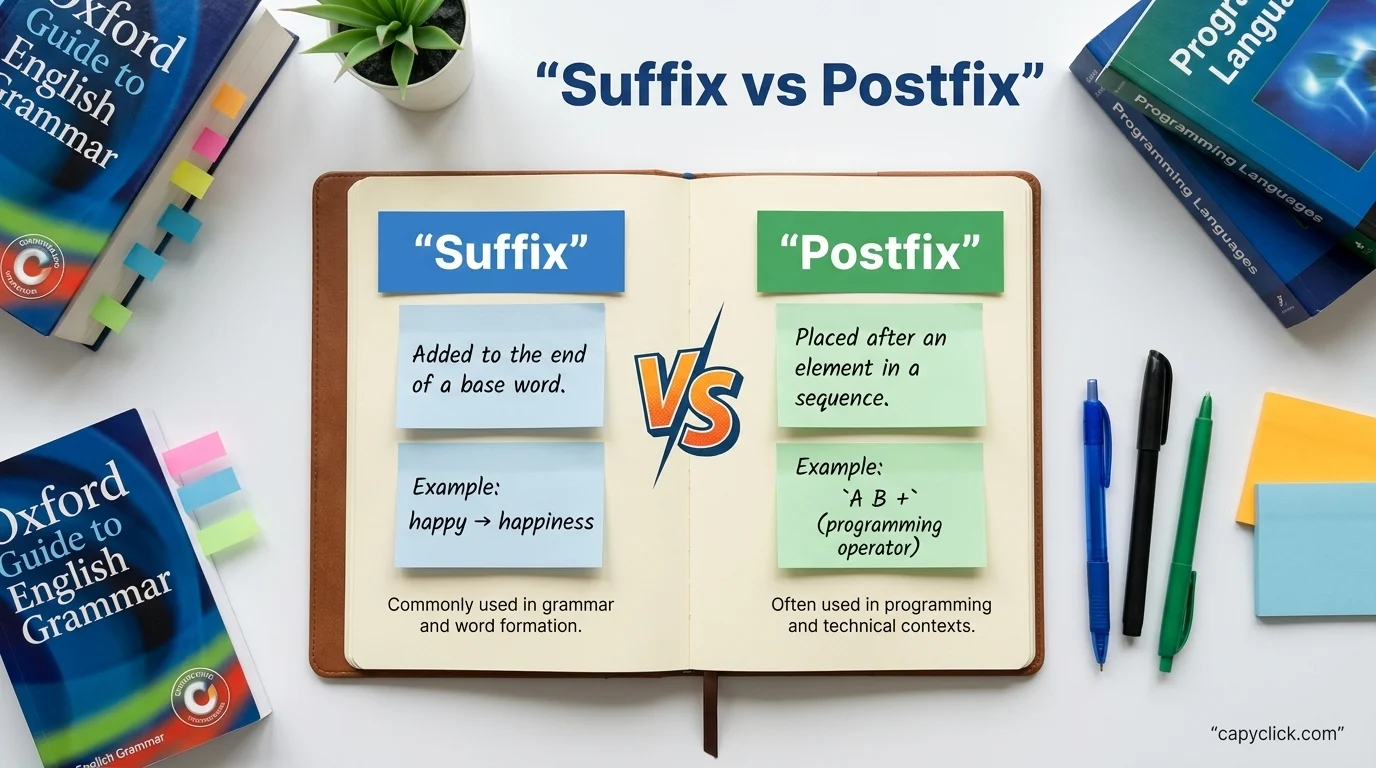
The words suffix vs postfix can be confusing because both are connected to something that comes after another element. In everyday English, a suffix is a letter or group of letters added to the end of a word, such as -ness in kindness. A postfix is also something placed after another element, but its meaning can be broader, especially in linguistics, programming, and mathematics.
The two terms sometimes overlap, so saying they are always completely different would be misleading. In English grammar, suffix is the more common term for a word ending. In programming, postfix operator describes an operator placed after its operand. When discussing file names, extension is often the clearest term. Understanding these differences will help you choose the right word for your subject and avoid common mistakes.
Quick Answer: Suffix vs Postfix
A suffix is an element added to the end of a word, such as -ful in helpful. A postfix is an element placed after another element and may refer to a suffix in some linguistic contexts. The terms can overlap, but suffix is more common in English grammar, while postfix is widely used in programming and mathematical notation.
Why Do People Confuse Suffix and Postfix?
People confuse suffix and postfix because both terms describe something that appears after another element.
The word suffix is associated with the end of a word. The word postfix combines post-, meaning after, with fix, suggesting something attached or placed.
Their meanings overlap in some dictionaries and linguistic contexts. However, their typical uses are different.
- Suffix: Usually an ending added to a word, such as -ly, -ness, or -ed.
- Postfix: Something that follows another element, including an operator in programming or a linguistic element placed after a base.
- Extension: The part of a file name that identifies its format or type, such as .html or .pdf.
For example, -ness is a suffix in kindness. In C++, x++ is a postfix increment expression. Both involve placement at the end, but they belong to different contexts.
The key is to consider what you are describing rather than assuming that one term is always correct and the other is always wrong.
What Does Suffix Mean?
A suffix is a letter or group of letters added to the end of a word or word base to form another word or change its grammatical form.
Suffixes are an important part of English grammar, vocabulary, and word formation. They help us create nouns, adjectives, adverbs, and different verb forms.
| Root or base | Suffix | Result | What changes? |
| Kind | -ness | Kindness | Adjective to noun |
| Help | -ful | Helpful | Forms an adjective |
| Quick | -ly | Quickly | Adjective to adverb |
| Teach | -er | Teacher | Forms a noun for a person |
| Walk | -ed | Walked | Marks past tense |
| Care | -less | Careless | Adds the meaning “without” |
| Develop | -ment | Development | Forms a noun |
| Happy | -ness | Happiness | Adjective to noun |
Examples of Suffixes in English
For example, kind describes a person or action. Adding the suffix -ness produces kindness, which names the quality of being kind.
Similarly, careless means lacking care, while careful means showing care. The suffix changes the meaning of the base word.
What Are the Main Types of Suffixes?
English suffixes are commonly divided into two groups: derivational suffixes and inflectional suffixes.
1. Derivational suffixes
These suffixes form new words or change a word’s grammatical category.
Examples:
- Happy → Happiness
- Teach → Teacher
- Care → Careful
- Quick → Quickly
- Develop → Development
The suffix -ness, for example, turns an adjective into a noun.
2. Inflectional suffixes
These suffixes change the grammatical form of a word without usually creating a completely new dictionary word.
Examples:
- Walk → Walked
- Cat → Cats
- Small → Smaller
- Work → Working
- Play → Plays
The suffix -s in cats marks a plural noun, while -ed in walked marks the past tense of a regular verb.
These examples show why suffixes in English are useful for understanding word meanings, spelling, and sentence structure.
What Does Postfix Mean?
A postfix is an element placed after another element. Depending on the subject, it may refer to a word ending, an operator, or another element that follows a base.
In ordinary English grammar lessons, suffix is the more familiar term. In computer science and mathematics, however, postfix has specific technical meanings.
Is Postfix a Synonym for Suffix?
Sometimes, yes.
In general English usage, postfix can mean a suffix. Some dictionaries also define it as an element added to the end of a word.
However, some linguistic discussions use the terms more precisely. Under one distinction, a postfix can be a broader category for an element placed after a base, while a suffix is a particular type of word-forming element.
For example, a linguistic analysis may distinguish a suffix from other elements that follow a word base, such as certain endings or clitics. The exact terminology depends on the linguistic framework and language being studied.
Therefore, it is not accurate to claim that suffix and postfix are always unrelated or that they are always interchangeable. Context determines the most appropriate term.
What Is a Postfix Operator in Programming?
In programming, a postfix operator appears after the value or variable it operates on.
For example, in C++:
x++
Here, ++ is the postfix increment operator because it follows x.
Compare it with:
++x
In this expression, ++ comes before x, so it is called a prefix increment operator.
In C++, when these expressions are used as values, the postfix form yields the original value before incrementing the variable, while the prefix form yields the incremented value. Their exact effects should be understood in the context of the programming language and expression.
This is a technical use of postfix, not an example of an English suffix.
What Is Postfix Notation in Mathematics?
Postfix notation, also known as Reverse Polish notation, places operators after their operands.
Consider the expression:
3 + 4
This is called infix notation because the plus sign appears between the numbers.
The same expression in postfix notation is:
3 4 +
The numbers appear first, followed by the addition operator.
More examples include:
| Infix notation | Postfix notation | Result |
| 2 + 5 | 2 5 + | 7 |
| 8 – 3 | 8 3 – | 5 |
| 4 × 6 | 4 6 * | 24 |
| 12 ÷ 3 | 12 3 / | 4 |
Postfix notation is useful in computing because expressions can be evaluated with a stack and do not need the same parentheses rules as ordinary infix expressions.
Suffix vs Postfix: What Is the Difference?
The main difference is their typical use, not simply whether something appears at the end.
| Feature | Suffix | Postfix |
| Basic meaning | An ending added to a word | An element placed after another element |
| Common context | English grammar and word formation | Programming, mathematics, and some linguistic contexts |
| Example in language | -ness in kindness | May refer to an element following a linguistic base |
| Example in programming | Not the usual term for x++ | Postfix increment operator in x++ |
| Mathematical use | Not normally used for operator order | Postfix notation, such as 3 4 + |
| Relationship | A specific term for word endings | Can be used more broadly, depending on context |
| Frequency in English lessons | Very common | Less common |
| Best everyday choice | Word endings and grammar | Technical placement after another element |
Important: The terms overlap in some definitions. The most useful distinction is that suffix is the standard word for ordinary English word endings, while postfix is particularly useful when discussing placement in technical notation.
When Should You Use Suffix or Postfix?
Choose the word that matches the subject you are discussing.
When to Use Suffix
Use suffixes when talking about English vocabulary, grammar, spelling, or word formation.
Examples:
- The suffix -ness turns kind into kindness.
- The word helpful contains the suffix -ful.
- Adding -ed forms the past tense of many regular verbs.
- The suffix -less gives careless the meaning “without care.”
- Students can learn new words by studying common suffixes.
In each example, the focus is on the ending of a word and how it affects meaning or grammar.
When to Use Postfix
Use postfix when discussing technical notation or when a linguistic framework specifically uses that term.
Examples:
- The expression x++ uses a postfix increment operator in C++.
- The calculator accepts postfix notation.
- The expression 3 4 + is written in postfix form.
- The program converts an infix expression into postfix notation.
- The researcher uses postfix as a broader term for elements following a linguistic base.
In these examples, postfix refers to a position or a technical category.
What Should You Call the Ending of a File Name?
This question is especially important because suffix, postfix, and extension can all appear in discussions about file names.
Consider this file name:
index.en.xhtml
The parts may be understood as follows:
- index is the base name.
- .xhtml is the final file extension in common usage.
- .en may be a language-related part of the file name.
- .en.xhtml may be described informally as a combined suffix or sequence of extensions, depending on the naming convention.
For most everyday computer users, file extension is the clearest term for the final part after the last dot. In this example, that is .xhtml, although some systems and tools display the extension without the dot.
If you need to describe the entire ending .en.xhtml, explain that you mean the combined ending rather than assuming every reader will interpret suffix or postfix in the same way.
The exact meaning of a file extension also depends on the software and naming convention. A file’s name alone does not always prove its actual content or format.
15 Examples of Suffix vs Postfix
The following examples show how the terms are used in everyday English, linguistics, file naming, programming, and mathematics.
Suffix Examples
1. Kindness
The suffix -ness changes the adjective kind into the noun kindness.
2. Helpful
The suffix -ful helps form an adjective from help.
3. Teacher
The suffix -er forms a noun for a person who teaches.
4. Quickly
The suffix -ly forms the adverb quickly from quick.
5. Walked
The suffix -ed marks the past-tense form of the regular verb walk.
6. Careless
The suffix -less means without or lacking something.
7. Development
The suffix -ment helps form the noun development from develop.
8. Happiness
The suffix -ness turns happy into happiness. The spelling changes from y to i before the suffix.
Postfix and Related Technical Examples
9. Postfix increment
In C++, x++ is a postfix increment expression because the operator follows the variable.
10. Prefix compared with postfix
In C++, ++x uses prefix notation, while x++ uses postfix notation.
11. Postfix addition
The ordinary expression 2 + 5 becomes 2 5 + in postfix notation.
12. Postfix subtraction
The expression 8 – 3 becomes 8 3 -.
13. Postfix multiplication
The expression 4 * 6 becomes 4 6 *.
14. A file-name ending
In report.en.html, .html is commonly called the file extension. The longer ending .en.html may be described as a combined suffix if the naming convention makes that meaning clear.
15. A linguistic postfix
In a linguistic framework that uses postfix as a broader category, the term may cover elements placed after a base, including certain endings that are not classified as ordinary suffixes.
These examples show that the correct word depends on the kind of element and the context in which it appears.
Common Mistakes When Using Suffix and Postfix
Mistake 1: Saying the Two Words Are Always Different
The claim that suffix and postfix can never mean the same thing is too strong. Some dictionaries and linguistic contexts use postfix as a synonym for suffix.
Better approach: Explain the context and use the term preferred in that field.
Mistake 2: Assuming They Are Always Interchangeable
The opposite claim is also misleading. In programming, postfix operator has a specific technical meaning. Replacing it with suffix would usually sound incorrect.
Better approach: Use postfix operator for an operator placed after its operand.
Mistake 3: Calling Every File-Name Ending an Extension
In everyday computing, extension commonly refers to the final part of a file name after the last dot. A longer sequence, such as .en.xhtml, may contain more than one meaningful part.
Better approach: Identify whether you mean the final extension or the entire ending.
Mistake 4: Confusing Prefix and Postfix
A prefix appears before an element; a postfix appears after it.
- ++x: prefix increment
- x++: postfix increment
The order matters in programming languages that support these operators.
Mistake 5: Thinking Every Suffix Creates a New Dictionary Word
Some suffixes create new words, while others change grammatical forms.
For example, care and careless have related but different meanings. By contrast, walk and walked are different grammatical forms of the same verb.
Better approach: Learn the difference between derivational and inflectional suffixes.
What Is an Easy Memory Trick for Suffix vs Postfix?
Use these simple reminders:
- Suffix = word ending.
- Postfix = placed after.
- Prefix = placed before.
- Extension = the final file-name ending in common computer usage.
For example, -ness is a suffix in kindness. The ++ in x++ is a postfix operator in C++. The ++ in ++x is a prefix operator.
Remember that these are practical rules rather than absolute definitions for every academic field. If you are writing an English grammar lesson, suffix is normally the best choice.
Is There a Difference Between American and British English?
There is no major difference between American and British English in the ordinary use of suffix and postfix.
Both varieties use suffix for word endings such as -ness, -ful, and -ed. Both also use technical expressions such as postfix operator and postfix notation in programming and mathematics.
The main difference is not regional spelling but context and frequency. Suffix is the more familiar term in general English grammar lessons, while postfix is particularly useful in technical writing.
What Are Similar Words to Suffix and Postfix?
Several related terms help explain how elements can be added to or arranged around words and expressions.
| Term | Meaning | Example |
| Prefix | An element placed before a base | un- in unhappy |
| Suffix | An element added to the end of a word base | -ness in kindness |
| Affix | A general term for a bound element added to a base | Prefixes and suffixes |
| Infix | An element inserted inside a base | Certain word patterns in some languages |
| Postfix notation | An expression format that places operators after operands | 3 4 + |
| Infix notation | An expression format that places operators between operands | 3 + 4 |
| Prefix notation | An expression format that places operators before operands | + 3 4 |
| File extension | The final file-name part commonly used to indicate a file type | .pdf in notes.pdf |
An affix is the broader linguistic term. Prefixes and suffixes are types of affixes, while postfix notation is a way of arranging mathematical or computational expressions.
These related words should not be treated as exact synonyms because each has its own meaning.
Frequently Asked Questions
1. What is the main difference between suffix and postfix?
A suffix is an element added to the end of a word, such as -ness in kindness. A postfix is an element placed after another element. Some dictionaries use postfix as a synonym for suffix, but the terms have different common uses in grammar and technical subjects.
2. Are suffix and postfix synonyms?
They can be synonyms in some contexts, particularly when postfix means an element added to the end of a word. However, they are not interchangeable in every situation. Suffix is the usual term in English grammar, while postfix operator and postfix notation are established technical expressions.
3. Is suffix or postfix correct in linguistics?
Suffix is the more common term in English-language discussions of word formation. Some linguistic frameworks use postfix more broadly for elements that follow a base. The best choice depends on the language being studied and the terminology used by the researcher.
4. What is an example of a suffix?
The ending -ness in kindness is a suffix. Other examples include -ful in helpful, -less in careless, -ly in quickly, and -ed in walked. These endings help form words or change their grammatical forms.
5. What is an example of a postfix in programming?
In C++, x++ is a postfix increment expression because the increment operator comes after the variable. The expression ++x is the corresponding prefix form. The difference can affect the value produced by the expression.
6. Should I call .en.xhtml a suffix or a postfix?
For a file named index.en.xhtml, .xhtml is commonly called the file extension. If you want to refer to the complete ending .en.xhtml, you can describe it as a combined suffix or a sequence of extensions, provided you explain what you mean. Postfix is possible in a broad positional sense but is less clear for ordinary file-name discussions.
7. What is the difference between suffix and extension?
A suffix is an ending added to a word or base. A file extension is the final part of a file name, commonly used to identify its format or the software associated with it. For example, -ness is a word suffix, while .pdf is a file extension.
8. What is the difference between prefix and postfix?
A prefix appears before another element, while a postfix appears after it. In programming, ++x is a prefix increment expression and x++ is a postfix increment expression. In word formation, un- in unhappy is a prefix, while -ness in kindness is a suffix.
Remember This
- Suffix: The usual term for an ending added to a word.
- Postfix: An element placed after another element; in some contexts, it can also mean a suffix.
- Postfix operator: An operator written after its operand, such as x++.
- Postfix notation: A mathematical expression format such as 3 4 +.
- File extension: The common term for the final part of a file name, such as .html.
The most important rule is to choose the term that matches your context. Do not assume that the words are always identical or always completely different.
Conclusion
The difference between suffix vs postfix is mainly about meaning, context, and common usage. A suffix is an ending added to a word, as in kindness or helpful. A postfix is something placed after another element and can also be used as a synonym for suffix in certain linguistic definitions. In programming and mathematics, however, postfix has specific meanings that are not the same as ordinary English word formation.
For students and English learners, suffix is generally the right word for word endings. For programmers, mathematicians, and readers discussing expression order, postfix is often the more precise term. When discussing file names, use file extension for the final part and explain longer combined endings when necessary. Understanding the context makes the distinction clear and helps you use both words accurately.

I’m Blake Thomas, a passionate caption writer at CapyClick. I love creating creative, catchy, funny, and meaningful captions that help people express themselves and make every social media post stand out.