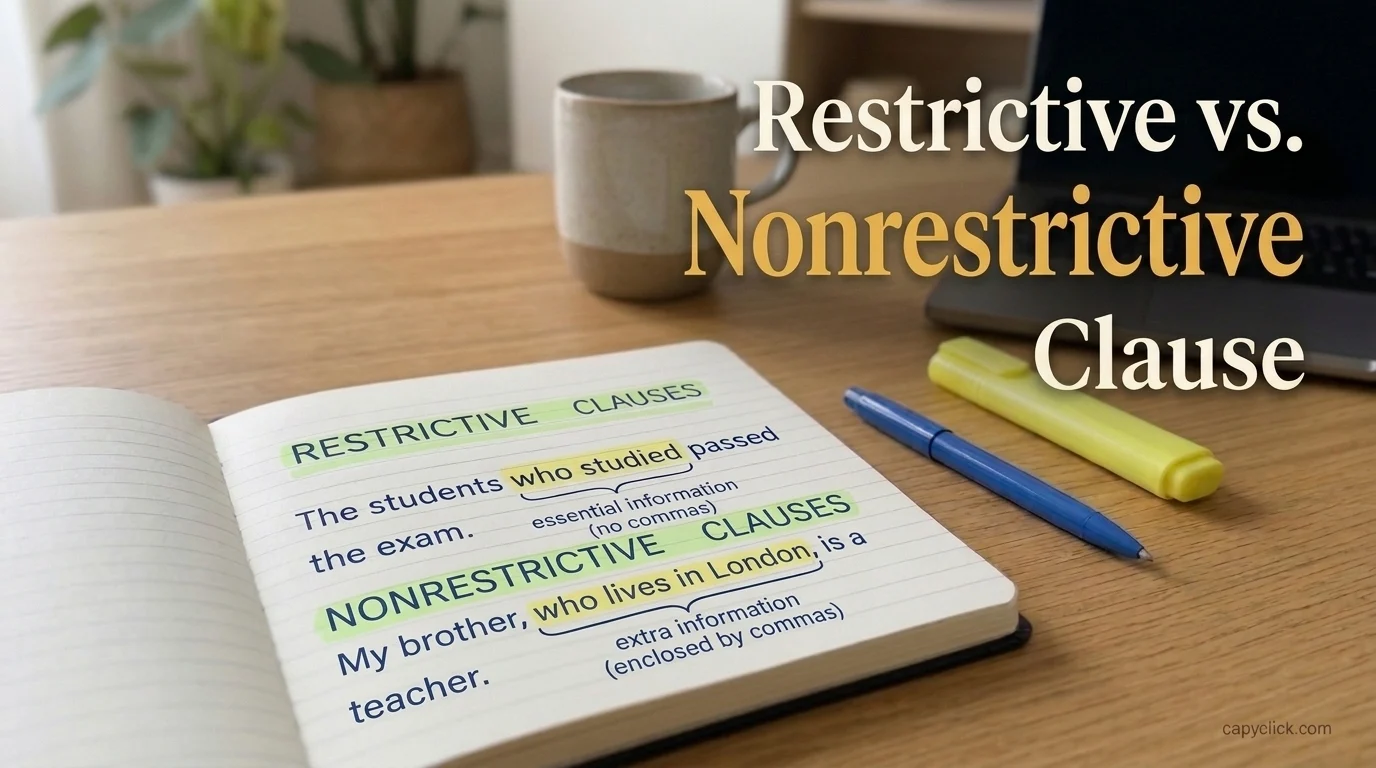
Understanding restrictive vs. nonrestrictive clauses can be confusing, especially when choosing between which and that or deciding whether a sentence needs commas. Both types of clauses provide information about nouns, but the information serves a different purpose. A restrictive clause identifies exactly which person or thing you mean, while a nonrestrictive clause adds extra information about something already identified.
The important point is that a clause is not automatically restrictive because it begins with that, or nonrestrictive because it begins with which. Its function and the writer’s intended meaning determine its type.
For example, “The paint which Mary bought at the store was bright red” uses a restrictive clause if the information identifies a particular batch of paint. However, “The paint, which Mary bought at the store, was bright red” uses a nonrestrictive clause if the paint is already identified. The difference is not simply the relative pronoun; it is the meaning, context, and punctuation.
Quick Answer: Restrictive vs. Nonrestrictive Clause
A restrictive clause gives essential information that identifies a noun and does not use commas. A nonrestrictive clause adds extra information about an already identified noun and is separated by commas. Both can use which or who, but standard written English uses that only in restrictive relative clauses, not nonrestrictive ones.
Why Do People Confuse Restrictive and Nonrestrictive Clauses?
People often confuse these clauses because they can look almost identical. Both provide information about a noun, and both can begin with relative pronouns such as who, which, and that.
The confusion becomes greater when writers assume that which always introduces a nonrestrictive clause and that always introduces a restrictive clause.
Although this distinction is a useful writing guideline, it does not explain the entire grammatical difference.
Consider these sentences:
- The paint which Mary bought at the store was bright red.
- The paint, which Mary bought at the store, was bright red.
Both sentences are grammatically possible, but they communicate slightly different things.
In the first sentence, the clause which Mary bought at the store identifies the particular paint being discussed. Perhaps there are several batches of paint, and the writer wants to distinguish one from another.
In the second sentence, the writer has already identified the paint. The clause simply adds information about where Mary bought it.
This distinction is easier to understand when you imagine a conversation involving several different objects or groups of people.
Why Does Context Matter?
A clause does not become restrictive or nonrestrictive simply because of its words. The surrounding context and the writer’s intended meaning determine its function.
For example:
Restrictive:
A: Did Mary buy the paint?
B: Yes. The paint which she bought at the hardware store is bright red, but the paint which she bought at the supermarket is dull.
Here, the clauses identify two different batches of paint. Without them, readers would not know which paint is bright red and which is dull.
Nonrestrictive:
A: Did Mary buy the supplies?
B: Yes. The paint, which she bought at the hardware store, is bright red.
Here, the paint is already identified. The information about the hardware store is simply an additional detail.
This is why understanding the meaning is more important than memorizing a rule about individual words.
What Is a Restrictive Clause?
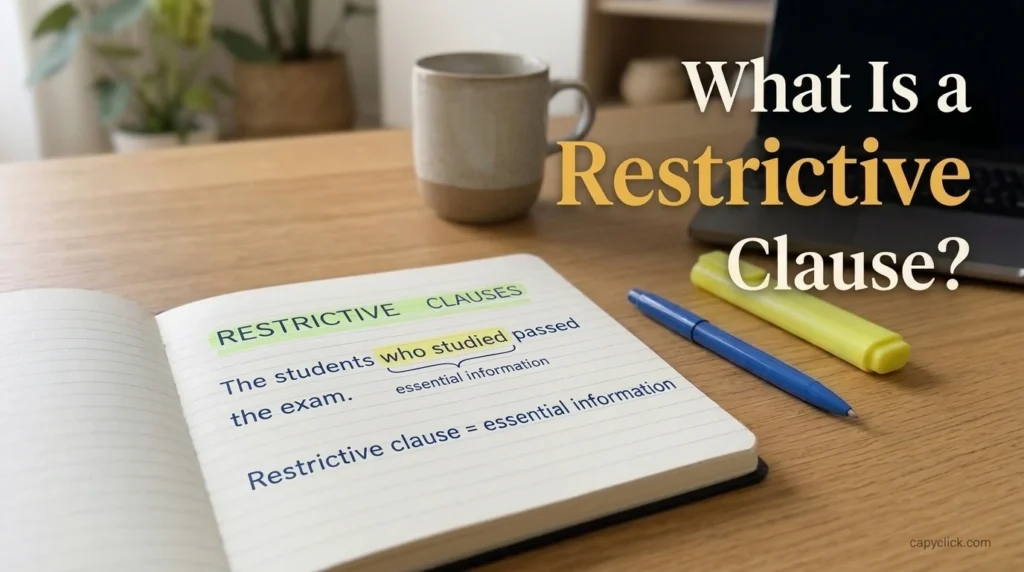
A restrictive clause is a dependent clause that provides essential information about a noun or noun phrase. It identifies, defines, or limits the noun so readers understand exactly which person, place, thing, or idea the sentence refers to.
It is also called an essential clause or defining relative clause.
Restrictive clauses do not use commas because their information is necessary to the intended meaning.
Examples:
- The students who study regularly usually get good grades.
- The book that you gave me is interesting.
- The paint which Mary bought at the store was bright red.
- The woman who teaches English is my aunt.
- The house that has a blue door belongs to my uncle.
In the first example, who study regularly identifies which students usually get good grades. The sentence does not necessarily refer to every student.
Similarly, in the paint example, which Mary bought at the store identifies the particular paint being discussed.
When Should You Use a Restrictive Clause?
Use a restrictive clause when readers need the information to identify a specific noun.
Common situations include:
- Identifying a person: The man who called yesterday is my teacher.
- Selecting an object: The phone that has a cracked screen is mine.
- Distinguishing between groups: Students who passed the exam received certificates.
- Identifying a place: The restaurant which serves Italian food is popular.
- Describing a specific item: The dress that I bought yesterday is beautiful.
A restrictive clause helps divide a larger group into smaller, more specific groups.
For example:
The students who walked to the top of the hill saw an eagle.
This sentence refers to the students who walked to the top of the hill, not necessarily every student.
That is the main purpose of a restrictive clause: it narrows down the meaning.
What Is a Nonrestrictive Clause?
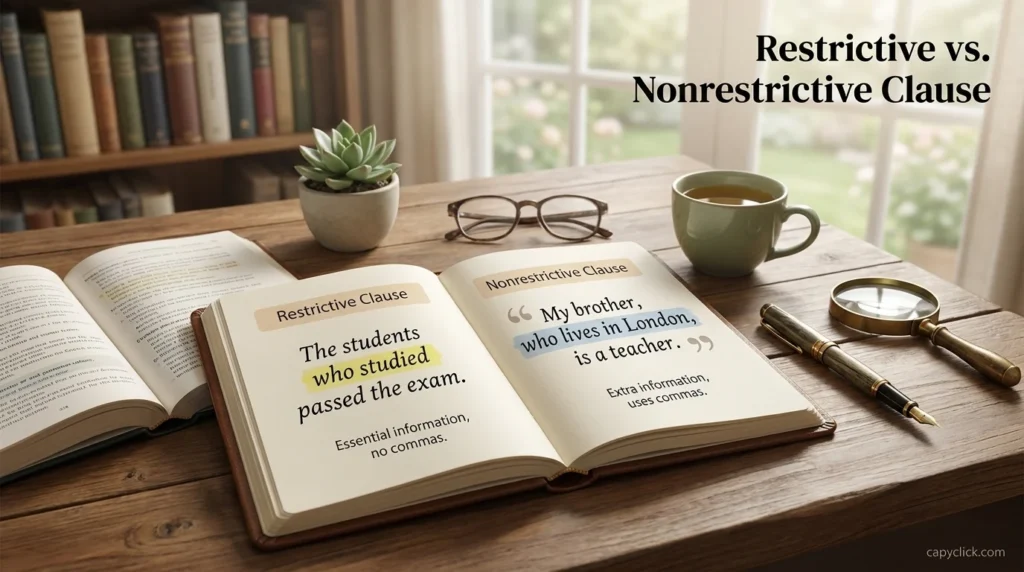
A nonrestrictive clause is a dependent clause that provides additional information about a noun without identifying or limiting it.
It is also known as a nonessential clause or nondefining relative clause.
The reader already knows which person or thing the writer is discussing. The clause simply adds an extra detail.
Nonrestrictive clauses are separated from the rest of the sentence by commas.
Examples:
- My sister, who lives in Canada, is a doctor.
- Paris, which is the capital of France, attracts millions of tourists.
- My laptop, which I bought last year, still works perfectly.
- Ahmed, who is my childhood friend, lives in London.
- The paint, which Mary bought at the store, was bright red.
In the first example, who lives in Canada adds information about my sister. It does not identify which person the writer means.
You can remove the clause without changing the main statement:
My sister is a doctor.
The sentence still communicates its central meaning.
When Should You Use a Nonrestrictive Clause?
Use a nonrestrictive clause when you want to add information about something that is already clearly identified.
Common situations include:
- Adding information about a family member: My father, who works in a bank, enjoys reading.
- Describing a known place: London, which has a rich history, attracts visitors.
- Providing details about an object: My car, which is quite old, still runs well.
- Describing a known person: Sara, who is my best friend, loves music.
- Adding background information: Mount Everest, which is the highest mountain above sea level, attracts climbers.
Think of a nonrestrictive clause as a little by the way detail. It adds something interesting without identifying the noun.
Restrictive vs. Nonrestrictive Clause: Comparison Table
| Feature | Restrictive Clause | Nonrestrictive Clause |
| Meaning | Essential information | Additional information |
| Purpose | Identifies or limits a noun | Describes an already identified noun |
| Other names | Essential, defining clause | Nonessential, nondefining clause |
| Commas | No commas | Uses commas |
| Can it be removed? | May change the intended meaning | Usually preserves the main meaning |
| Common relative pronouns | Who, that, which, whose | Who, which, whose |
| Function | Narrows down a group | Adds extra details |
| Example | The dog that barks is mine. | My dog, which barks loudly, is friendly. |
Which vs. That: What Is the Difference?
One of the most common questions about restrictive and nonrestrictive clauses is whether to use which or that.
The basic rule in standard written English is:
- Use that to introduce restrictive clauses.
- Use which to introduce restrictive or nonrestrictive clauses, depending on the intended meaning and style.
- Do not use that to introduce nonrestrictive clauses.
When Should You Use That?
Use that when the clause provides essential information about a noun.
Examples:
- The car that I purchased is expensive.
- The movie that we watched was excellent.
- The food that you prepared tastes delicious.
- The book that is on the table belongs to me.
In each example, the clause identifies the particular car, movie, food, or book.
When Should You Use Which?
Use which in nonrestrictive clauses to introduce additional information.
Examples:
- My car, which I purchased last year, is expensive.
- The movie, which we watched yesterday, was excellent.
- The food, which you prepared, tastes delicious.
- My book, which is on the table, belongs to me.
You can also use which in restrictive clauses, particularly in British English and in writing styles that permit it.
For example:
The car which I purchased is expensive.
Here, which I purchased identifies the particular car. It is restrictive, so no commas are needed.
Can Which Introduce Both Restrictive and Nonrestrictive Clauses?
Yes. This is an important point that many English learners misunderstand.
Consider these examples:
Restrictive:
The paint which Mary bought at the store was bright red.
The clause identifies which paint was bright red.
Nonrestrictive:
The paint, which Mary bought at the store, was bright red.
The paint is already identified, and the clause adds information about where Mary bought it.
Both constructions are grammatically possible. The difference comes from the intended meaning and punctuation.
When Do Commas Change the Meaning of a Sentence?
Commas are important because they help readers understand whether information is essential or additional.
Adding or removing commas can change the meaning of an entire sentence.
Consider these examples.
Example 1: Brothers
Restrictive:
My brothers who live in Dubai are visiting me.
This means that only the brothers who live in Dubai are visiting. Other brothers may live somewhere else.
Nonrestrictive:
My brothers, who live in Dubai, are visiting me.
This suggests that all the brothers being discussed live in Dubai and are visiting.
Example 2: Students
Restrictive:
The students who completed their assignments received certificates.
Only the students who completed their assignments received certificates.
Nonrestrictive:
The students, who completed their assignments, received certificates.
This presents the students as an already identified group and adds that they completed their assignments.
Example 3: Books
Restrictive:
The books which are on the shelf belong to me.
The clause identifies which books belong to me.
Nonrestrictive:
My books, which are on the shelf, belong to me.
The books are already identified as mine. Their location is additional information.
The key lesson is that commas are not simply used to show where a reader should pause. They help communicate the relationship between the clause and the noun.
15 Restrictive and Nonrestrictive Clause Examples
The following examples show how both clause types work in everyday English.
Restrictive Clause Examples
- The girl who is wearing a red dress is my cousin.
- The book that you recommended is interesting.
- Employees who arrive late must inform the manager.
- The man who lives next door is a doctor.
- The restaurant which serves fresh pizza is always busy.
- The car that has a damaged door belongs to my brother.
- Students who complete their homework can leave early.
- The movie that we watched last night was exciting.
These clauses identify specific people, places, or things.
Nonrestrictive Clause Examples
- My mother, who loves gardening, grows beautiful flowers.
- John, who is my childhood friend, lives in New York.
- The Eiffel Tower, which is in Paris, attracts millions of visitors.
- My phone, which I purchased last month, has a great camera.
- Our teacher, who is very friendly, helps every student.
- Mount Everest, which is the highest mountain above sea level, attracts climbers.
- My bicycle, which is quite old, still works properly.
These clauses provide additional information about nouns that are already identified.
Common Mistakes When Using Restrictive and Nonrestrictive Clauses
Even experienced writers sometimes confuse these grammatical structures. Understanding the following mistakes can help you write more accurately.
1. Adding Commas Around a Restrictive Clause
Incorrect: The students, who study regularly, get good grades.
Correct: The students who study regularly get good grades.
Why? If you mean only the students who study regularly, the clause identifies a specific group and should not have commas.
2. Forgetting Commas Around a Nonrestrictive Clause
Incorrect: My brother who lives in Canada is a teacher.
Correct: My brother, who lives in Canada, is a teacher.
Why? If you have already identified your brother and simply want to add information about him, use commas.
3. Thinking Which Always Introduces a Nonrestrictive Clause
Incorrect: The book, which is on the table, belongs to me. (If the purpose is to identify which book belongs to you.)
Correct: The book which is on the table belongs to me.
Why? Which can introduce a restrictive clause without commas. The intended meaning determines the punctuation.
4. Using That in a Nonrestrictive Clause
Incorrect: My car, that is very expensive, needs repairs.
Correct: My car, which is very expensive, needs repairs.
Why? In standard written English, that does not introduce nonrestrictive relative clauses.
5. Assuming Every Clause Beginning With Who Is Nonrestrictive
Incorrect: The woman, who called yesterday, is my teacher. (If the clause is needed to identify which woman.)
Correct: The woman who called yesterday is my teacher.
Why? Who can introduce both restrictive and nonrestrictive clauses. Its grammatical function depends on the information it provides.
6. Using the Removal Test Without Considering Context
A common mistake is assuming that a clause is automatically restrictive whenever removing it makes a sentence less informative.
For example:
The paint which Mary bought at the store was bright red.
Removing the clause gives:
The paint was bright red.
The shorter sentence is still grammatically correct. However, it may no longer identify the particular paint the writer intended.
The correct question is not simply whether the sentence remains grammatical. Ask whether the clause is needed to identify the noun in the given context.
Easy Memory Trick: How to Remember the Difference
Use these two simple words to remember the rules:
- Restrictive = Required: The information identifies or limits the noun. Do not use commas.
- Nonrestrictive = Extra: The information adds details about an already identified noun. Use commas.
You can also remember nonrestrictive clauses as by the way information.
For example:
My sister, who lives in Canada, is a doctor.
Think of it as:
My sister is a doctor. By the way, she lives in Canada.
For restrictive clauses, think about selecting one person or thing from a larger group.
For example:
The student who won the competition received a prize.
The clause tells you exactly which student received the prize.
One important tip: Always consider the context and intended meaning before deciding whether to use commas.
Restrictive vs. Nonrestrictive Clauses in American vs. British English
The basic grammatical difference between restrictive and nonrestrictive clauses is the same in American and British English. Both varieties use commas to separate nonrestrictive clauses from the main sentence.
However, there are some differences in preferred writing styles.
American English
Many American style guides prefer that for restrictive clauses referring to things and which for nonrestrictive clauses.
Examples:
- The computer that I bought is expensive.
- My computer, which I bought last year, is expensive.
British English
British English commonly allows which in restrictive clauses as well as nonrestrictive clauses.
Examples:
- The computer which I bought is expensive.
- My computer, which I bought last year, is expensive.
These are general style preferences rather than absolute rules followed by every writer.
The most important thing is to use commas correctly and make the intended meaning clear.
Similar Words and Related Grammar Terms
Understanding these related grammar terms can help you recognize restrictive and nonrestrictive clauses more easily.
| Grammar Term | Meaning |
| Essential clause | Another name for a restrictive clause |
| Nonessential clause | Another name for a nonrestrictive clause |
| Defining clause | Identifies or limits a noun |
| Nondefining clause | Adds extra information about a noun |
| Relative clause | Provides information about a noun or pronoun |
| Dependent clause | Contains a subject and verb but cannot stand alone as a complete sentence |
| Relative pronoun | A word such as who, which, that, or whose that introduces a relative clause |
Are Restrictive and Nonrestrictive Clauses Relative Clauses?
Yes. Both are types of relative clauses.
A relative clause provides information about a noun or pronoun. It can identify the noun or add extra details.
For example:
- Restrictive: The student who sits near the window is my friend.
- Nonrestrictive: Ahmed, who sits near the window, is my friend.
Both describe a person, but their purposes are different.
Are Restrictive and Defining Clauses the Same?
Yes. A restrictive clause is also known as a defining clause because it identifies or limits the noun being discussed.
Similarly, a nonrestrictive clause is also called a nondefining clause because it provides information that is not necessary to identify the noun.
Final Verdict: Restrictive vs. Nonrestrictive Clause
The difference between restrictive and nonrestrictive clauses is not simply about choosing that or which. It is about understanding whether the information identifies a noun or adds an extra detail.
A restrictive clause identifies or limits a noun and does not use commas. A nonrestrictive clause provides additional information about an already identified noun and is separated by commas.
Remember that which can introduce both types of clauses, depending on the intended meaning. In standard written English, that introduces restrictive clauses but not nonrestrictive ones.
Frequently Asked Questions
1. What Is the Main Difference Between Restrictive and Nonrestrictive Clauses?
A restrictive clause provides essential information that identifies a noun, while a nonrestrictive clause adds extra information about an already identified noun. Restrictive clauses do not use commas, but nonrestrictive clauses do.
2. Can Which Be Used in a Restrictive Clause?
Yes. Which can introduce a restrictive clause, especially in British English and in styles that allow it.
Example: The house which has a red roof belongs to my uncle.
The clause identifies the particular house, so no commas are needed.
3. Can That Be Used in a Nonrestrictive Clause?
No. In standard written English, that is not used to introduce nonrestrictive relative clauses.
Use which for things or who for people when appropriate.
4. Do Restrictive Clauses Need Commas?
No. Restrictive clauses provide essential information and are written without commas.
Example: The students who passed the test received certificates.
5. Do Nonrestrictive Clauses Always Need Commas?
Yes. A nonrestrictive clause is separated from the main sentence by commas.
Example: My father, who loves gardening, grows vegetables.
6. Can the Same Relative Clause Be Restrictive and Nonrestrictive?
Yes. The same words can introduce either type, depending on the context and intended meaning.
For example:
- Restrictive: The paint which Mary bought at the store was bright red.
- Nonrestrictive: The paint, which Mary bought at the store, was bright red.
The first identifies a particular batch of paint, while the second adds information about already identified paint.
7. What Is Another Name for a Restrictive or Nonrestrictive Clause?
A restrictive clause is also called an essential clause or defining clause. A nonrestrictive clause is also called a nonessential clause or nondefining clause.
Remember This
- Restrictive clauses provide essential information.
- Nonrestrictive clauses add extra information.
- Restrictive clauses do not need commas.
- Nonrestrictive clauses are separated by commas.
- Which can introduce both restrictive and nonrestrictive clauses.
- That introduces restrictive clauses, not nonrestrictive clauses, in standard written English.
- Context and intended meaning determine the type of clause.
Conclusion
Understanding restrictive vs. nonrestrictive clauses becomes much easier when you focus on what the information does rather than simply looking at the words which and that. A restrictive clause identifies a particular person or thing, while a nonrestrictive clause adds information about something the reader already knows. Both are types of relative clauses, but they communicate different meanings.
The most useful rule is to check whether the information is necessary to identify the noun. If it is essential, do not use commas. If it is additional information, separate it with commas. Remember that which can be used in both types of clauses, while that is used for restrictive clauses in standard written English. With these rules and examples, you can write clearer sentences and avoid common punctuation mistakes.

I am Troy James, Administrator at CapyClick. I help create and organize creative, stylish, funny, and meaningful captions that inspire users to make their social media posts stand out.