A gerund phrase is a group of words that begins with a gerund and functions as a noun in a sentence. It names an activity, action, or experience. For example, in Reading books before bed helps me relax, the phrase reading books before bed acts as the subject of the sentence.
Gerund phrases are common in everyday English, school assignments, essays, and conversations. They help you talk about activities such as learning a language, playing sports, cooking meals, or reading books. However, they can be confusing because gerunds look like verbs and share their -ing ending with present participles.
The easiest way to understand a gerund phrase is to learn how it is formed, identify its role in a sentence, and compare it with similar grammatical structures. This guide explains the gerund phrase definition, its types, grammar rules, and practical examples in simple English.
Quick Answer: What Is a Gerund Phrase?
A gerund phrase consists of a gerund (a verb form ending in -ing that functions as a noun) and its related words, such as objects and modifiers. The complete phrase acts as a noun in a sentence. For example, eating ice cream on a windy day is a gerund phrase in the sentence Eating ice cream on a windy day can be messy.
Why Do People Confuse Gerund Phrases?
People often confuse gerund phrases with present participial phrases because both can begin with an -ing word. The main difference is their grammatical function.
A gerund phrase functions as a noun, while a present participial phrase usually describes a noun or pronoun. An -ing form can also be part of a verb phrase.
Consider these examples:
- Gerund phrase: Jamming too many clothes into a washing machine can cause problems.
- Present participial phrase: Jamming too many clothes into the washing machine, Amir saved money but overloaded the machine.
- Verb phrase: Amir is jamming too many clothes into the washing machine.
In the first sentence, the gerund phrase acts as the subject. In the second, the participial phrase describes Amir and tells us what he was doing. In the third, is jamming forms the verb phrase.
The key is to identify the phrase’s function in the sentence, rather than relying only on its -ing ending.
What Is a Gerund?
A gerund is a verb form ending in -ing that functions as a noun. It names an activity rather than acting as the main verb of a sentence.
Examples:
- Reading improves vocabulary.
- I enjoy cooking.
- She loves dancing.
- Swimming is good exercise.
In these sentences, the -ing words function as nouns.
A gerund can stand alone or form part of a longer phrase. When it includes related words that complete or modify its meaning, it forms a gerund phrase.
What Is a Gerund Phrase?
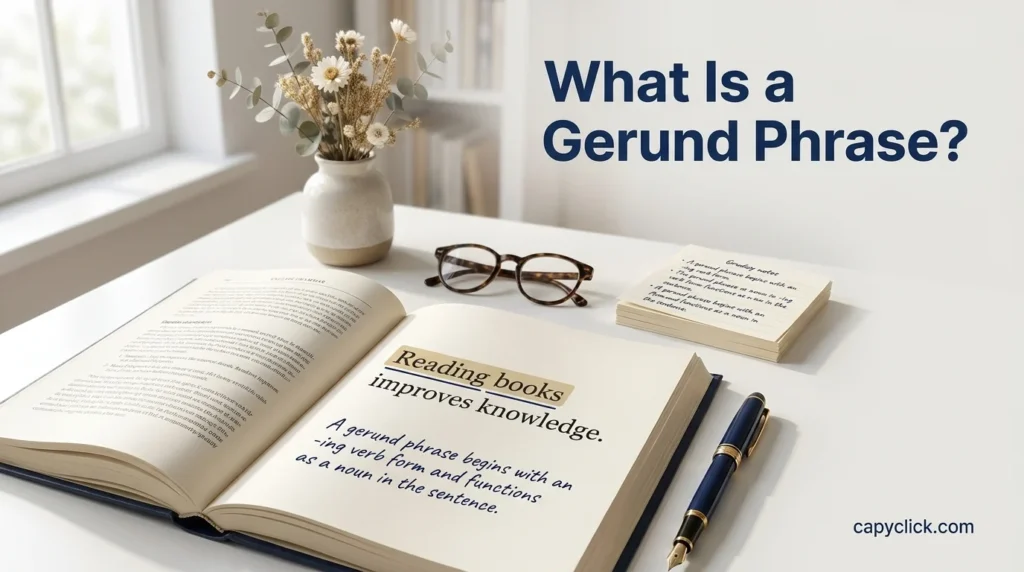
A gerund phrase is a gerund together with its objects, modifiers, and other related words. The entire phrase functions as a noun.
For example:
Learning a new language takes patience.
The phrase learning a new language contains:
- Learning: the gerund.
- A new language: the direct object of the gerund.
Together, these words form a gerund phrase that acts as the subject of the sentence.
Here are more examples:
- Playing chess with friends improves concentration.
- I enjoy watching movies on weekends.
- She is interested in learning Spanish online.
- Waking up early every morning can be difficult.
A gerund phrase does not always need a direct object. For example, singing beautifully is a gerund phrase when the complete phrase functions as a noun. The word beautifully modifies the activity.
How Is a Gerund Phrase Formed?
A simple pattern is:
Gerund + object, modifier, or other related words
| Gerund | Related words | Gerund phrase |
| Reading | novels at night | Reading novels at night |
| Playing | football after school | Playing football after school |
| Cooking | healthy meals at home | Cooking healthy meals at home |
| Learning | English through practice | Learning English through practice |
| Walking | along the beach every morning | Walking along the beach every morning |
The gerund is the central word. The additional words provide more information about the activity.
What Are the Main Functions of a Gerund Phrase?
A gerund phrase always functions as a noun in traditional English grammar. It can serve as a subject, direct object, object of a preposition, or subject complement.
1. Gerund Phrase as a Subject
A subject tells us what a sentence is about. A gerund phrase can name the activity being discussed.
Examples:
- Eating ice cream on a windy day can be messy.
- Reading books before bed helps me relax.
- Exercising three times a week improves fitness.
- Learning new words every day builds vocabulary.
In the first example, the phrase eating ice cream on a windy day is the subject of the sentence.
2. Gerund Phrase as a Direct Object
A direct object receives the action expressed by a verb. Many verbs can be followed by a gerund phrase.
Examples:
- I enjoy watching comedy shows.
- She loves painting pictures of nature.
- They finished cleaning the classroom.
- Wild food adventures require getting your hair cut to a short, safe length.
In the last example, the gerund phrase is the direct object of require. The phrase names the action that the adventures require.
Common verbs followed by gerunds include enjoy, avoid, finish, consider, suggest, and keep.
3. Gerund Phrase as the Object of a Preposition
A gerund phrase can follow a preposition such as at, about, for, without, or by.
Examples:
- She is good at solving difficult problems.
- He left without saying goodbye to anyone.
- They talked about starting a small business.
- I improved my English by practicing every day.
In each sentence, the gerund phrase acts as the object of the preposition.
Remember that when a verb directly follows a preposition, the -ing form is normally used.
4. Gerund Phrase as a Subject Complement
A subject complement follows a linking verb and identifies or explains the subject.
Examples:
- My favorite activity is reading mystery novels.
- Her greatest challenge was managing a busy schedule.
- My dog’s most annoying habit is hogging the middle of the bed.
In the last example, the phrase hogging the middle of the bed identifies the dog’s annoying habit.
Gerund vs. Gerund Phrase vs. Participial Phrase
These terms are related, but they do not mean the same thing.
| Feature | Gerund | Gerund phrase | Present participial phrase |
| Structure | One -ing word | Gerund plus related words | Present participle plus related words |
| Main function | Acts as a noun | Entire phrase acts as a noun | Usually describes a noun or pronoun |
| Example | Reading is enjoyable. | Reading books at night is enjoyable. | Reading a book, Sara waited for the bus. |
| Role | Names an activity | Names an activity in more detail | Describes what someone is doing |
| Key question | What activity? | What activity in detail? | Which person, or what is the person doing? |
How Can You Tell the Difference?
Compare these examples:
Gerund phrase:
Buttering toast with a fork is an unusual habit.
The phrase buttering toast with a fork acts as the subject.
Present participial phrase:
Buttering toast with a fork, Bernard decided to wash the dishes.
The phrase describes Bernard and explains what he was doing.
Verb phrase:
Bernard is buttering toast with a fork.
Here, is buttering is the verb phrase.
Notice that the same -ing form can have different grammatical functions depending on how it is used.
When Should You Use a Gerund Phrase?
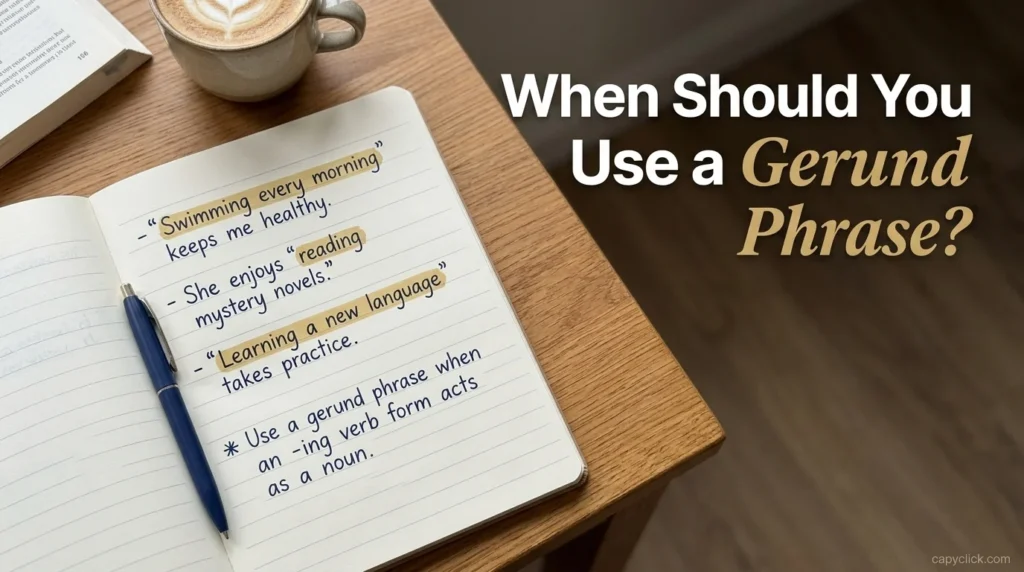
Use a gerund phrase when you want to discuss an activity as a thing, habit, interest, or experience.
Use It at the Beginning of a Sentence
A gerund phrase can serve as the subject when an activity is the main topic.
- Practicing English every day improves confidence.
- Eating breakfast before school helps me feel energetic.
- Walking through the park every evening helps me relax.
Use It After Certain Verbs
Some verbs are commonly followed by gerunds rather than infinitives.
- I enjoy reading books in my free time.
- She avoided answering the difficult question.
- He finished writing his homework before dinner.
- They considered moving to a larger house.
Incorrect: I enjoy to read novels.
Correct: I enjoy reading novels.
Use It After Prepositions
When a verb follows a preposition, it usually takes the -ing form.
- She is excited about starting her new job.
- He left without locking the front door.
- They succeeded by working together as a team.
Use It to Describe Hobbies and Habits
Gerund phrases help you discuss activities you enjoy or do regularly.
- Playing football after school is my favorite hobby.
- Cooking healthy meals at home saves money.
- Learning a new skill every month keeps me motivated.
15 Gerund Phrase Examples in Everyday English
Study these examples to see how a gerund phrase works in a complete sentence.
| No. | Example sentence | Function |
| 1 | Reading books before bed helps me relax. | Subject |
| 2 | I enjoy cooking dinner for my family. | Direct object |
| 3 | Learning English through daily practice takes patience. | Subject |
| 4 | She is interested in studying computer science abroad. | Object of a preposition |
| 5 | He finished washing his car in the driveway. | Direct object |
| 6 | Playing video games with friends makes him happy. | Subject |
| 7 | They talked about moving to a larger house. | Object of a preposition |
| 8 | I love watching the sunset from my balcony. | Direct object |
| 9 | Exercising regularly to stay healthy requires discipline. | Subject |
| 10 | She apologized for arriving late to the meeting. | Object of a preposition |
| 11 | Taking care of younger children requires patience. | Subject |
| 12 | We discussed planning a family trip for the holidays. | Direct object |
| 13 | He improved his writing by reading articles every morning. | Object of a preposition |
| 14 | Saving money for future needs is a sensible habit. | Subject |
| 15 | My dog’s annoying habit is hogging the middle of the bed. | Subject complement |
These gerund phrase examples show how the same grammatical structure can perform different noun functions in a sentence.
What Are Common Gerund Phrase Mistakes?
Understanding common errors will help you use gerund phrases correctly.
Mistake 1: Confusing a Gerund With a Present Participle
Not every -ing word is a gerund.
- Gerund: Swimming in cold water can be refreshing.
- Present participial phrase: Swimming in cold water, the children laughed.
- Verb phrase: The children are swimming in cold water.
In the first example, the phrase functions as the subject. In the second, it describes the children. In the third, are swimming forms the verb phrase.
Mistake 2: Using an Infinitive Instead of a Gerund
Some verbs are normally followed by gerunds.
Incorrect: She finished to write the letter.
Correct: She finished writing the letter.
Incorrect: He avoids to drive at night.
Correct: He avoids driving at night.
However, some verbs allow both gerunds and infinitives. The correct choice depends on the verb and, in some cases, the intended meaning.
Mistake 3: Assuming Every Gerund Phrase Needs an Object
A gerund phrase does not always need a direct object.
Both sentences are correct:
- Singing beautifully makes her happy.
- Singing beautiful songs makes her happy.
The first phrase includes a modifier. The second includes a direct object.
Mistake 4: Misplacing a Participial Phrase
A participial phrase should clearly describe the correct noun or pronoun.
Confusing: Walking through the park, the trees looked beautiful.
This sentence suggests that the trees were walking.
Clearer: Walking through the park, I noticed that the trees looked beautiful.
The revised sentence makes it clear that I was walking.
Mistake 5: Forgetting That the Whole Phrase Functions as a Noun
In Eating ice cream on a windy day can be messy, the subject is not just eating. It is the complete phrase eating ice cream on a windy day.
Identifying the entire phrase helps you understand the sentence’s structure.
Memory Trick: How to Identify a Gerund Phrase
Use these three steps whenever you see an -ing word.
Step 1: Find the gerund.
Look for a word such as reading, swimming, cooking, or learning.
Step 2: Find the related words.
Identify the objects and modifiers connected to the gerund.
Step 3: Check the grammatical function.
Ask whether the complete phrase acts as a noun. If it names an activity and functions as a subject, object, or subject complement, it is a gerund phrase.
For example:
Learning English every day builds confidence.
The phrase learning English every day names an activity and functions as the subject.
Easy rule to remember: A gerund phrase names an activity; a present participial phrase usually describes a noun or pronoun.
Gerund Phrases in American vs. British English
Gerund phrases follow essentially the same grammatical rules in American and British English. Both varieties use gerunds as subjects, objects, and objects of prepositions.
Examples used in both varieties include:
- Learning a new language takes time.
- She enjoys watching films at home.
- He is interested in playing football with friends.
Differences are mainly related to spelling and vocabulary.
| American English | British English | Difference |
| Traveling abroad | Travelling abroad | Spelling |
| Practicing English | Practising English | Verb spelling |
| Watching a movie | Watching a film | Common vocabulary |
| Playing soccer | Playing football | Common sports terminology |
These are general preferences rather than strict rules. The grammatical structure of the gerund phrase remains the same.
Similar Grammar Terms You Should Know
Learning related grammar terms will make it easier to recognize gerund phrases.
- Gerund: An -ing verb form functioning as a noun. Example: Swimming is relaxing.
- Gerund phrase: A gerund and its related words functioning as a noun. Example: Swimming in the sea is relaxing.
- Infinitive phrase: A phrase built around an infinitive. Example: To learn a new language takes time.
- Present participial phrase: A phrase that usually describes a noun or pronoun. Example: Smiling at the audience, the speaker began her talk.
- Verb phrase: A main verb with any auxiliary verbs. Example: has been studying.
- Noun phrase: A group of words built around a noun. Example: the new English book.
A gerund phrase and an infinitive phrase can sometimes perform similar functions.
For example:
- Gerund phrase: Learning English is rewarding.
- Infinitive phrase: To learn English is rewarding.
Both sentences are grammatically correct, although the preferred structure may depend on the context.
Frequently Asked Questions About Gerund Phrases
1. What is a gerund phrase in simple words?
A gerund phrase is a group of words that begins with an -ing form functioning as a noun. For example, playing football after school is a gerund phrase in the sentence Playing football after school keeps me active.
2. What are five examples of gerund phrases?
Five examples are reading books before bed, cooking dinner for my family, learning English every day, walking along the beach, and playing games with friends. Each phrase names an activity and can function as a noun in a suitable sentence.
3. What is the difference between a gerund and a gerund phrase?
A gerund is a single word, such as reading, that functions as a noun. A gerund phrase includes that word and its related words, such as reading interesting books.
4. Can a gerund phrase be the subject of a sentence?
Yes. In Practicing English every morning improves my speaking skills, the phrase practicing English every morning acts as the subject.
5. Can a gerund phrase contain a direct object?
Yes. In writing short stories improves creativity, writing is the gerund and short stories is its direct object. The entire phrase functions as the subject.
6. How can I identify a gerund phrase in a sentence?
Find the -ing word, identify its related words, and check the complete phrase’s function. In She enjoys singing beautiful songs, singing beautiful songs is the direct object of enjoys.
7. Is every word ending in -ing a gerund?
No. An -ing word can function as a gerund, a present participle, or part of a verb phrase. Its role in the sentence determines its grammatical function.
8. Can a gerund phrase follow a preposition?
Yes. Gerund phrases commonly follow prepositions. For example, in He left without saying goodbye, saying goodbye is the object of the preposition without.
Remember This
- A gerund is an -ing verb form that functions as a noun.
- A gerund phrase includes the gerund and its related words.
- The complete phrase functions as a noun.
- Gerund phrases can act as subjects, direct objects, objects of prepositions, and subject complements.
- Not every -ing word is a gerund.
- Always check the phrase’s role in the sentence to distinguish a gerund phrase from a present participial phrase.
Conclusion
A gerund phrase is a useful part of English grammar because it allows you to talk about actions and activities as nouns. Once you understand its structure and functions, you can recognize it in everyday conversations, school assignments, and formal writing.
Practice with examples such as reading books before bed, learning English through daily practice, and eating ice cream on a windy day. Focus on the entire phrase and the job it performs in the sentence. With regular practice, distinguishing gerund phrases from present participial phrases and verb phrases becomes much easier.

I am Troy James, Administrator at CapyClick. I help create and organize creative, stylish, funny, and meaningful captions that inspire users to make their social media posts stand out.