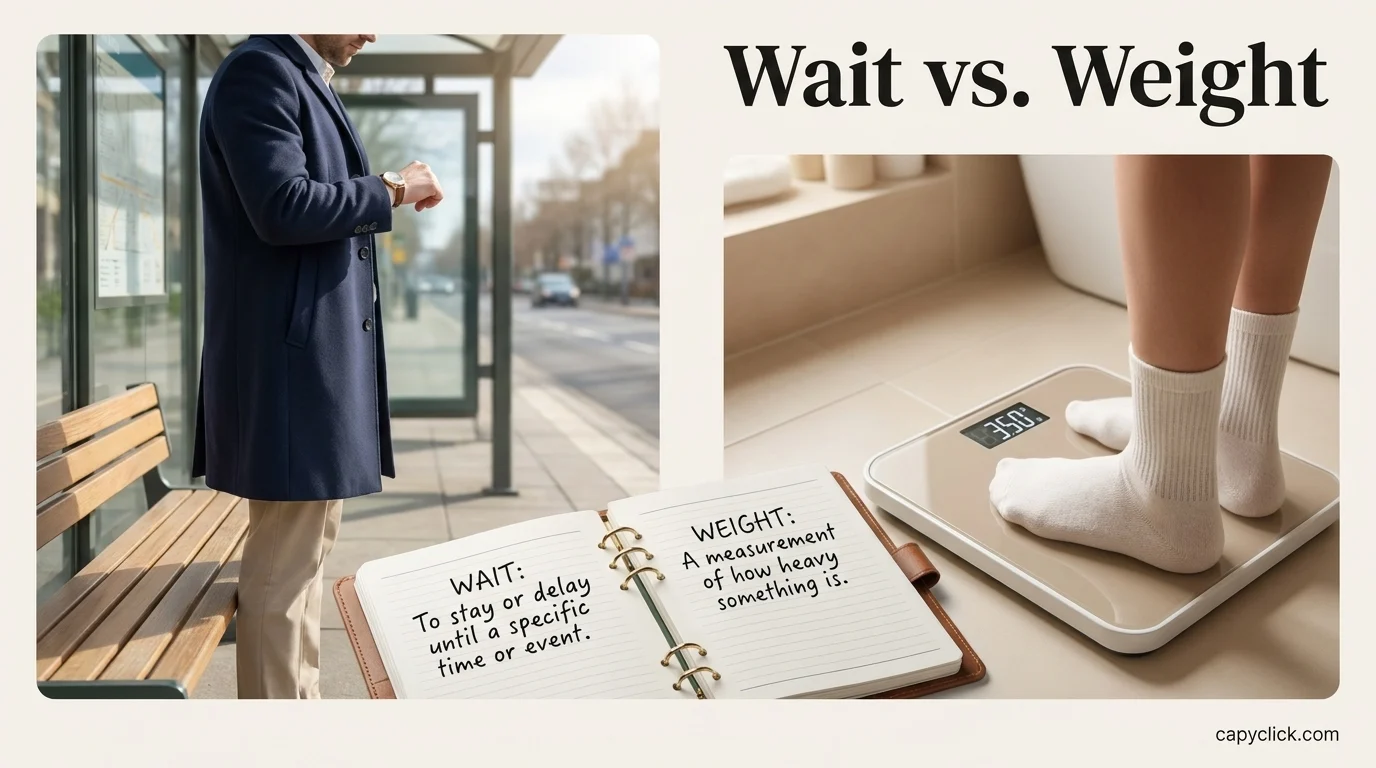
Have you ever been confused about whether to write wait or weight? These two English words sound exactly the same, but they have completely different meanings and uses. Choosing the wrong spelling can change the meaning of your sentence, especially in writing, messages, emails, and school assignments.
The difference between wait vs. weight is simple once you understand their definitions. Wait is a verb that means to stay somewhere until something happens or to delay an action. Weight is usually a noun that refers to how heavy a person or object is. For example, you might wait for a bus, but you might measure the weight of your luggage before boarding it.
Both words are pronounced /weɪt/, which explains why English learners and even native speakers sometimes confuse them. In this guide, you will learn their meanings, pronunciation, grammatical differences, examples, and common mistakes.
Quick Answer: What Is the Difference Between Wait and Weight?
Wait means to stay in a place, delay an action, or remain until something happens. Weight means the heaviness of a person or object, usually measured in kilograms or pounds. Both words sound identical but have different spellings, meanings, and grammatical uses. For example, you wait for a bus but measure its weight.
Why Do People Confuse Wait and Weight?
People often confuse wait and weight because they are homophones. Homophones are words that have the same pronunciation but different spellings and meanings.
Both words are pronounced /weɪt/, so you cannot identify the correct spelling by listening alone. You need to understand the context of the sentence.
There are three main reasons these words are confusing:
- Same pronunciation: Wait and weight sound exactly alike in standard English pronunciation.
- Different meanings: Wait relates to time and delay, while weight relates to heaviness.
- Different grammatical roles: Wait is mainly a verb, whereas weight is mainly a noun.
The easiest way to avoid confusion is to remember what you are trying to describe: waiting for something or measuring how heavy something is.
What Does Wait Mean?

Wait is primarily a verb that means to stay in a place until something happens, someone arrives, or a particular time comes.
It can also mean delaying an action until the right moment or remaining ready for something expected to happen.
In everyday English, people use wait when talking about appointments, transportation, conversations, plans, and daily activities.
Wait as a Verb
As a verb, wait describes the action of staying somewhere or delaying something.
Examples:
- Please wait here until I return.
- We need to wait for the bus.
- She decided to wait until Monday to make a decision.
- I cannot wait to see my family again.
- They waited outside the restaurant for their friends.
Different Forms of Wait
The word wait changes depending on the tense of the sentence.
| Verb Form | Example |
| Base form: Wait | I wait for my brother. |
| Third-person singular: Waits | She waits for the train. |
| Past tense: Waited | We waited for an hour. |
| Present participle: Waiting | He is waiting outside. |
| Future form: Will wait | I will wait for you. |
Common Expressions With Wait
Here are some everyday expressions that use the word wait:
- Wait for: Stay until someone or something arrives.
- Wait a minute: Ask someone to pause briefly.
- Wait and see: Delay a decision until you know what happens.
- Can’t wait: Feel very excited about something.
- Wait your turn: Stay until it is your opportunity.
Examples:
- Please wait for me outside.
- Wait a minute; I am not ready.
- We will wait and see what happens.
- I can’t wait for the holidays.
- You must wait your turn.
What Does Weight Mean?
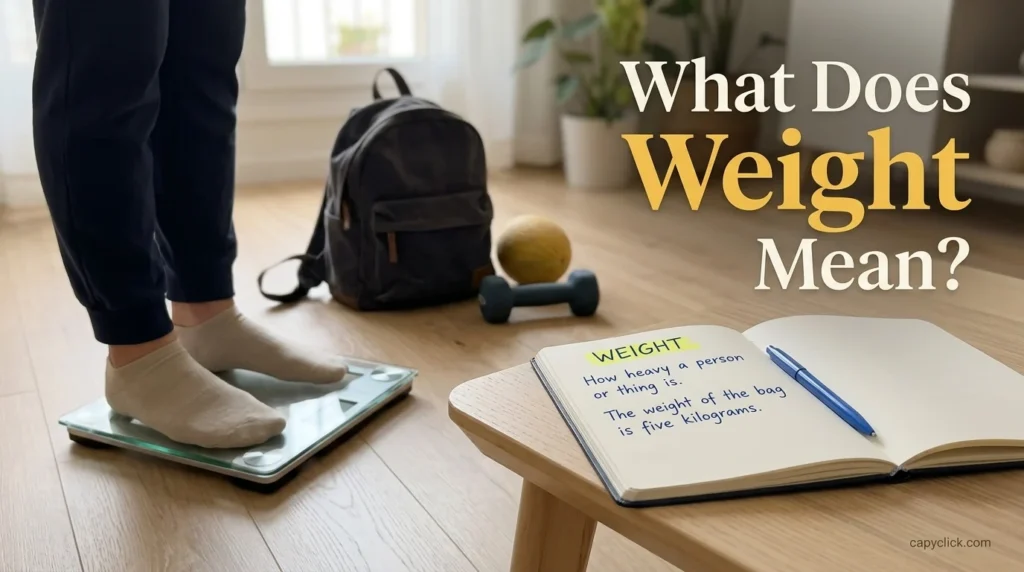
Weight is a noun that refers to how heavy a person, animal, or object is. It can also describe the amount of heaviness something has.
Weight is commonly discussed in health, fitness, science, shopping, transportation, and everyday life.
For example, when someone stands on a weighing scale, the measurement displayed is commonly called their weight.
Weight as a Noun
As a noun, weight describes the heaviness of something or someone.
Examples:
- My weight has increased over the last few months.
- The weight of this box is 10 kilograms.
- She lifted a heavy weight at the gym.
- Please check the weight of your luggage.
- The doctor advised him to monitor his weight.
Different Types and Uses of Weight
The word weight can be used in several contexts.
1. Body Weight
This refers to how heavy a person’s body is.
Example: She checks her weight every month.
2. Object Weight
This describes how heavy an item is.
Example: The weight of this suitcase is 15 kilograms.
3. Fitness Weight
In exercise, weight can refer to a heavy object used for strength training.
Example: He lifted a 20-kilogram weight at the gym.
4. Importance or Influence
Weight can also describe the importance or influence of an opinion, argument, or decision.
Example: The teacher gave considerable weight to the students’ suggestions.
Common Expressions With Weight
- Lose weight: Become lighter in body weight.
- Gain weight: Become heavier.
- Weight loss: A reduction in body weight.
- Weight gain: An increase in body weight.
- Heavyweight: A person or object with great weight.
- Pull your weight: Do your fair share of work or responsibility.
- Worth its weight in gold: Extremely valuable or useful.
Examples:
- He wants to lose weight.
- My luggage gained weight after shopping.
- Everyone should pull their weight in a team.
- Her advice was worth its weight in gold.
Wait vs. Weight: Key Differences
Although wait and weight have identical pronunciation, their meanings, spellings, and grammatical roles are different.
| Feature | Wait | Weight |
| Meaning | To stay or delay | How heavy something is |
| Part of speech | Mainly verb | Mainly noun |
| Pronunciation | /weɪt/ | /weɪt/ |
| Main idea | Time and patience | Heaviness and measurement |
| Common use | Waiting for someone | Measuring an object |
| Example | I will wait for you. | The box has a weight of 5 kg. |
Remember: Use wait when talking about time or delaying an action. Use weight when talking about heaviness, mass-related measurements, or importance.
When Should You Use Wait vs. Weight?
Knowing when to use each word will help you avoid spelling mistakes in everyday writing.
When to Use Wait
Use wait when you are talking about:
- Staying somewhere until someone arrives.
- Delaying an action or decision.
- Remaining until a particular time.
- Feeling excited about an upcoming event.
- Giving someone time to finish something.
Examples:
- I will wait for you at the bus stop.
- Please wait until the teacher arrives.
- We should wait before making a decision.
- I can’t wait for my birthday.
- She waited for her food at the restaurant.
When to Use Weight
Use weight when you are talking about:
- The heaviness of a person or object.
- Body weight and fitness.
- The measurement of luggage or packages.
- Exercise equipment.
- The importance or influence of something.
Examples:
- What is the weight of this package?
- His weight is 75 kilograms.
- The weight of the suitcase is too high.
- She uses weights during her workout.
- Your opinion carries a lot of weight.
15 Examples of Wait vs. Weight in Sentences
These examples will help you understand how both words work in different situations.
Examples of Wait in Sentences
- Please wait for me near the entrance.
- I had to wait two hours for my appointment.
- We should wait until the rain stops.
- She is waiting for her best friend.
- I can’t wait to start my new job.
- They waited outside the cinema.
- You should wait before making an important decision.
- The children are waiting for their parents.
Examples of Weight in Sentences
- The weight of this bag is 8 kilograms.
- He wants to gain some weight.
- Please check the weight before shipping the package.
- She lifted a heavy weight at the gym.
- My luggage exceeds the allowed weight.
- The weight of the evidence influenced the decision.
- Regular exercise can help people manage their body weight.
Wait vs. Weight: Examples in Everyday Conversations
Sometimes, seeing words in conversations makes their meanings easier to understand.
Conversation 1: Waiting for a Friend
Alex: Where are you?
Sam: I am waiting outside the restaurant.
Alex: Okay, please wait for five more minutes.
Conversation 2: Checking Luggage
Emma: How much does your suitcase weigh?
Jack: Its weight is about 18 kilograms.
Emma: That’s fine. We can take it with us.
Conversation 3: At the Gym
Mike: Why are you using those weights?
David: I want to improve my strength.
Mike: How much weight can you lift?
David: Around 40 kilograms.
Common Mistakes When Using Wait and Weight
Even though these words have different meanings, their identical pronunciation can lead to spelling mistakes.
Here are some common errors to avoid.
1. Using Weight Instead of Wait
Incorrect: Please weight for me here.
Correct: Please wait for me here.
Why? The sentence describes staying in a place, so the correct word is wait.
2. Using Wait Instead of Weight
Incorrect: What is your wait?
Correct: What is your weight?
Why? The sentence asks about someone’s body heaviness, so weight is correct.
3. Confusing Their Meanings
Incorrect: I cannot weight for the bus.
Correct: I cannot wait for the bus.
Why? Waiting for transportation involves time, not heaviness.
4. Forgetting the Grammatical Difference
Incorrect: The box wait is 10 kilograms.
Correct: The box’s weight is 10 kilograms.
Why? Weight is the noun that describes how heavy the box is.
5. Using the Wrong Expression
Incorrect: I want to wait weight.
Correct: I want to lose weight.
Why? The correct expression for reducing body heaviness is lose weight.
Easy Memory Trick to Remember Wait vs. Weight
If you find it difficult to remember these two words, use this simple trick:
Wait = Time
Think about waiting for a bus, a friend, or an appointment.
Weight = Heavy
Think about weighing a bag, checking body weight, or lifting weights at the gym.
You can also remember the extra letters in weight:
- W-A-I-T = Waiting for something.
- W-E-I-G-H-T = Heaviness or measurement.
Quick memory examples:
- I will wait for you.
- What is the weight of this bag?
Whenever you are unsure, ask yourself whether the sentence is about time or heaviness.
Are Wait and Weight Pronounced the Same in American and British English?
Yes. Wait and weight are homophones in both American and British English.
Both words are generally pronounced /weɪt/, with the same long vowel sound.
| Word | American English | British English |
| Wait | /weɪt/ | /weɪt/ |
| Weight | /weɪt/ | /weɪt/ |
There is no meaningful difference in their standard pronunciation or spelling between the two varieties.
The main difference is their meaning and grammatical use, not regional pronunciation.
What Are Some Similar Words to Wait and Weight?
English contains many words that sound alike but have different meanings and spellings. Learning these homophones can improve your vocabulary and writing skills.
Here are some useful examples:
| Word Pair | Meaning |
| Wait vs. Weight | Delay vs. heaviness |
| Right vs. Write | Correct or direction vs. putting words on paper |
| See vs. Sea | Look with your eyes vs. large body of salt water |
| There vs. Their | A place vs. belonging to them |
| To vs. Too | Direction or purpose vs. also or excessively |
| Here vs. Hear | A place vs. listening |
| One vs. Won | Number 1 vs. past tense of win |
| Break vs. Brake | Damage or pause vs. stopping mechanism |
| Peace vs. Piece | Freedom from conflict vs. a part of something |
| Weak vs. Week | Not strong vs. seven days |
Understanding these word pairs will help you recognize the importance of spelling and context in English.
Final Verdict: Wait vs. Weight
The difference between wait and weight comes down to their meanings and grammatical roles.
- Wait is mainly a verb that means to stay somewhere, delay an action, or remain until something happens.
- Weight is mainly a noun that describes how heavy a person or object is.
Both words are pronounced /weɪt/, but they cannot be used interchangeably.
For example:
- Correct: I will wait for my friend.
- Correct: The weight of my luggage is 20 kilograms.
Remember that wait is about time, while weight is about heaviness. This simple distinction will help you choose the correct word whenever you write or speak English.
Frequently Asked Questions (FAQs)
1. What is the difference between wait and weight?
Wait means to stay somewhere or delay an action until something happens. Weight means the heaviness of a person or object. Both words sound the same but have different meanings and spellings.
2. Are wait and weight homophones?
Yes. Wait and weight are homophones because they have the same pronunciation but different spellings and meanings.
3. Is weight a noun or a verb?
Weight is primarily a noun. It describes how heavy something is or the importance of something. For example, “The weight of the box is 10 kilograms.”
4. Is wait a noun or a verb?
Wait is primarily a verb. It describes staying somewhere or delaying an action. For example, “I will wait for you outside.”
5. How do you pronounce wait and weight?
Both words are pronounced /weɪt/. They have the same pronunciation in standard American and British English.
6. Can wait and weight be used interchangeably?
No. They cannot be used interchangeably because they have different meanings. Use wait for time and delay, and weight for heaviness or importance.
7. What is an easy way to remember wait vs. weight?
Remember wait = time and weight = heaviness. You wait for a bus, but you measure the weight of your luggage. This simple trick makes it easier to choose the correct spelling.
Remember This
- Wait means to stay, pause, or delay an action.
- Weight means the heaviness of a person or object.
- Both words are pronounced /weɪt/.
- Wait is primarily a verb, while weight is primarily a noun.
- They are homophones, not interchangeable words.
- Use context to choose the correct spelling.
Conclusion
Understanding the difference between wait vs. weight is important for writing clear and correct English. Although these words sound identical, their meanings are completely different. Wait is used when talking about time, patience, or delaying an action, while weight describes the heaviness of a person or object. Learning their grammatical roles and everyday uses can help you avoid common spelling mistakes.
The easiest way to remember the difference is to connect wait with time and weight with heaviness. if you are writing an email, completing schoolwork, or having an everyday conversation, this simple rule will help you use both words correctly and confidently.

I am Troy James, Administrator at CapyClick. I help create and organize creative, stylish, funny, and meaningful captions that inspire users to make their social media posts stand out.