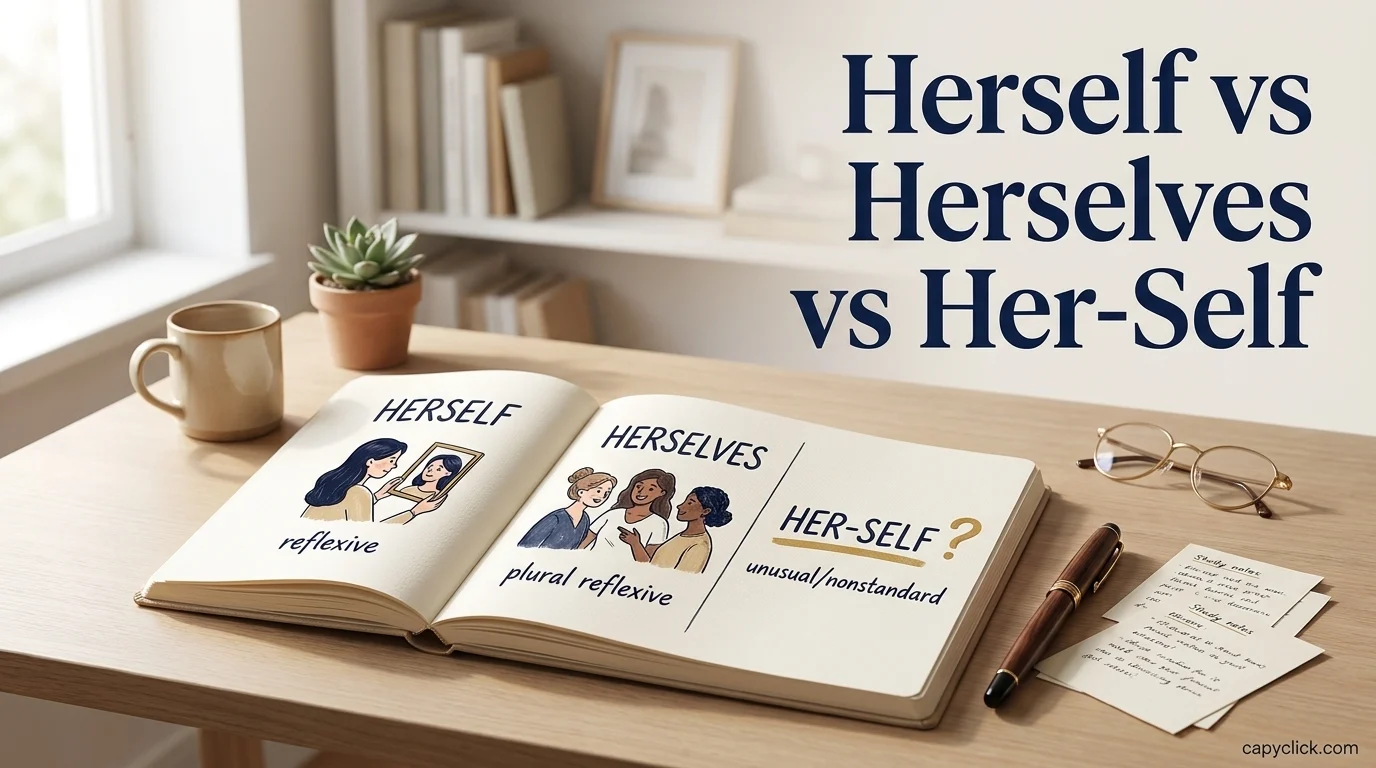
Have you ever paused while writing and wondered whether the correct form is herself, herselves, or her-self? These expressions look similar, but only one is the standard reflexive pronoun for a female person. The confusion often happens because English uses different endings for singular and plural reflexive pronouns.
The good news is that the rule is simple: herself is the correct form when referring to one female person. Herselves is not the standard plural form, and her-self is not the accepted spelling of the reflexive pronoun. If you are talking about someone’s identity or personality, however, the separate phrase her self can be correct in expressions such as her true self.
This guide explains the difference between these forms, shows how to use herself correctly, and provides practical examples. You will also learn why herselves and her-self are usually incorrect, how to avoid common pronoun mistakes, and which form to choose in everyday and professional writing.
Quick Answer: Herself vs Herselves vs Her-Self
Herself is the correct standard reflexive pronoun for one female person. Herselves is not the standard plural reflexive form, and her-self is not the standard spelling. Use themselves when referring to multiple people. The separate phrase her self can describe a woman’s identity or inner nature.
Examples:
- Correct: Maria prepared herself for the interview.
- Incorrect: Maria prepared herselves for the interview.
- Incorrect: Maria prepared her-self for the interview.
- Correct: The women prepared themselves for the meeting.
- Correct: She wanted to discover her true self.
Why Do People Confuse Herself, Herselves, and Her-Self?
People confuse these forms because English reflexive pronouns do not all follow the same spelling pattern.
For example, English has these common reflexive pronouns:
- Myself
- Yourself
- Himself
- Herself
- Itself
- Ourselves
- Yourselves
- Themselves
When learners notice words such as ourselves, yourselves, and themselves, they may assume that the plural form of herself should be herselves. It seems logical, but that is not how standard English works.
The hyphen creates another possible confusion. Some writers separate her and self because they think the two parts should be joined with a hyphen. However, the established spelling of the reflexive pronoun is one word: herself.
There is also a genuine two-word expression, her self, which has a different meaning. It refers to someone’s identity or inner nature rather than functioning as a reflexive pronoun.
Is Herself the Correct Form?
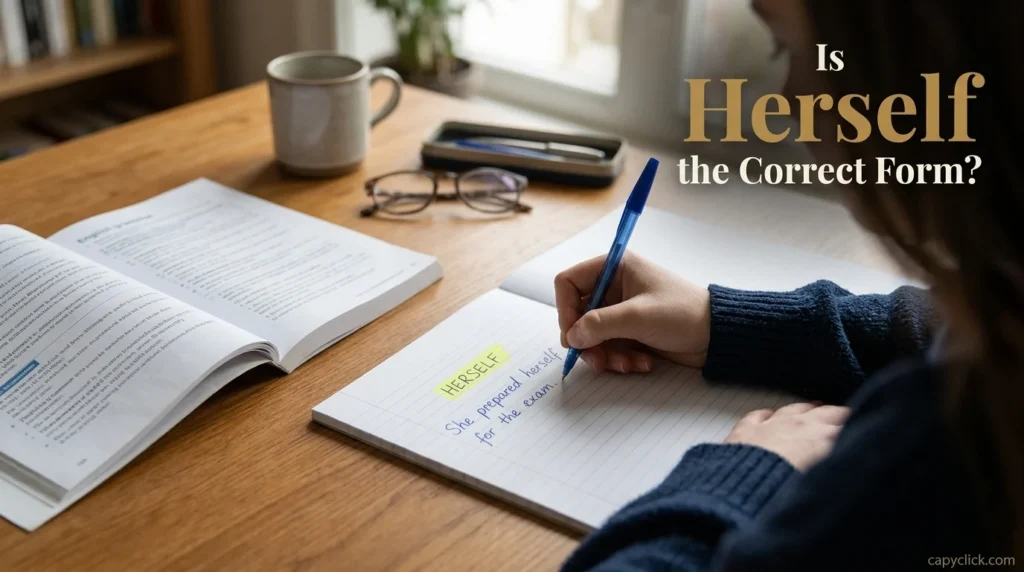
Yes. Herself is the standard reflexive pronoun used when referring to one female person. It can also emphasize that a woman personally performed an action.
It is always written as one word, without a space or hyphen.
What Does Herself Mean?
Herself has two main grammatical uses:
- Reflexive pronoun: It refers back to the female subject of a sentence.
- Emphatic pronoun: It emphasizes that the female person personally performed an action.
1. Herself as a Reflexive Pronoun
Use herself when the subject and the person receiving the action are the same.
Examples:
- She looked at herself in the mirror.
- Maria taught herself how to paint.
- Emily bought herself a new laptop.
- Sarah blamed herself for the mistake.
- The little girl dressed herself.
In the sentence Maria taught herself how to paint, Maria is both the person doing the teaching and the person learning. The pronoun herself refers back to Maria.
2. Herself as an Emphatic Pronoun
Use herself to emphasize that a woman personally did something.
Examples:
- The manager herself approved the request.
- Sarah herself called the customer.
- The author herself answered the question.
- Maria prepared the entire meal herself.
In these sentences, herself adds emphasis. It highlights the person’s direct involvement.
Common Phrases With Herself
You will also find herself in many everyday expressions.
| Phrase | Meaning | Example |
| By herself | Alone or without help | She completed the task by herself. |
| For herself | For her own benefit | She bought a gift for herself. |
| To herself | Privately or without telling others | She kept the news to herself. |
| All by herself | Completely alone | She traveled all by herself. |
| Take care of herself | Look after her own needs | She knows how to take care of herself. |
| Proud of herself | Feeling pleased with her own actions | She was proud of herself. |
These expressions are common in conversations, emails, school assignments, and professional writing.
Is Herselves a Correct English Word?
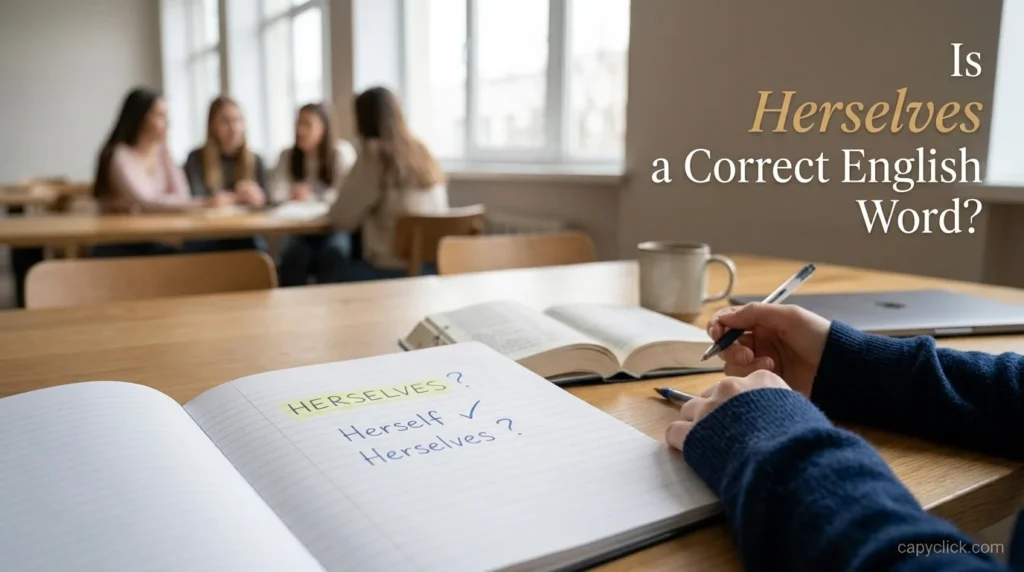
Herselves is not the standard reflexive pronoun in modern English. You should not use it as the plural form of herself in ordinary writing.
For one female person, use herself. For a plural subject, use the appropriate plural reflexive pronoun, usually themselves.
Compare:
- Incorrect: She introduced herselves to the teacher.
- Correct: She introduced herself to the teacher.
- Incorrect: The girls introduced herselves to the teacher.
- Correct: The girls introduced themselves to the teacher.
Why Isn’t Herselves the Standard Plural Form?
English does not create a separate female plural reflexive pronoun by adding -s to herself.
The standard plural pronoun themselves works for groups of women, men, or people of different genders.
For example:
- The sisters prepared themselves for the trip.
- The boys introduced themselves to the coach.
- The students reminded themselves to finish their homework.
The correct choice depends on the subject’s grammatical number, not on whether a plural group consists entirely of women.
Reflexive Pronouns: Singular and Plural Forms
This table shows the standard reflexive pronouns in English.
| Subject | Reflexive pronoun | Example |
| I | Myself | I taught myself to cook. |
| You (singular) | Yourself | You should trust yourself. |
| He | Himself | He introduced himself. |
| She | Herself | She prepared herself. |
| It | Itself | The door closed by itself. |
| We | Ourselves | We enjoyed ourselves. |
| You (plural) | Yourselves | Please make yourselves comfortable. |
| They | Themselves | They helped themselves. |
Notice that the standard form for she is herself, while the standard form for they is themselves.
Why Is Her-Self Usually Incorrect?
Her-self is not the standard spelling of the reflexive pronoun. The correct form is herself, written as one word.
A hyphen is unnecessary and should not be added when you mean the ordinary reflexive pronoun.
Compare these forms:
| Form | Standard usage | Explanation |
| Herself | Correct | Standard singular reflexive pronoun |
| Herselves | Nonstandard | Not the standard plural reflexive pronoun |
| Her-self | Incorrect for the pronoun | Unnecessary hyphen |
| Her self | Correct in suitable contexts | Noun phrase referring to identity |
| Themselves | Correct | Standard plural reflexive pronoun |
For example:
- Incorrect: She taught her-self to drive.
- Correct: She taught herself to drive.
- Incorrect: The manager her-self approved the report.
- Correct: The manager herself approved the report.
The important point is that her-self and herself are not interchangeable spellings.
Is Her Self Ever Correct?
Yes. Her self can be grammatically correct when self is used as a noun referring to a woman’s identity, personality, or inner nature.
This is different from the reflexive pronoun herself.
The two-word phrase is most natural in expressions such as:
- Her true self
- Her inner self
- Her authentic self
- Her best self
- Her creative self
Examples:
- She wanted to discover her true self.
- Meditation helped her connect with her inner self.
- She felt comfortable expressing her authentic self.
- The experience helped her become her best self.
- Painting gave her a way to express her creative self.
In these examples, self is a noun, and her tells us whose identity or nature is being discussed.
Her Self vs Herself: What Is the Difference?
The difference becomes clear when you look at the meaning of each expression.
| Expression | Grammar | Meaning | Example |
| Herself | Reflexive or emphatic pronoun | Refers to one female person | She made the dress herself. |
| Her self | Noun phrase | Refers to her identity or inner nature | She wanted to express her true self. |
Compare these sentences:
- She taught herself to swim.
- She wanted to understand her true self.
The first sentence describes an action. The second describes personal identity.
Do not write her self when you simply mean that a woman did something personally. In that situation, herself is the correct form.
Herself vs Herselves vs Her-Self: Comparison Table
Here is a quick comparison of all the main forms.
| Form | Meaning or role | Correct usage? | Example |
| Herself | Singular reflexive or emphatic pronoun | Yes | She completed it herself. |
| Herselves | Intended plural female reflexive pronoun | No, not standard | Use themselves instead. |
| Her-self | Hyphenated version of the pronoun | No | Write herself. |
| Her self | Noun phrase about identity | Yes, in suitable contexts | She discovered her true self. |
| Themselves | Plural reflexive pronoun | Yes | They prepared themselves. |
The main distinction is simple: herself is the standard pronoun, her self is a noun phrase, and herselves and her-self should not be used as standard alternatives to herself.
When Should You Use Herself, Her Self, or Themselves?
Choosing the correct form becomes easier when you identify what your sentence means.
Use Herself for One Female Person
Choose herself when the subject is one female person and the pronoun refers back to her.
Examples:
- She reminded herself to stay calm.
- My sister taught herself French.
- The actress introduced herself to the audience.
- Emma made herself a cup of tea.
- She looked after herself during the journey.
You can also use it for emphasis:
- The principal herself welcomed the visitors.
- Sarah herself designed the invitation.
Use Her Self for Identity or Personality
Choose her self when self is a noun referring to a woman’s identity or inner nature.
Examples:
- She wanted to find her true self.
- She was learning to accept her inner self.
- The journey helped her understand her authentic self.
The phrase usually sounds most natural with a descriptive word before self.
Use Themselves for Multiple People
When your subject refers to more than one person, use themselves where a plural reflexive pronoun is needed.
Examples:
- The women introduced themselves.
- The sisters prepared themselves for the competition.
- The students taught themselves a new skill.
- The players congratulated themselves after the match.
Do not use herselves just because the group consists entirely of women.
15 Examples of Herself, Her Self, and Themselves in Sentences
These examples show how the correct forms work in everyday English.
Using examples Herself
- She taught herself how to play the piano.
- Maria looked at herself in the mirror.
- The young girl dressed herself for school.
- Sarah bought herself a beautiful notebook.
- She reminded herself to remain patient.
- Emma introduced herself to her new classmates.
- My mother prepared dinner herself.
- She blamed herself for the misunderstanding.
- The manager herself answered the question.
- She completed the project by herself.
Examples Using Her Self
- She wanted to discover her true self.
- Writing helped her understand her inner self.
- She felt proud of her authentic self.
- The experience helped her become her best self.
Examples Using Themselves
- The sisters prepared themselves for the journey.
These examples show that the correct form depends on the sentence’s meaning and subject.
Common Mistakes With Herself, Herselves, and Her-Self
Here are some frequent mistakes and their correct versions.
1. Writing Her-Self Instead of Herself
Incorrect: She completed the assignment her-self.
Correct: She completed the assignment herself.
Why? The reflexive pronoun is written as one word, without a hyphen.
2. Using Herselves for One Female Person
Incorrect: Maria prepared herselves for the exam.
Correct: Maria prepared herself for the exam.
Why? Herself is the standard singular reflexive pronoun.
3. Using Herselves for a Group of Women
Incorrect: The women introduced herselves.
Correct: The women introduced themselves.
Why? The standard plural reflexive pronoun is themselves, regardless of the group’s gender.
4. Separating Herself Without a Reason
Incorrect: She blamed her self for the mistake.
Correct: She blamed herself for the mistake.
Why? The sentence needs a reflexive pronoun, not a noun phrase about identity.
5. Confusing Herself With Her True Self
Incorrect: She wanted to discover herself true.
Correct: She wanted to discover her true self.
Why? The phrase her true self describes a person’s identity or inner nature.
Memory Trick: How to Remember the Correct Form
Use this simple memory trick:
- She → Herself: One female person.
- They → Themselves: More than one person.
- Her self: Her identity or inner nature.
- Her-self: Do not use this as the standard spelling of the pronoun.
- Herselves: Avoid it in standard English.
Remember these two patterns:
She → Herself
She prepared herself for the interview.
They → Themselves
They prepared themselves for the interview.
You do not need to create a separate female plural pronoun. Standard English uses themselves for plural groups.
Is Herself Different in American and British English?
No. There is no meaningful difference between standard American and British English in the use or spelling of herself.
Both varieties use:
- Herself as the singular reflexive pronoun.
- Themselves as the standard plural reflexive pronoun.
- Her self in suitable expressions about identity or personality.
Neither standard variety normally uses herselves or her-self as alternatives to herself.
Examples that are correct in both varieties include:
- She made the decision herself.
- She wanted to discover her true self.
- The women introduced themselves.
You can use these forms confidently in schoolwork, emails, reports, and everyday conversations.
Similar Words and Related Reflexive Pronouns
Understanding other reflexive pronouns can make this grammar rule easier to remember.
| Reflexive pronoun | Example |
| Myself | I taught myself to draw. |
| Yourself | You should believe in yourself. |
| Himself | He introduced himself. |
| Herself | She prepared herself. |
| Itself | The door closed by itself. |
| Ourselves | We enjoyed ourselves. |
| Yourselves | Please make yourselves comfortable. |
| Themselves | They helped themselves. |
You may also find these related expressions useful:
- Her true self: Her real identity or personality.
- Her inner self: Her private thoughts, feelings, or inner nature.
- Her authentic self: The person she genuinely is.
- Her best self: The version of herself she wants to become.
- By herself: Alone or without another person’s help.
These expressions are related in meaning, but they do not all perform the same grammatical job.
Final Verdict: Is It Herself, Herselves, or Her-Self?
Herself is the correct standard spelling when referring to one female person. Use it as a reflexive pronoun when the subject and object refer to the same person, or as an emphatic pronoun when you want to highlight that she personally performed an action.
Herselves is not the standard plural form of herself. When referring to several people, use themselves. Similarly, her-self is not the standard spelling of the reflexive pronoun because the word does not need a hyphen.
Remember that her self is a separate, grammatically possible noun phrase when discussing identity or personality, as in her true self. It is not an alternative spelling of herself.
Frequently Asked Questions
1. Is Herself One Word or Two?
Herself is one word. It is the standard singular reflexive pronoun used with she.
Example: She completed the assignment herself.
2. Is Herselves a Real Word?
You may encounter herselves in nonstandard writing or specialized language discussions, but it is not the standard reflexive pronoun in modern English. Use herself for one female person and themselves for a plural subject.
3. Is Her-Self Grammatically Correct?
No, not when you intend to use the standard reflexive pronoun. The correct spelling is herself, without a hyphen.
Example: She taught herself to drive.
4. What Is the Plural of Herself?
The standard plural reflexive pronoun used for multiple people is themselves.
Example: The girls prepared themselves for the competition.
English does not normally use a separate female plural form of herself.
5. Is Her Self Ever Correct?
Yes. Her self can be correct when self is a noun referring to a woman’s identity, personality, or inner nature.
Example: She wanted to discover her true self.
It is not correct as a replacement for the reflexive pronoun herself.
6. Should I Write She Did It Herself or She Did It Her-Self?
Write She did it herself. The reflexive or emphatic pronoun is one word and does not normally take a hyphen.
7. Can I Say the Girls Prepared Herselves?
No. The standard sentence is The girls prepared themselves. The pronoun themselves is used for plural groups, whether they consist of women, men, or people of different genders.
8. What Is the Difference Between Herself and Themselves?
Herself refers to one female person, while themselves refers to multiple people.
Examples:
- She taught herself.
- They taught themselves.
Remember This
- Herself: Correct standard reflexive pronoun for one female person.
- Themselves: Correct standard reflexive pronoun for multiple people.
- Her self: A noun phrase about identity or inner nature.
- Herselves: Not the standard plural reflexive form.
- Her-self: Not the standard spelling of the pronoun.
Conclusion
The difference between herself, herselves, and her-self is easier to understand when you remember the standard English reflexive pronouns. Use herself when referring to one female person, and use themselves when referring to a group. Do not add an unnecessary hyphen or create a plural form by changing herself to herselves.
Also remember that her self can be correct when you are talking about someone’s identity, such as her true self or her inner self. It has a different grammatical role from the pronoun herself. Once you understand this small difference, you can choose the correct form confidently in conversations, school assignments, emails, and professional writing.

I am Troy James, Administrator at CapyClick. I help create and organize creative, stylish, funny, and meaningful captions that inspire users to make their social media posts stand out.