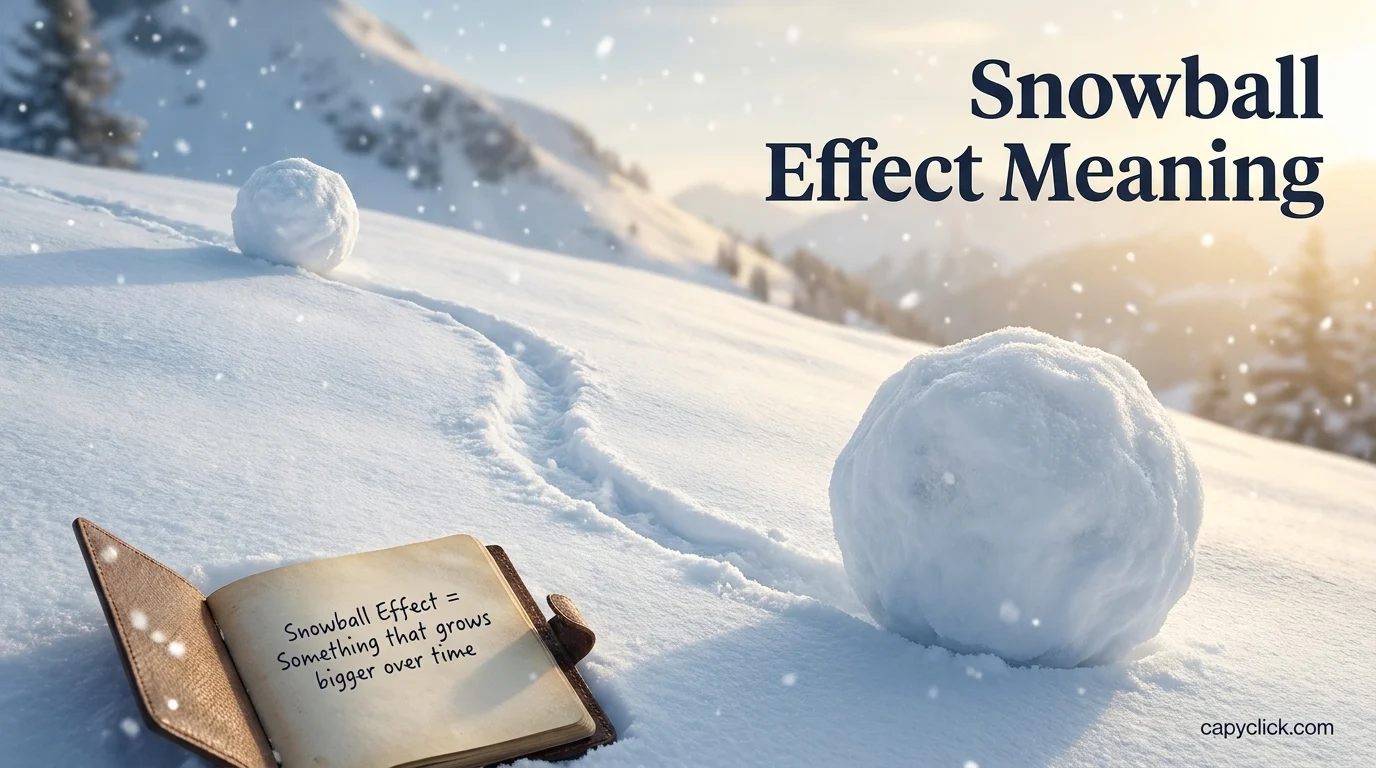
The snowball effect is an English expression used when something starts small and gradually becomes bigger, stronger, or more serious because of a series of connected events. It can describe positive situations, such as small daily habits leading to great success, or negative situations, such as a minor mistake turning into a major problem. But what exactly does this phrase mean, and how can you use it correctly in a sentence?
The expression comes from the image of a snowball rolling down a snowy hill. As it moves, it collects more snow and becomes larger. In everyday English, the same idea applies to situations that continue growing over time. You might hear people use snowball effect when talking about money, business, relationships, education, social media, or personal achievements. Learning its meaning, common uses, and sentence examples will help you understand this popular expression and use it naturally in everyday conversations and writing.
Quick Answer: What Does Snowball Effect Mean?
The snowball effect means a process in which something small gradually grows into something much bigger through a series of actions or consequences. Like a snowball collecting more snow as it rolls downhill, one event leads to another, making the situation grow. It can describe both positive developments and negative problems.
Why Do People Confuse the Snowball Effect?
People sometimes confuse the snowball effect with ordinary growth or a sudden change. However, the expression has a more specific meaning.
It describes a situation in which an initial action or event creates additional results, and those results cause further growth.
For example:
- One small mistake leads to several bigger problems.
- A successful video attracts more viewers and creates new opportunities.
- Regular saving gradually builds a larger amount of money.
- A small misunderstanding develops into a serious disagreement.
The main idea is small beginning, growing consequences, and a bigger final result.
What Does Snowball Mean?
A snowball is a round ball made by gathering and pressing snow together. Children often make snowballs for snowmen or snowball fights.
A snowball can also become larger when it rolls over a snowy surface because it collects additional snow.
Examples:
- The children made a big snowball in the garden.
- He threw a snowball at his brother.
- The snowball became larger as it rolled down the hill.
In the expression snowball effect, the snowball represents something that grows gradually as it continues moving forward.
What Does Effect Mean?
An effect is a result or change caused by an action, event, or situation.
For example, if you exercise regularly, improved fitness may be an effect of your efforts.
Here are a few more examples:
- Exercise has a positive effect on your health.
- Heavy rain had a serious effect on traffic.
- Her encouraging words had a good effect on his confidence.
When these two words combine, snowball effect describes a result that keeps growing through additional actions or consequences.
How to Use Snowball Effect in a Sentence
You can use snowball effect as a noun phrase when describing something that gradually becomes bigger or more powerful.
It commonly appears with verbs and expressions such as:
- Create a snowball effect
- Cause a snowball effect
- Start a snowball effect
- Lead to a snowball effect
- Trigger a snowball effect
- Have a snowball effect
- Set off a snowball effect
- Result in a snowball effect
- Experience a snowball effect
- A growing snowball effect
You can also use it with adjectives such as positive, negative, massive, and costly.
Example sentences:
- One small mistake created a snowball effect.
- Her first business success started a positive snowball effect.
- Rising fuel prices can have a snowball effect on the cost of everyday goods.
- His negative thoughts triggered a snowball effect that affected his confidence.
Notice that the expression does not always need to describe something bad. Its meaning depends on the situation.
Snowball Effect Examples in Different Situations
The expression is useful in many areas of everyday life. Here are some common situations where it naturally fits.
1. Snowball Effect in Everyday Life
Small daily actions can create bigger results over time.
Example: One missed appointment created a snowball effect, causing several other delays throughout the day.
2. Snowball Effect in Business
A small business achievement can lead to more customers, better recognition, and new opportunities.
Example: The company received positive customer feedback, which started a snowball effect and increased its popularity.
3. Snowball Effect in Education
Small learning habits can gradually improve knowledge and academic performance.
Example: Learning five new English words every day created a snowball effect in her vocabulary development.
4. Snowball Effect in Finance
Small unpaid debts can become larger because of interest, fees, and additional borrowing.
Example: Ignoring his credit card payments created a snowball effect that made his financial situation worse.
5. Snowball Effect on Social Media
One popular post can attract attention, encourage sharing, and reach a much larger audience.
Example: Her first viral video created a snowball effect, bringing thousands of new followers.
6. Snowball Effect in Relationships
A small misunderstanding can grow into a bigger disagreement when people do not communicate.
Example: Their failure to discuss a minor issue caused a snowball effect in their relationship.
20 Examples of Snowball Effect in a Sentence
Here are 20 original snowball effect sentence examples to help you understand how the expression works in different contexts.
- One small mistake created a snowball effect that affected the entire project.
- Her first successful video started a positive snowball effect on social media.
- Missing one homework assignment caused a snowball effect on his academic performance.
- Saving a little money every month can create a positive snowball effect.
- A small disagreement between friends turned into a snowball effect of arguments.
- Regular exercise had a snowball effect on his physical and mental well-being.
- The company’s first successful product created a snowball effect of new business opportunities.
- Rising fuel prices can have a snowball effect on transportation and food costs.
- One negative customer review started a snowball effect of complaints.
- Reading every day created a snowball effect that improved her vocabulary.
- A minor delay in production caused a snowball effect across the entire supply chain.
- His first online sale created a snowball effect that helped his small business grow.
- Ignoring small expenses can create a snowball effect on your monthly budget.
- One kind action inspired others to help, creating a positive snowball effect in the community.
- The rumor started with one person but soon had a snowball effect across the school.
- Her early achievements created a snowball effect that increased her confidence.
- A small technical problem caused a snowball effect and interrupted the whole system.
- The growing demand for the product created a snowball effect in the market.
- Practicing English for a few minutes daily can have a snowball effect on your speaking skills.
- One unexpected event triggered a snowball effect that changed the entire situation.
These examples of snowball effect in sentences show that the expression works in casual conversations, professional writing, news discussions, and educational contexts.
Common Mistakes When Using Snowball Effect
Even though the expression is easy to understand, there are a few mistakes worth avoiding.
1. Thinking It Always Describes Something Negative
The snowball effect can describe positive or negative situations.
Incorrect understanding: The snowball effect only means that a problem gets worse.
Correct understanding: It can also describe success, progress, and positive changes.
Example: Her small daily improvements created a positive snowball effect.
2. Using It for Every Type of Increase
Not every increase is a snowball effect.
For example, if a shop sells ten products today and twenty tomorrow, this is simply an increase in sales.
However, if the first sales attract more customers, those customers bring referrals, and the business continues growing, the expression may fit.
3. Confusing It With a Sudden Change
The snowball effect generally describes growth through connected events or consequences.
It is not simply another way to say that something happened suddenly.
4. Writing the Expression Incorrectly
The standard spelling is two separate words:
- Correct: Snowball effect
- Incorrect: Snowballeffect
Also, remember that snowball effect is a noun phrase.
5. Forgetting the Connection Between Events
The expression makes sense when an initial action leads to additional results that continue building on one another.
Simply describing something as large or important does not automatically make it a snowball effect.
Snowball Effect vs. Domino Effect vs. Ripple Effect
The snowball effect, domino effect, and ripple effect are related expressions. All three describe how one event can influence other events, but their meanings are slightly different.
| Expression | Meaning | Example |
| Snowball effect | Something gradually grows bigger | Small debts become a large financial burden. |
| Domino effect | One event triggers a chain of other events | One employee’s absence causes delays across a team. |
| Ripple effect | One action spreads its influence outward | One kind action inspires others to help. |
| Compound effect | Small results build on previous results | Daily saving gradually increases wealth. |
| Chain reaction | One event causes several connected events | A technical failure causes multiple system problems. |
Snowball Effect vs. Domino Effect
The snowball effect focuses on gradual growth. Something starts small and becomes bigger as more consequences develop.
The domino effect focuses on a chain of events. One event triggers another, much like falling dominoes.
Snowball Effect vs. Ripple Effect
The ripple effect describes how an action spreads its influence to other people or situations.
The snowball effect focuses more on something becoming larger or more significant over time.
Snowball Effect vs. Compound Effect
The compound effect describes how small actions and results build on one another.
It is commonly used when discussing money, learning, personal development, and habits.
Easy Memory Trick to Remember Snowball Effect

Think about a small snowball rolling down a snowy hill.
At first, it is tiny. As it rolls, it collects more snow and becomes larger and heavier.
Remember these three steps:
- Small beginning: Something starts with a small action or event.
- Continuous growth: More actions or consequences follow.
- Bigger result: The situation becomes larger or more significant.
Memory trick: Small beginning + growing consequences = Snowball effect.
This simple picture will help you remember the meaning whenever you see or hear the expression.
Is Snowball Effect Different in American and British English?
No. Snowball effect has the same meaning and spelling in both American and British English.
People in both varieties use this expression in everyday conversations, professional writing, news reports, and educational discussions.
| Feature | American English | British English |
| Expression | Snowball effect | Snowball effect |
| Meaning | Something gradually grows | Something gradually grows |
| Spelling | Snowball effect | Snowball effect |
| Usage | Common | Common |
American English: The small mistake had a snowball effect on the project.
British English: The minor problem soon had a snowball effect across the department.
There is no special spelling or grammatical difference between the two varieties.
Frequently Asked Questions About Snowball Effect
1. What Is the Simple Meaning of Snowball Effect?
The snowball effect means something starts small and gradually becomes bigger, stronger, or more serious because of additional actions or consequences.
2. How Do You Use Snowball Effect in a Sentence?
Use it as a noun phrase to describe a situation that keeps growing.
Example: One small mistake created a snowball effect that affected the entire project.
3. Is Snowball Effect Positive or Negative?
It can be both. A positive snowball effect describes small actions leading to bigger benefits, while a negative snowball effect describes small problems becoming increasingly serious.
4. Why Is It Called the Snowball Effect?
The expression comes from a snowball rolling across snow and collecting more snow as it moves. It becomes larger over time, just like a situation that grows through connected events.
5. Is Snowball Effect an Idiom?
Yes. Snowball effect is commonly treated as an idiomatic expression because its figurative meaning describes a growing situation rather than a literal ball of snow.
6. What Is Another Word for Snowball Effect?
Depending on the context, similar expressions include chain reaction, domino effect, ripple effect, and compound effect. However, each expression has a slightly different meaning.
7. What Is an Example of a Positive Snowball Effect?
Learning a few English words every day is a positive example. As your vocabulary grows, you may understand more sentences, read more easily, and become more confident when speaking.
8. What Is the Opposite of Snowball Effect?
There is no single exact opposite. Words such as reduction, decline, slowdown, and containment may describe situations in which growth decreases or stops.
Remember This
Here are the most important points to remember:
- Snowball effect means something starts small and gradually becomes bigger.
- It describes a series of connected actions and consequences.
- It can have positive or negative results.
- It is commonly used in business, education, finance, relationships, and everyday conversations.
- Common expressions include create, cause, trigger, start, and have a snowball effect.
- It has the same spelling and meaning in American and British English.
Conclusion
The snowball effect is a useful English expression that describes how a small action, event, or problem can grow into something much bigger over time. Its meaning comes from a real snowball collecting more snow as it rolls downhill. In everyday language, it explains how one event can lead to additional consequences that keep increasing.
You can use this expression when talking about growing problems, business success, financial changes, personal habits, or social situations. Remember the simple idea: something small starts the process, and the results continue to grow. With the sentence examples and explanations above, you can now understand and use snowball effect confidently in everyday English.

I’m Drew Michael, a passionate caption writer who loves creating creative, engaging, and meaningful captions that help people express their thoughts, feelings, and moments perfectly on social media.