Have you ever wondered whether to write awaiting vs waiting in an email, a text message, or an English assignment? Both words describe the idea of staying until something happens or someone arrives. However, they follow different grammar rules and can create different tones. Knowing the difference will help you choose the right word and avoid common English mistakes.
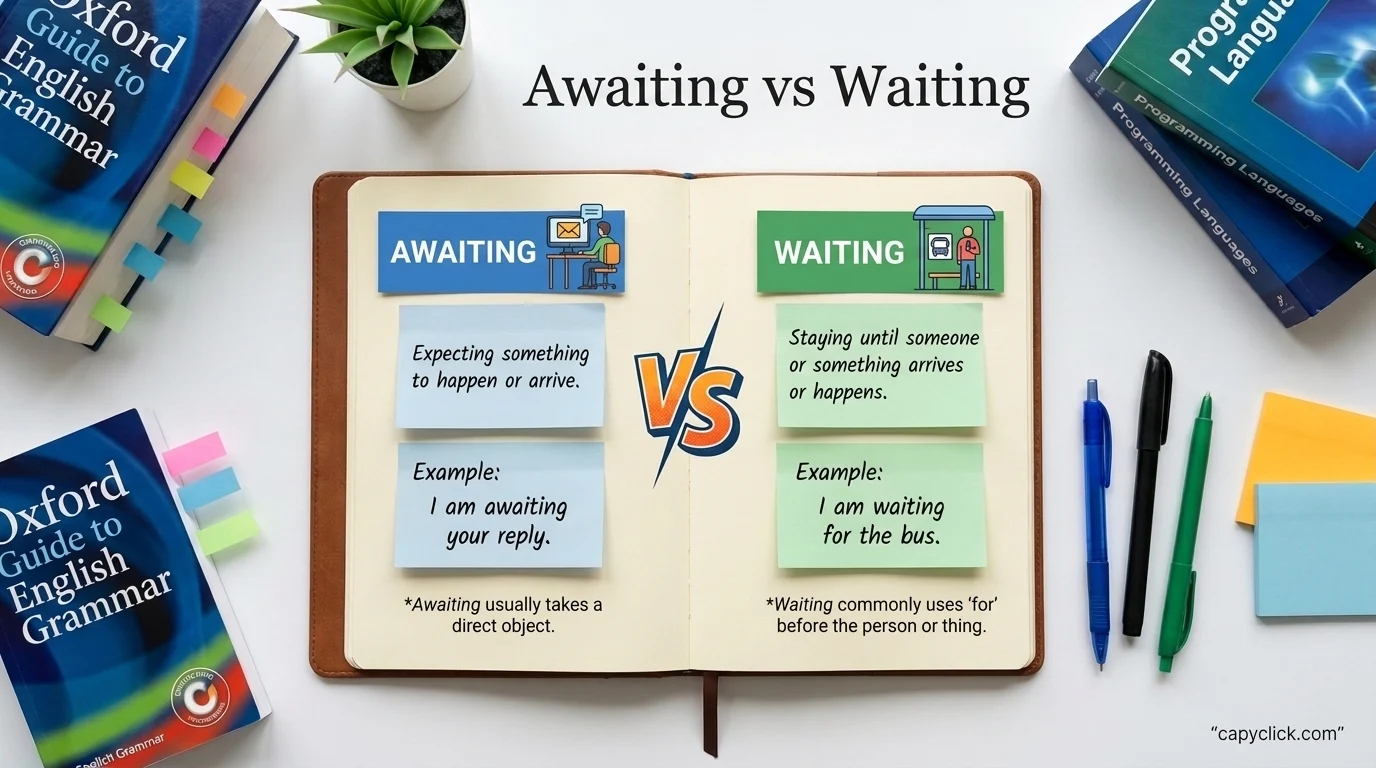
The easiest way to understand the difference is to remember that awaiting usually takes a direct object, while waiting often uses the word “for” before the person or thing you expect. For example, “I am awaiting your response” and “I am waiting for your response” are both correct. The first sounds more formal, while the second is more common in everyday conversation. Let’s explore their meanings, usage rules, differences, and examples so you can use both words confidently.
Quick Answer: Awaiting vs Waiting
Awaiting means waiting for something expected to happen or arrive. It usually takes a direct object, as in “I am awaiting your reply.” Waiting means staying until something happens or someone arrives. It often uses “for,” as in “I am waiting for your reply.” Both are correct, but awaiting generally sounds more formal.
Why Do People Confuse Awaiting and Waiting?
People often confuse these words because they share a similar meaning. Both can describe expecting a reply, decision, result, arrival, or future event.
Consider these two sentences:
- I am awaiting the results.
- I am waiting for the results.
Both sentences communicate the same basic idea. The difference is in their grammatical structure and tone.
There are three main reasons people mix them up:
- Similar meanings: Both words refer to something expected to happen or arrive.
- Different grammar rules: Awaiting normally takes an object directly, whereas waiting commonly uses “for” before the expected person or thing.
- Different levels of formality: Awaiting is often preferred in formal writing, while waiting sounds natural in everyday conversations.
Understanding these differences makes it easier to choose the correct word in emails, essays, messages, and daily conversations.
What Does Awaiting Mean?

Awaiting is the -ing form of the verb await. It means waiting for something to happen or someone to arrive.
The word often appears in professional communication, official announcements, reports, and formal writing. It can describe a person expecting a reply or an application that needs a decision.
How to Use Awaiting in a Sentence
The usual sentence pattern is:
Subject + be verb + awaiting + object
Examples:
- I am awaiting your response.
- She is awaiting the final decision.
- We are awaiting further instructions.
- The company is awaiting approval.
- They are awaiting the examination results.
Notice that the expected thing comes directly after awaiting. You do not normally put “for” between awaiting and its object.
For example:
- Correct: We are awaiting your confirmation.
- Incorrect: We are awaiting for your confirmation.
Is Awaiting Formal or Informal?
Awaiting generally sounds more formal than waiting. It is especially useful when you want your writing to sound professional or official.
For example:
- Formal: We are awaiting your confirmation before proceeding.
- Conversational: We are waiting for your confirmation before moving ahead.
Both sentences are grammatically correct. The choice depends on the situation and the tone you want.
You might use waiting in a business email, an application update, or an official notice. In a casual conversation with a friend, waiting is usually the more natural choice.
Can Awaiting Be Used Without an Object?
The verb await normally takes an object when it is used in an ordinary sentence. However, the object does not always need to appear immediately after the word awaiting.
For example:
- The challenges awaiting us may be difficult.
- A bright future is awaiting her.
- Several applications are awaiting review.
In the first example, awaiting us means that the challenges lie ahead of us. In the other examples, the sentence structure makes the expected person or thing clear.
A sentence such as “She is awaiting” is usually incomplete when no context explains what she is awaiting.
What Does Waiting Mean?
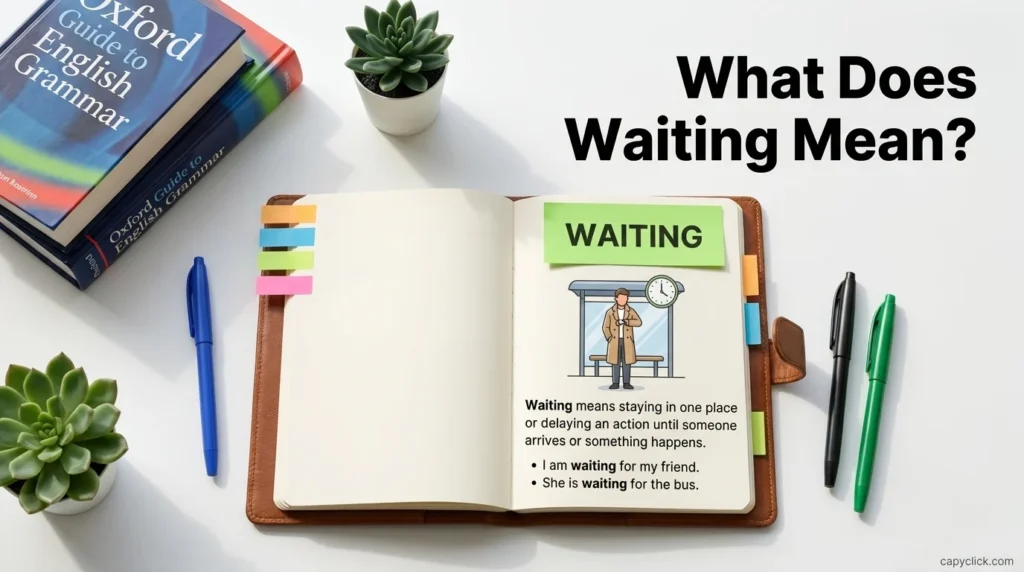
Waiting is the -ing form of the verb wait. It means staying somewhere, delaying an action, or allowing time to pass until a person arrives or an event happens.
Waiting is common in everyday English and can be used in casual and professional situations.
How to Use Waiting in a Sentence
When you mention the person or thing you expect, the usual pattern is:
Subject + be verb + waiting + for + object
Examples:
- I am waiting for my friend.
- She is waiting for the bus.
- We are waiting for an answer.
- He is waiting for his turn.
- They are waiting for the meeting to begin.
The word “for” connects waiting to the person, thing, or event being expected.
Can Waiting Be Used Without For?
Yes. Unlike awaiting, the verb wait can be used without an object. You do not always need to say what you are waiting for.
Examples:
- I am waiting.
- Please wait here.
- We waited patiently.
- She is tired of waiting.
- He cannot wait any longer.
You can also use waiting in expressions such as waiting to hear from you, waiting to see what happens, and waiting for someone to arrive.
Is Waiting More Common Than Awaiting?
Waiting is generally the more natural choice in everyday conversation.
For example, if your friend is late, you would probably say:
“I am waiting for you.”
The sentence “I am awaiting you” is grammatically possible, but it sounds formal or unnatural in many everyday situations.
However, waiting is not limited to informal English. It is also appropriate in professional writing when a simple, natural tone is preferred.
Awaiting vs Waiting: Comparison Table
| Feature | Awaiting | Waiting |
| Meaning | Expecting something to happen or arrive | Staying until something happens or arrives |
| Base verb | Await | Wait |
| Common structure | Awaiting + object | Waiting + for + object |
| Use of “for” | Not normally used before the direct object | Commonly used before the expected person or thing |
| Tone | Generally more formal | Generally more conversational |
| Everyday conversation | Less common in many situations | Very common |
| Professional writing | Suitable | Also suitable |
| Example | I am awaiting your reply. | I am waiting for your reply. |
| Can it stand alone? | Usually needs an object or clear context | Yes, it can be used without an object |
The main rule: Use “awaiting a reply” or “waiting for a reply.” Both expressions are correct, but their grammatical patterns are different.
Awaiting vs Waiting For: What Is the Difference?
One of the most common questions is whether to write awaiting or waiting for.
The answer depends on the verb you choose.
When you use await, the object follows directly:
- We are awaiting approval.
- She is awaiting a response.
- The team is awaiting instructions.
When you use wait, you generally add “for” before the expected thing:
- We are waiting for approval.
- She is waiting for a response.
- The team is waiting for instructions.
Avoid these common errors in standard English:
- Incorrect: I am awaiting the results.
- Correct: I am awaiting the results.
- Incorrect: I am waiting for the results.
- Correct: I am waiting for the results.
There is one useful detail to remember: waiting does not always require “for.” For example, “I am waiting outside” is correct because outside tells us where the person is waiting, not what they are waiting for.
When Should You Use Awaiting vs Waiting?
The best choice depends on what you want to say, your sentence structure, and the situation.
1. Use Awaiting in Formal Writing
Choose awaiting when writing a formal email, official update, report, or professional message.
Examples:
- We are awaiting your confirmation.
- Your application is awaiting review.
- The department is awaiting further instructions.
- The company is awaiting the client’s decision.
These sentences are clear and appropriate for professional communication.
2. Use Waiting in Everyday Conversations
Use waiting when speaking with friends, family members, classmates, or colleagues.
Examples:
- I am waiting for my friend.
- We are waiting for dinner.
- She is waiting for the school bus.
- He is waiting for his brother.
These expressions sound natural in everyday English.
3. Use Waiting When Describing a Location
When you describe someone staying in a particular place until something happens, waiting is usually the natural choice.
Examples:
- I am waiting at the station.
- She is waiting outside the office.
- They are waiting in the classroom.
- We are waiting near the entrance.
You would not normally replace these sentences with “I am awaiting at the station” or “She is awaiting outside the office.”
4. Use Either Word When Expecting a Reply
Both words work when you are expecting a response, decision, result, or announcement.
- We are awaiting your reply.
- We are waiting for your reply.
The first sounds more formal. The second is more conversational.
5. Use Waiting When You Want to Emphasize the Time Spent
Waiting is especially natural when the sentence focuses on how long someone has stayed or how they feel during the delay.
Examples:
- I have been waiting for two hours.
- She is tired of waiting.
- We cannot keep waiting forever.
- They waited patiently for their turn.
Awaiting is more focused on the expected thing, while waiting can describe the experience or duration of the wait.
15 Examples of Awaiting vs Waiting
The following examples show how both words can communicate a similar idea.
| Awaiting | Waiting |
| 1. I am awaiting your reply. | I am waiting for your reply. |
| 2. She is awaiting the results. | She is waiting for the results. |
| 3. We are awaiting approval. | We are waiting for approval. |
| 4. He is awaiting further instructions. | He is waiting for further instructions. |
| 5. They are awaiting a final decision. | They are waiting for a final decision. |
| 6. The team is awaiting confirmation. | The team is waiting for confirmation. |
| 7. I am awaiting an update. | I am waiting for an update. |
| 8. The patient is awaiting treatment. | The patient is waiting for treatment. |
| 9. We are awaiting the announcement. | We are waiting for the announcement. |
| 10. She is awaiting her interview results. | She is waiting for her interview results. |
| 11. The project is awaiting funding. | The project is waiting for funding. |
| 12. I am awaiting your decision. | I am waiting for your decision. |
| 13. The application is awaiting review. | The application is waiting for review. |
| 14. They are awaiting permission to enter. | They are waiting for permission to enter. |
| 15. We are awaiting more details. | We are waiting for more details. |
All these sentences are grammatically acceptable. The best choice depends on context, tone, and personal writing style.
More Examples of Waiting in Everyday English
Waiting also works naturally without an object or with other sentence patterns.
- I am waiting outside the classroom.
- Please wait until I return.
- She has been waiting since morning.
- He is waiting to speak to the manager.
- We waited until the rain stopped.
- The children are waiting for their parents.
- I cannot wait to see you.
These examples demonstrate the flexibility of the verb wait.
Common Mistakes With Awaiting and Waiting
Even experienced English learners sometimes make mistakes with these words. Here are the most important errors to avoid.
Mistake 1: Saying Awaiting For
Incorrect: I am awaiting for your response.
Correct: I am awaiting your response.
Why? Await normally takes a direct object without the preposition “for.”
Mistake 2: Forgetting For After Waiting
Incorrect: I am waiting your response.
Correct: I am waiting for your response.
Why? When wait is followed by the expected person or thing, it normally takes “for.”
Mistake 3: Assuming Awaiting Is Always More Correct
Incorrect assumption: Awaiting is always better because it sounds more professional.
Correct understanding: Both words are correct when used with the appropriate structure. Waiting may be clearer and more natural in many situations.
For example, “I am waiting for my friend” is usually better for everyday conversation than “I am awaiting my friend.”
Mistake 4: Using Awaiting With a Location
Awkward: I am awaiting at the bus stop.
Natural: I am waiting at the bus stop.
Why? Waiting can describe staying in a place. Awaiting normally requires an object in this type of sentence.
Mistake 5: Confusing Awaiting With Awaited
Incorrect: I am awaited your response.
Correct: I am awaiting your response.
Other correct examples include:
- We awaited the announcement yesterday.
- The long-awaited decision finally arrived.
Awaiting describes an ongoing action in the first correct example, while awaited can describe a past action or form part of an adjective, as in “long-awaited decision.”
Mistake 6: Thinking Awaiting Always Means Excitement
Awaiting can appear in sentences about excitement, but excitement is not part of its basic meaning.
For example:
- We are awaiting the exam results.
- The family is anxiously awaiting news.
- The company is awaiting payment.
The first and third examples do not necessarily express excitement. Awaiting simply indicates that something is expected.
What Is an Easy Memory Trick for Awaiting vs Waiting?
Use this simple rule:
Awaiting + object. Waiting + for + object.
Remember these two examples:
- Awaiting approval.
- Waiting for approval.
You can also connect the words with their usual tone:
- Awaiting: Often formal.
- Waiting: Often conversational.
When writing a sentence, ask yourself two questions:
- Am I using the verb await or wait?
- If I am using wait and naming the expected person or thing, have I added “for”?
For example:
- I am awaiting the answer.
- I am waiting for the answer.
Both sentences are correct. This small memory trick will help you avoid the most common grammar mistakes.
Awaiting vs Waiting in American and British English
There is no major difference in the basic meanings or grammar of awaiting and waiting in American and British English.
Both varieties use awaiting in formal communication and waiting in everyday conversations.
Examples used in both varieties include:
- I am awaiting your response.
- I am waiting for the bus.
- We are awaiting approval.
- She is waiting for her friend.
The choice usually depends on tone and context rather than whether the writer uses American or British English.
In both varieties, “I am awaiting for your response” is generally incorrect in standard usage. The correct alternatives are “I am awaiting your response” and “I am waiting for your response.”
Awaiting vs Waiting vs Expecting vs Anticipating
Several English words are related to awaiting and waiting. However, they do not always express exactly the same idea.
| Word | Meaning | Example |
| Awaiting | Waiting for something expected, often in a formal context | We are awaiting approval. |
| Waiting | Staying until something happens or someone arrives | I am waiting for the bus. |
| Expecting | Believing something will probably happen or arrive | I am expecting a phone call. |
| Anticipating | Looking ahead to something expected, often with preparation or excitement | We are anticipating a busy week. |
| Delaying | Causing something to happen later than planned | The storm is delaying our flight. |
Awaiting vs Expecting
Expecting vs Awaiting is another common comparison. Awaiting usually focuses on waiting for a particular event or result. Expecting focuses more on believing that something will happen.
- I am awaiting the results. This means I am waiting for them to arrive.
- I am expecting good results. This means I believe the results will be good.
Waiting vs Anticipating
Waiting often focuses on the time spent before something happens. Anticipating focuses on looking ahead to an expected event.
- We are waiting for the holidays to begin.
- We are anticipating the holidays with excitement.
Both sentences are correct, but they emphasize different things.
Frequently Asked Questions
1. What is the main difference between awaiting and waiting?
Awaiting means waiting for something expected and usually takes a direct object. Waiting describes staying until something happens and often uses “for” before the expected person or thing. Awaiting generally sounds more formal.
2. Is it awaiting or waiting for?
Both expressions are correct when used properly. Say “awaiting a reply” or “waiting for a reply.” Do not normally write “awaiting for a reply.”
3. Can I say “I am awaiting you”?
Yes, the sentence is grammatically possible, but it can sound formal or unusual in everyday conversation. “I am waiting for you” is usually the more natural expression.
4. Is awaiting more formal than waiting?
Generally, yes. Awaiting is common in official announcements, professional writing, and formal emails. Waiting is widely used in both casual and professional English.
5. Is “awaiting for your response” grammatically correct?
No, not in standard English. The correct forms are “awaiting your response” and “waiting for your response.” The verb await normally takes its object directly.
6. Can waiting be used without for?
Yes. You can say “I am waiting,” “Please wait here,” or “We waited patiently.” When you mention the person or thing expected, use “for” in the usual construction, as in “I am waiting for my friend.”
7. What is the difference between await and awaited?
Await is the base form of the verb, while awaited is its simple past and past-participle form. Awaiting is its -ing form.
Examples:
- I await your response.
- I awaited your response yesterday.
- I am awaiting your response.
8. Which word should I use in a professional email?
Either word can work. Use awaiting for a more formal tone, as in “We are awaiting your confirmation.” Use waiting for when you prefer a natural, conversational tone, as in “I am waiting for your feedback.”
Remember This: Awaiting vs Waiting
Here are the main rules to remember:
- Awaiting + noun: I am awaiting your answer.
- Waiting for + noun: I am waiting for your answer.
- Awaiting: Usually more formal.
- Waiting: Common in everyday conversations and useful for describing the time spent waiting.
- Both words: Can describe expecting a person, response, decision, or event.
The most important grammar rule is simple: do not normally add “for” after awaiting, but use “for” when wait is followed by the person or thing you expect.
Final Verdict: Which Word Is Correct?
Both awaiting and waiting are correct English words, but they follow different grammatical patterns. Awaiting usually takes a direct object and often sounds formal, as in “We are awaiting approval.” Waiting commonly uses “for” before the expected person or thing and sounds natural in everyday English, as in “We are waiting for approval.”
When writing a professional email, awaiting may be a suitable choice. When talking with friends, describing a delay, or explaining where someone is staying, waiting is often more natural. Learn the difference between awaiting vs waiting, remember the role of “for,” and you can use both words accurately and confidently.

I’m Drew Michael, a passionate caption writer who loves creating creative, engaging, and meaningful captions that help people express their thoughts, feelings, and moments perfectly on social media.