Should you say be patient or have patience? Both expressions are correct English, and both are used when someone needs to stay calm, wait without frustration, or deal with a difficult situation. However, they are not exactly the same grammatically.
Be patient means to remain calm and avoid becoming upset while waiting or facing a challenge. Have patience means to possess or show the ability to wait calmly without getting frustrated. The main difference is that patient is an adjective, while patience is a noun.
For example, you can say, “Please be patient with me“ or “Please have patience with me.” Both sentences are correct and communicate a similar message.
In this guide, you will learn the difference between be patient and have patience, their meanings, correct grammar, everyday uses, common mistakes, and practical examples.
Quick Answer: Be Patient vs Have Patience
Be patient and have patience both mean to stay calm while waiting or dealing with something difficult. Use be patient to describe someone’s attitude or behavior. Use have patience to talk about the ability or quality of waiting calmly.
- Be patient: Please be patient while I finish my work.
- Have patience: You need to have patience when learning a new skill.
- Be patient with me: Please treat me with understanding while I work through this.
- Have patience with me: Please show patience while dealing with me.
Both expressions are grammatically correct and can often be used in similar situations.
Why Do People Confuse Be Patient and Have Patience?
People often confuse these expressions because they share almost the same meaning. Both are connected to patience, calm behavior, tolerance, and the ability to wait without becoming frustrated.
For example:
- Be patient while the doctor checks your report.
- Have patience while the doctor checks your report.
Both sentences ask someone to wait calmly. The difference is in the way the message is expressed.
The word patient is an adjective when it describes someone who can wait calmly. The word patience is a noun that names the quality or ability to remain calm.
There is another reason for the confusion: the word patient can also be a noun. In medical situations, a patient is someone receiving care from a doctor or other healthcare professional.
Here is the difference:
- Patient (adjective): She is patient with children.
- Patient (noun): The patient is waiting for the doctor.
- Patience (noun): Learning English requires patience.
Understanding these meanings makes it easier to choose the correct expression.
What Does Be Patient Mean?
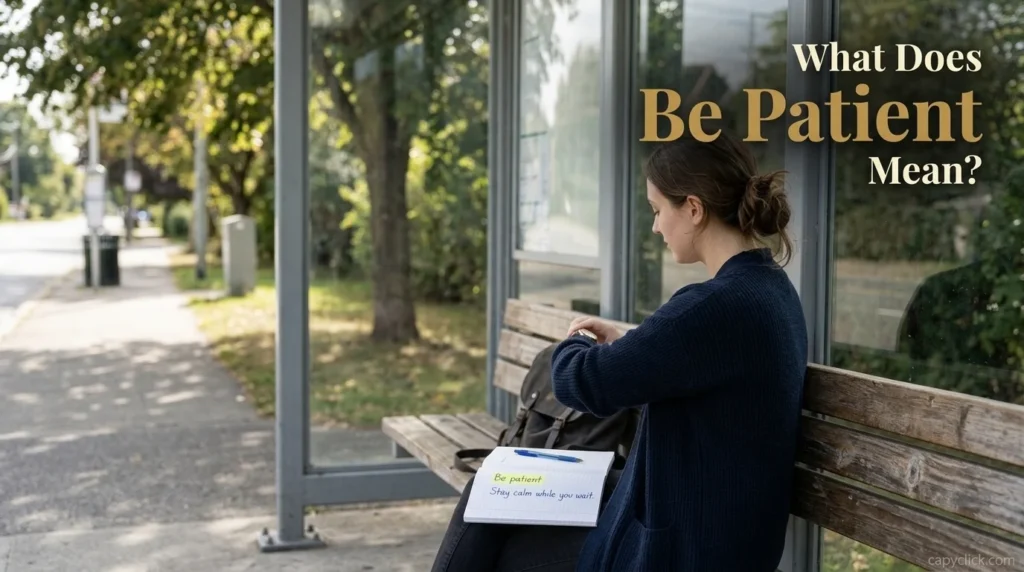
Be patient means to stay calm, avoid getting annoyed, and give something enough time. It encourages someone to wait without complaining or becoming frustrated.
The phrase is commonly used when giving advice, making a request, offering encouragement, or asking someone to show understanding.
Its grammatical structure is:
Be + adjective
Here, be is the verb, and patient is the adjective describing a person’s attitude or behavior.
For example:
- Please be patient while I check your order.
- You should be patient with yourself when learning English.
- Try to be patient during difficult times.
- Be patient; your turn will come soon.
- Parents should be patient with their children.
How Is Be Patient Used in a Sentence?
Use be patient when you want someone to remain calm or behave in an understanding way.
It is especially natural in these situations:
1. Giving advice
- Be patient when learning something new.
- You should be patient with people who make mistakes.
- Be patient; success takes time.
2. Making a request
- Please be patient while we resolve the issue.
- Be patient while I prepare your documents.
- Could you be patient for a few more minutes?
3. Offering encouragement
- Be patient with yourself. You are making progress.
- Do not give up. Be patient and keep practicing.
- Be patient during this difficult period.
In all these examples, the phrase focuses on someone’s behavior or attitude.
What Does Be Patient With Someone Mean?
Be patient with someone means to treat that person calmly, kindly, and understandingly, especially when they make mistakes, need extra time, or behave in a difficult way.
Examples:
- Please be patient with your students.
- She is always patient with her children.
- Teachers should be patient with beginners.
- I try to be patient with my coworkers.
- You need to be patient with people who are learning.
The expression does not mean that you must agree with everything someone does. It means giving them time and understanding instead of reacting with unnecessary frustration.
What Does Be Patient With Yourself Mean?
Be patient with yourself means to avoid judging yourself too harshly when learning, improving, or dealing with mistakes.
This expression is common in conversations about personal growth, education, and self-improvement.
Examples:
- Be patient with yourself while learning a new language.
- You do not have to become perfect overnight, so be patient with yourself.
- Be patient with yourself when progress feels slow.
- Everyone makes mistakes, so be patient with yourself.
It reminds people that improvement takes time and that making mistakes is a normal part of learning.
What Does Have Patience Mean?

Have patience means to possess or show the ability to wait calmly without becoming annoyed, angry, or frustrated.
The phrase focuses on patience as a personal quality. It can describe how much patience someone has or encourage someone to develop more of it.
Its grammatical structure is:
Have + noun
Here, have is the verb, and patience is the noun.
Examples:
- You need to have patience when teaching children.
- Learning a new language requires patience.
- Please have patience while we fix the problem.
- She has enough patience to explain things more than once.
- I do not have much patience for unnecessary delays.
How Is Have Patience Used in a Sentence?
Use have patience when talking about the ability to wait calmly or handle something that takes time.
It is especially useful when discussing a quality someone needs to succeed or manage a difficult situation.
Examples:
- You must have patience when learning a musical instrument.
- Parents need to have patience with their children.
- Building a successful business takes time and patience.
- Have patience; the results will come.
- Good communication requires time and patience.
The phrase can also describe how much patience someone possesses.
For example:
- I have a lot of patience.
- He has very little patience.
- She has more patience than I do.
- We need to have enough patience to finish this project.
What Does Have Patience With Someone Mean?
Have patience with someone means to remain understanding and calm while dealing with that person.
It is often used when someone needs extra time, makes repeated mistakes, or requires help.
Examples:
- Please have patience with me.
- Teachers must have patience with beginners.
- She has great patience with young children.
- I have little patience with people who constantly interrupt.
- You should have patience with someone who is trying to learn.
What Does Having Patience Mean?
Having patience means showing the ability to remain calm, tolerate delays, and continue dealing with challenges without giving up too quickly.
It is often seen as a useful personal quality because many goals require time, effort, and consistent work.
For example:
- Having patience is important when learning a new skill.
- Having patience with children can make teaching easier.
- Having patience during difficult times helps you make thoughtful decisions.
- Having patience with yourself makes personal growth easier.
Patience does not mean doing nothing or accepting every situation without action. You can work hard toward a goal while remaining patient about the results.
Be Patient vs Have Patience: Comparison Table
Here is a simple comparison of both expressions.
| Feature | Be Patient | Have Patience |
| Meaning | Stay calm and avoid frustration | Possess or show the ability to wait calmly |
| Grammar | Verb + adjective | Verb + noun |
| Main word | Patient | Patience |
| Focus | Attitude or behavior | Personal quality or ability |
| Common use | Advice, requests, and instructions | Encouragement and discussions about patience |
| Example | Be patient with yourself. | Have patience with yourself. |
| Negative expression | Be impatient | Lose patience |
| Question | Can you be patient? | Can you have patience? |
The main difference is grammatical, not a completely different meaning. Both phrases can encourage someone to remain calm, but be patient describes how someone should act, while have patience emphasizes the quality needed.
When Should You Use Be Patient or Have Patience?
Choosing between these expressions becomes easier when you understand what you want to communicate.
Use Be Patient When Giving Advice or Instructions
Choose be patient when you want someone to remain calm in a particular situation.
Examples:
- Be patient while waiting for your turn.
- Please be patient with the new employee.
- Be patient; your application is still being reviewed.
- Try to be patient when things do not go as planned.
- Be patient with yourself while practicing.
This phrase is especially natural when giving a direct instruction, polite request, or gentle reminder.
Use Have Patience When Talking About a Quality
Choose have patience when discussing someone’s ability to wait calmly or handle difficulties.
Examples:
- You need to have patience to learn a musical instrument.
- Good teachers have patience with their students.
- It takes patience to build a strong relationship.
- Have patience while the problem is being solved.
- You need time and patience to improve your writing.
This phrase often highlights patience as a personal quality that helps someone manage challenges.
Can You Use Both Expressions in the Same Situation?
Yes. In many situations, both expressions communicate almost the same message.
For example:
- Be patient while the website loads.
- Have patience while the website loads.
Both sentences ask someone to wait calmly. The first focuses on the person’s behavior, while the second emphasizes the ability to wait.
Here is another example:
- Be patient with me while I learn.
- Have patience with me while I learn.
Both are correct and natural. The choice depends on the sentence structure and the emphasis you want.
15 Examples of Be Patient and Have Patience in Sentences
These everyday examples show how to use both expressions correctly.
Examples Using Be Patient
- Please be patient while I prepare your documents.
- You should be patient with yourself when learning a new skill.
- Parents must be patient with young children.
- Be patient; your turn will come soon.
- She asked her students to be patient during the lesson.
- Try to be patient when someone makes a mistake.
- We need to be patient while waiting for the results.
- He learned to be patient during difficult situations.
Examples Using Have Patience
- You need to have patience when teaching beginners.
- Please have patience while we fix the problem.
- Learning a new language requires patience.
- She has enough patience to work with young children.
- You must have patience if you want to improve.
- Good communication requires time and patience.
- I have little patience for people who constantly interrupt others.
Common Mistakes When Using Be Patient and Have Patience
These expressions are easy to understand, but English learners sometimes confuse the adjective patient with the noun patience.
Here are the most common mistakes and their corrections.
1. Using Patient Instead of Patience
Incorrect: You need to have patient.
Correct: You need to have patience.
Why? The verb have is followed by the noun patience in this expression. Patient is an adjective, not the noun needed here.
2. Using Patience Instead of Patient
Incorrect: Please be patience.
Correct: Please be patient.
Why? The verb be is followed by the adjective patient when describing someone’s attitude.
3. Writing Be Patience With Me
Incorrect: Be patience with me.
Correct: Be patient with me.
You can also say:
Correct: Have patience with me.
Why? Use the correct grammatical combinations: be patient or have patience. Do not mix the adjective and noun.
4. Confusing Patient With Patience
These words look and sound similar, but they have different meanings and grammatical roles.
| Word | Part of Speech | Meaning | Example |
| Patient | Adjective | Able to wait calmly | She is patient. |
| Patient | Noun | A person receiving medical care | The patient is resting. |
| Patience | Noun | The ability to wait calmly | She has patience. |
| Impatient | Adjective | Easily annoyed by waiting | He is impatient. |
| Impatience | Noun | Lack of patience | His impatience was clear. |
5. Using Have Patient Instead of Have Patience
Incorrect: I do not have enough patient.
Correct: I do not have enough patience.
Why? After expressions such as have enough, have more, and have little, use the noun patience when talking about this quality.
6. Thinking Be Patient and Have Patience Have Completely Different Meanings
Both expressions are used to communicate the idea of staying calm and avoiding frustration.
For example:
- Be patient while the food is being prepared.
- Have patience while the food is being prepared.
Both are correct. The difference is their grammatical structure and emphasis.
Memory Trick: How to Remember Be Patient vs Have Patience
Use this simple grammar trick:
- Be patient = Be + adjective. It describes how someone should behave.
- Have patience = Have + noun. It describes the quality or ability someone needs.
Remember these examples:
- Be patient with your family.
- Have patience with your family.
You can also ask yourself one simple question:
Am I describing someone’s attitude or talking about a quality?
- If you are describing an attitude, use patient.
- If you are talking about the quality, use patience.
This small rule will help you avoid most mistakes.
Be Patient vs Have Patience in American and British English
There is no major grammatical difference between American and British English in the use of these expressions.
Both varieties commonly use:
- Be patient when asking someone to remain calm.
- Have patience when talking about the ability to wait calmly.
Examples:
- Please be patient with the staff.
- You need to have patience when learning a new language.
Both expressions are understood in the United States, the United Kingdom, and other English-speaking regions.
The choice usually depends on the sentence structure, context, and personal style rather than regional grammar rules.
Similar Words and Related Expressions
Understanding related words can help you use be patient and have patience more naturally.
| Word or Phrase | Meaning | Example |
| Patient | Able to wait calmly | She is patient with children. |
| Patience | Ability to wait calmly | Learning requires patience. |
| Impatient | Easily annoyed by waiting | He becomes impatient in traffic. |
| Impatience | Lack of patience | Her impatience was noticeable. |
| Tolerant | Willing to accept differences or difficulties | Be tolerant of other opinions. |
| Calm | Peaceful and not upset | Stay calm during the meeting. |
| Understanding | Willing to consider another person’s situation | She is understanding with beginners. |
| Wait patiently | Wait without becoming frustrated | Please wait patiently. |
| Lose patience | Become annoyed or frustrated | Do not lose patience with yourself. |
| Keep your patience | Continue to remain calm | Try to keep your patience. |
Be Patient vs Be Impatient
These expressions have opposite meanings.
- Be patient: Stay calm while waiting.
- Be impatient: Become annoyed or frustrated because something is taking too long.
Example:
- Be patient while your food is being prepared.
- Do not be impatient with the restaurant staff.
Have Patience vs Lose Patience
These expressions also have opposite meanings.
- Have patience: Remain calm and understanding.
- Lose patience: Become annoyed or frustrated.
Example:
- You need to have patience when teaching children.
- Do not lose patience when they make mistakes.
Final Verdict: Is It Be Patient or Have Patience?
Both be patient and have patience are correct English expressions. They share a similar meaning, but their grammatical structures are different.
Use be patient when describing how someone should behave or when asking them to stay calm. For example, “Please be patient while I finish my work.”
Use have patience when talking about the ability or quality of waiting calmly. For example, “You need to have patience when learning something new.”
Neither expression is automatically more formal than the other. Both are natural in everyday English, and the best choice depends on the sentence you are writing.
The easiest way to remember the difference is that patient is an adjective and patience is a noun. Say be patient, not be patience, and have patience, not have patient.
Frequently Asked Questions
1. Is It Be Patient or Have Patience?
Both are correct. Be patient means to stay calm, while have patience means to possess or show the ability to wait calmly.
Examples:
- Be patient with your students.
- Have patience with your students.
2. What Is the Difference Between Patient and Patience?
Patient is an adjective that describes someone who can wait calmly. Patience is a noun that names the ability to wait without becoming frustrated.
Examples:
- She is patient.
- She has patience.
3. Is Be Patient Grammatically Correct?
Yes. Be patient is grammatically correct because be is followed by the adjective patient.
Example: Please be patient while we check your request.
4. Is Have Patience Grammatically Correct?
Yes. Have patience is grammatically correct because have is followed by the noun patience.
Example: You need to have patience when learning a new language.
5. Should I Say Be Patient With Me or Have Patience With Me?
Both expressions are correct and natural.
- Be patient with me asks someone to treat you calmly and understandingly.
- Have patience with me asks someone to show patience while dealing with you.
The choice depends on your preferred sentence structure.
6. Can I Say Please Have Patience?
Yes. Please have patience is a polite and correct expression. It is often used when asking people to wait calmly.
Example: Please have patience while we resolve this issue.
7. What Is the Opposite of Be Patient?
The opposite is be impatient. It means to become annoyed or frustrated when something takes too long.
Example: Try not to be impatient when waiting for your turn.
8. What Does It Mean to Have Patience With Someone?
It means to remain calm, understanding, and tolerant while dealing with another person, especially when they need extra time or make mistakes.
Example: Teachers need to have patience with students who are learning something new.
Remember This
- Be patient = Be + adjective; describes a calm attitude.
- Have patience = Have + noun; describes the ability to wait calmly.
- Patient describes a person or attitude.
- Patience names a quality.
- Be impatient means to become frustrated while waiting.
- Lose patience means to stop remaining calm.
- Both expressions are correct and natural in everyday English.
Conclusion
The difference between be patient and have patience is simple once you understand the words patient and patience. Both expressions encourage someone to remain calm, wait without frustration, and deal with difficult situations in a positive way. However, be patient uses an adjective, while have patience uses a noun.
You can use either expression in many similar situations, such as learning a new skill, waiting for results, teaching children, or dealing with delays. Just remember the grammar: be patient and have patience. With this simple rule, you can use both phrases naturally and confidently in everyday English.

I’m Blake Thomas, a passionate caption writer at CapyClick. I love creating creative, catchy, funny, and meaningful captions that help people express themselves and make every social media post stand out.