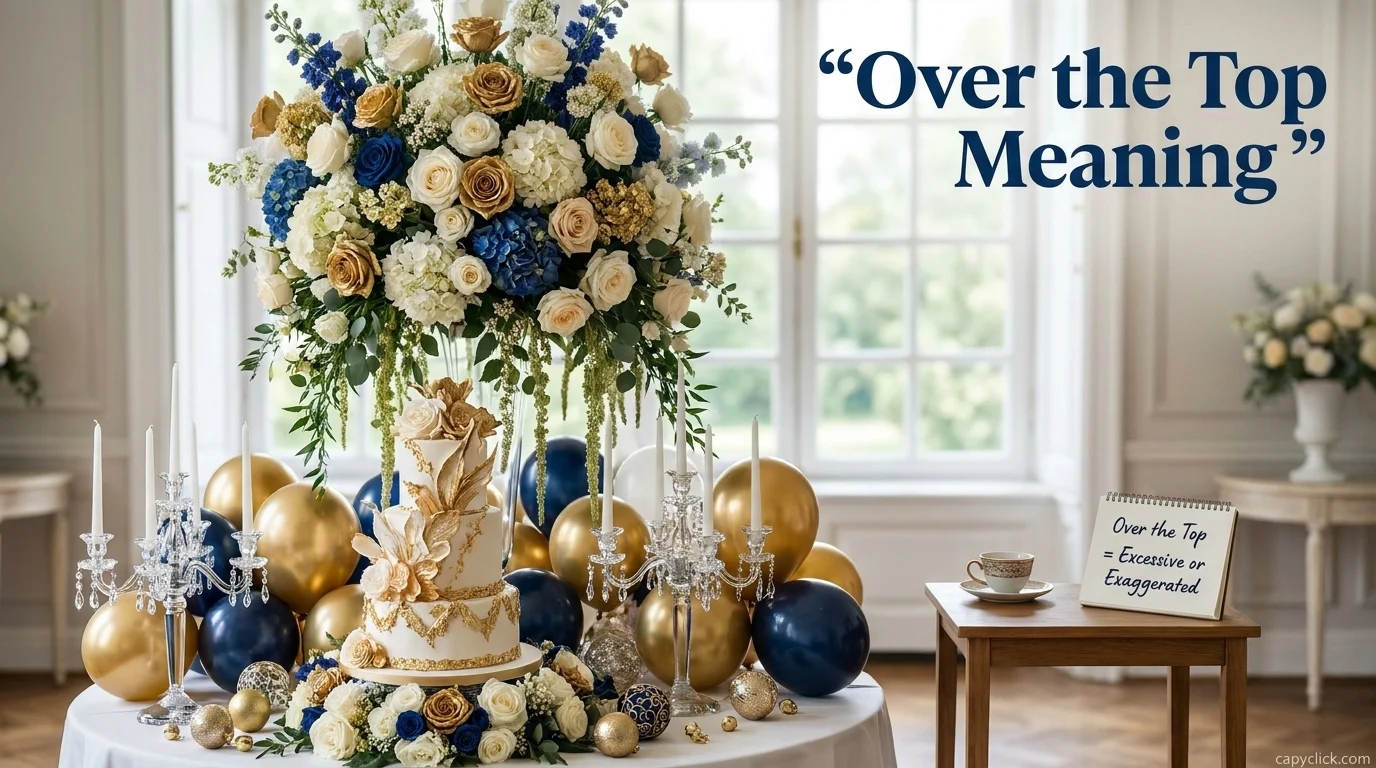
Have you ever heard someone describe a reaction, outfit, speech, or celebration as over the top? This common English idiom is used when something seems too extreme, exaggerated, or more than a situation really needs. For example, spending thousands of dollars on a small birthday party might seem over the top. Similarly, getting extremely angry over a tiny mistake can be described as an over-the-top reaction.
The over the top meaning is excessive, exaggerated, or beyond what is considered normal, reasonable, or appropriate. It can describe someone’s behavior, emotions, appearance, spending, or actions. The expression is particularly common in informal English, especially in British English, where OTT is a popular abbreviation.
Depending on the situation and the speaker’s tone, it can express criticism, humor, or even admiration. Learning how to use this phrase will help you understand everyday English conversations and express your thoughts more naturally.
Quick Answer: What Does Over the Top Mean?
Over the top means too extreme, excessive, exaggerated, or more than is suitable for a particular situation. It describes something that attracts too much attention, demands unnecessary effort, or goes beyond reasonable limits. For example, an extremely dramatic speech or unnecessarily expensive celebration can be called over the top. Its informal abbreviation is OTT.
Why Do People Confuse Over the Top?
People sometimes confuse over the top because its figurative meaning is different from the literal meanings of its individual words.
Literally, over can mean above something, while top refers to the highest part of an object. However, when these words form an idiom, they describe something that goes beyond an acceptable or expected limit.
Another reason for confusion is that the expression does not always have the same emotional meaning. It usually suggests excess, but the speaker may use it humorously or positively.
For example:
- His reaction was over the top. (His response was unnecessarily extreme.)
- The decorations were way over the top. (They were much too elaborate.)
- The performance was completely over the top, but everyone loved it. (It was exaggerated and entertaining.)
The situation and tone help determine the intended meaning.
What Does Over the Top Mean?
Over the top is an English idiom that means too extreme, excessive, exaggerated, or unsuitable for a particular situation.
It is commonly used when someone or something demands too much attention, effort, money, or emotion.
According to its dictionary meaning, the expression is particularly associated with something that is too extreme or unsuitable, especially when it is uncontrolled.
Here are some common situations where you can use it:
- Behavior: Someone behaves in an unnecessarily extreme way.
- Emotions: A person reacts too strongly to a small situation.
- Decorations: Something is decorated more than necessary.
- Spending: Someone spends an unreasonable amount of money.
- Communication: A speech or comment is unnecessarily dramatic.
- Entertainment: A movie or performance uses exaggerated actions or effects.
Examples:
- Your reaction to his joke was a little over the top.
- The wedding decorations were way over the top.
- He realized he had gone over the top with the seating arrangements.
Is Over the Top Positive or Negative?
The phrase is generally used to suggest that something is excessive or goes too far. However, its emotional meaning depends on the context.
Negative use: It criticizes something that is unnecessary, inappropriate, or exaggerated.
Example: His angry response was over the top for such a small mistake.
Humorous or positive use: It can describe something unusually dramatic, entertaining, or impressive.
Example: The birthday celebration was over the top, but we had an amazing time.
Therefore, over the top does not always mean something bad. It can also describe something that is excessive in an enjoyable way.
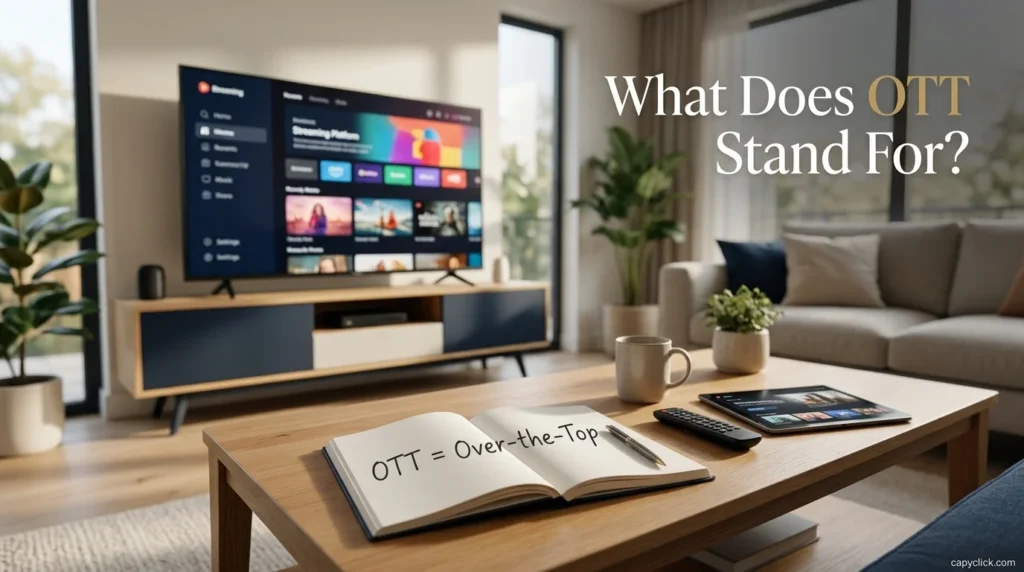
What Does OTT Stand For?
OTT stands for over the top. It is an informal abbreviation commonly used in British English and casual communication.
People use OTT in text messages, social media posts, conversations, and informal writing when they want to describe something exaggerated or excessive.
Examples:
- That outfit is a little OTT.
- The decorations were totally OTT.
- His reaction was way too OTT.
- The movie was funny but slightly OTT.
OTT is convenient in casual communication, but writing the complete expression over the top is generally better in formal writing.
Over the Top Meaning: Word-by-Word Explanation
Understanding the individual words can make the idiom easier to remember.
What Does Over Mean?
Over is a common English word with several meanings. It can refer to something above another object, something finished, or something beyond a particular amount or limit.
Examples:
- The plane flew over the city.
- The meeting is over.
- She spent over $100 on dinner.
In the idiom, over suggests going beyond a normal or expected limit.
What Does Top Mean?
Top means the highest part or upper surface of something.
Examples:
- The book is on top of the desk.
- She reached the top of the mountain.
- There is a cup on top of the refrigerator.
Together, the words form an idiomatic expression meaning something that goes beyond normal limits.
Over the Top vs. Similar Expressions
Several English words and phrases have meanings related to over the top, but they are not always interchangeable.
| Expression | Meaning | Example |
| Over the top | Too extreme or excessive | His reaction was over the top. |
| Too much | More than necessary | This decoration is too much. |
| Overboard | Beyond reasonable limits | You are going overboard with the spending. |
| Excessive | More than is suitable or needed | The criticism was excessive. |
| Exaggerated | Made to seem more extreme | His story sounded exaggerated. |
| Extravagant | Unnecessarily expensive or elaborate | They planned an extravagant party. |
| Overdone | Done more than necessary | The makeup looks overdone. |
Over the Top vs. Overboard
Both expressions describe going beyond reasonable limits, but their usage can differ.
- Over the top: Describes something that is too extreme or exaggerated.
- Overboard: Often describes someone doing or using too much of something.
Examples:
- His response was over the top.
- You are going overboard with the decorations.
When Should You Use Over the Top?
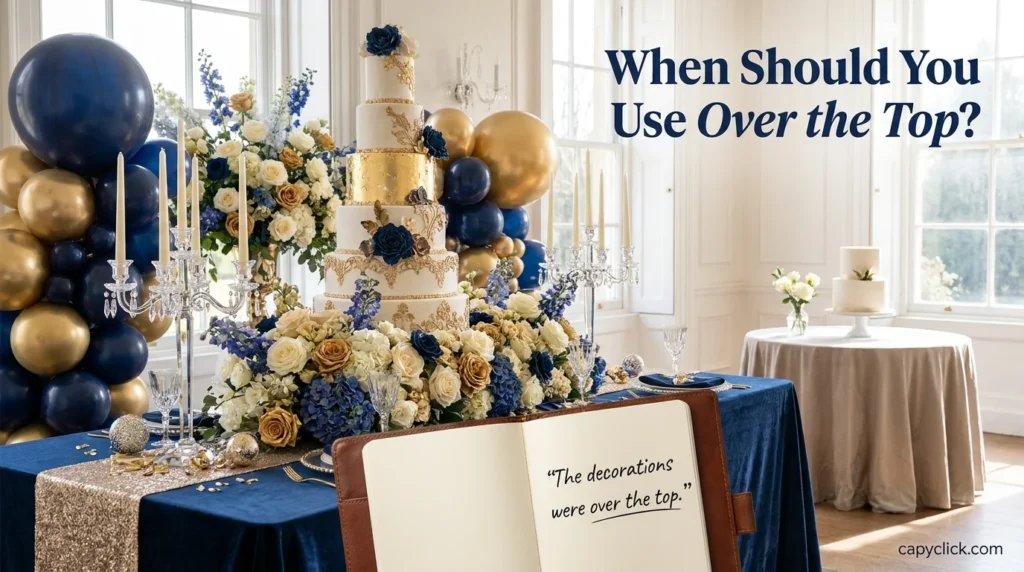
You can use over the top when something is more extreme than a situation requires or when it attracts more attention than necessary.
1. When Someone Overreacts
Use it when a person responds too strongly to a small problem.
Example: Getting upset because someone borrowed your pencil is a little over the top.
2. When Decorations Are Excessive
Use it to describe decorations that are unusually elaborate or attention-grabbing.
Example: The Christmas decorations in their house were way over the top.
3. When Someone Spends Too Much Money
The phrase can describe unnecessary or unreasonable spending.
Example: Buying an expensive watch just to impress your friends seems over the top.
4. When a Speech Is Too Dramatic
Use it when someone makes a speech that sounds unnecessarily emotional or exaggerated.
Example: His speech was a bit OTT for such a simple occasion.
5. When Someone Makes Too Much Effort
It can describe a situation where someone does more work than necessary.
Example: He realized he had gone over the top with the seating arrangements.
15 Examples of Over the Top in Everyday English
Here are practical over the top examples to help you understand how the expression works in different situations.
- His reaction to the simple question was completely over the top.
- The decorations at their wedding were way over the top.
- Spending $500 on a birthday cake seems a little over the top.
- Her outfit was over the top, but she looked confident.
- The movie’s action scenes were so over the top that everyone laughed.
- You do not need to apologize ten times; that is a bit over the top.
- The company organized an over-the-top celebration for its employees.
- His expensive lifestyle is becoming over the top.
- The teacher thought my response was a little over the top.
- Their holiday decorations were completely OTT this year.
- The actor gave an over-the-top performance in the comedy.
- Buying a new phone every month is over the top.
- The restaurant served an over-the-top dessert with chocolate and cream.
- Her excitement about the small gift was not over the top at all.
- The entire event was over the top, but everyone enjoyed it.
Common Mistakes When Using Over the Top
Even though this expression is easy to understand, English learners sometimes make mistakes when using it.
1. Thinking It Always Has a Negative Meaning
The expression often criticizes something excessive, but it can also describe an entertaining or impressive experience.
Correct: The concert was over the top, and we loved every minute of it.
2. Confusing It With On Top
These expressions have different meanings.
- Over the top: Excessive or exaggerated.
- On top: Positioned on the upper surface of something.
Example: The phone is on top of the table.
3. Using It for Everything Impressive
Something impressive is not automatically over the top. The expression suggests that something goes beyond normal expectations.
Example:
- Impressive: She gave an excellent presentation.
- Over the top: She used fireworks and a giant screen for a simple classroom presentation.
4. Confusing OTT With a Formal Expression
OTT is an informal abbreviation. In academic or professional writing, the complete expression or a suitable alternative may be more appropriate.
5. Forgetting the Word The
The standard idiom is over the top, not simply over top.
Correct: His reaction was over the top.
Incorrect: His reaction was over top.
Is It Over the Top or Over-the-Top?
Both forms are correct, but they are used differently depending on their grammatical position.
Over the top is generally written without hyphens when it appears after a linking verb or functions as an idiom.
Examples:
- His behavior was over the top.
- The decorations went over the top.
- Her reaction seemed over the top.
Over-the-top is commonly hyphenated when it works as a compound adjective before a noun.
Examples:
- He gave an over-the-top performance.
- They organized an over-the-top celebration.
- The movie had over-the-top action scenes.
Easy rule: Use over the top when describing something after a verb, and commonly use over-the-top before a noun as a compound modifier.
How Can You Remember the Meaning of Over the Top?
A simple way to remember this expression is:
Over the top = More than necessary.
Imagine someone decorating a small birthday cake with 100 candles, expensive ornaments, and fireworks. These decorations go far beyond what a normal birthday cake needs.
That is an example of something being over the top.
Remember these related words:
- Excessive
- Too much
- Exaggerated
- Extreme
- Extravagant
- Overdone
Whenever something goes beyond normal or reasonable limits, think of over the top.
Is Over the Top Used Differently in American and British English?
The expression over the top is understood in both American and British English. Its basic meaning remains the same.
However, the abbreviation OTT is particularly common in informal British English.
Examples in American English:
- His reaction was totally over the top.
- That party was really over the top.
Examples in British English:
- Her comments were a bit over the top.
- The decorations were rather OTT.
Both varieties use the expression naturally. The main difference is not its meaning but the frequency of certain informal expressions and abbreviations.
What Are the Synonyms and Opposites of Over the Top?
Learning over the top synonyms and opposite words can help you build your English vocabulary.
Synonyms of Over the Top
| Synonym | Simple meaning |
| Excessive | More than necessary |
| Exaggerated | Too dramatic or overstated |
| Extravagant | Unnecessarily expensive or elaborate |
| Extreme | Beyond normal limits |
| Overdone | Done too much |
| Unreasonable | Not fair or sensible |
| Dramatic | Showing unusually strong emotions |
| Overboard | Going beyond reasonable limits |
Opposite Words of Over the Top
The opposite of over the top depends on the context, but these words are commonly suitable:
- Moderate: Not excessive.
- Reasonable: Fair and sensible.
- Appropriate: Suitable for a situation.
- Simple: Not complicated or elaborate.
- Restrained: Controlled and not excessive.
- Understated: Simple and not attention-seeking.
Example: Instead of an over-the-top celebration, they organized a simple family dinner.
Final Verdict: What Does Over the Top Really Mean?
Over the top means too extreme, excessive, exaggerated, or unsuitable for a particular situation. It is an informal English idiom used to describe behavior, emotions, decorations, spending, speeches, and performances that go beyond reasonable limits.
The expression can communicate criticism, humor, or admiration depending on the context. Its informal abbreviation is OTT, and the hyphenated form over-the-top is commonly used before nouns, as in an over-the-top performance.
Frequently Asked Questions
1. What does over the top mean in simple words?
Over the top means too much, excessive, or more than necessary. It describes something that goes beyond what is normal or suitable.
Example: Spending thousands of dollars on a small birthday party is over the top.
2. What does OTT stand for?
OTT stands for over the top. It is an informal abbreviation, particularly common in British English and casual conversations.
3. Is over the top a positive or negative phrase?
It can be either, depending on the situation. It often criticizes something excessive but can also describe something entertaining, impressive, or wonderfully dramatic.
4. What is another word for over the top?
Common synonyms include excessive, exaggerated, extravagant, extreme, overdone, and unreasonable. The best choice depends on the context.
5. What does going over the top mean?
Going over the top means doing something excessively or taking an action beyond what is necessary or appropriate.
Example: You are going over the top with these decorations.
6. Is over the top an idiom?
Yes. Over the top is an English idiom because its figurative meaning is different from the literal meanings of its individual words.
7. Should over the top have hyphens?
It depends on its grammatical use. Write over the top in expressions such as “His reaction was over the top.” Use over-the-top as a compound adjective before a noun, as in “an over-the-top performance.”
8. What is the opposite of over the top?
Common opposites include moderate, reasonable, appropriate, restrained, simple, and understated.
9. Is over the top formal or informal?
It is mainly an informal expression used in everyday conversations. It is also understood in general writing, but more formal alternatives such as excessive or disproportionate may be better for academic and professional contexts.
Remember This
- Over the top means too extreme, excessive, or unsuitable.
- It is commonly used to describe exaggerated behavior and situations.
- OTT is the informal abbreviation.
- Over-the-top is commonly used as a compound adjective before a noun.
- The phrase is used in both American and British English.
- Its meaning can be critical, humorous, or positive depending on context.
Conclusion
The over the top meaning is simple: something is more extreme, exaggerated, or excessive than a situation requires. You can use this everyday English idiom to describe an unnecessary reaction, an expensive purchase, elaborate decorations, or a dramatic performance. It is especially useful when you want to explain that someone or something has gone beyond reasonable limits.
Remember that OTT is simply the short form of over the top, while over-the-top is commonly used before nouns. Once you understand these forms and their meanings, you can use the expression naturally in everyday conversations, messages, and writing.

I’m Blake Thomas, a passionate caption writer at CapyClick. I love creating creative, catchy, funny, and meaningful captions that help people express themselves and make every social media post stand out.