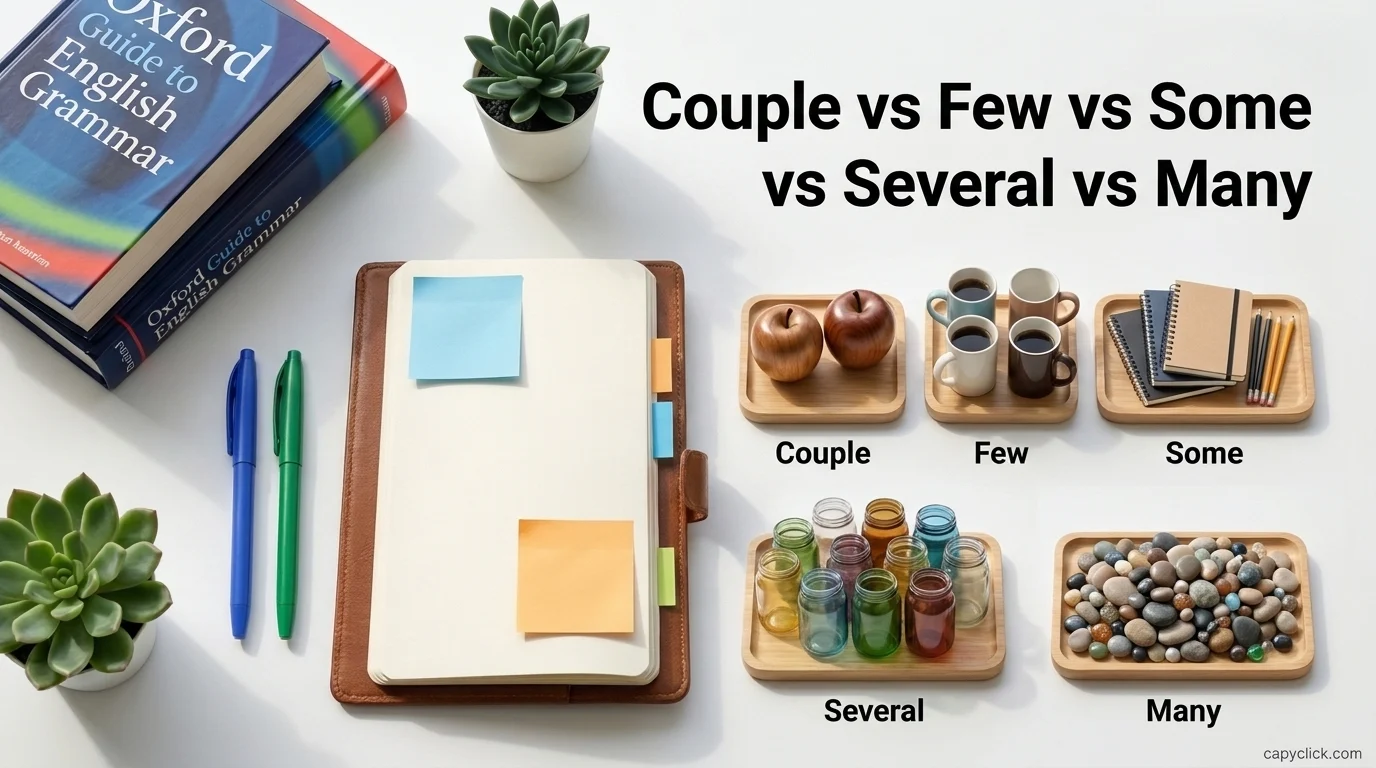
Choosing between couple, few, some, several, and many can be confusing for English learners. These words all describe amounts or numbers, but they do not mean exactly the same thing. Some refer to a small number, while others can describe a larger or less specific amount.
The main difference is that a couple usually means two, a few means a small number, some means an unspecified amount, several means more than a few but not many, and many means a large number. However, the exact meaning can depend on the noun, the situation, and the speaker’s intention. Learning these differences will help you speak more naturally, write clearer sentences, and avoid common grammar mistakes.
Quick Answer
- Couple: Usually two people or things. Example: I need a couple of minutes.
- Few: A small number. Example: I have a few questions.
- Some: An unspecified amount or number. Example: I bought some apples.
- Several: More than a few, but not a large number. Example: She visited several places.
- Many: A large number, especially with countable nouns. Example: Many students passed the exam.
Why Do People Confuse Couple, Few, Some, Several, and Many?
People confuse these words because they all answer questions such as “How many?” or “How much?” They also describe amounts without always giving an exact number.
For example, if someone says, “I have a few friends,” the listener knows the number is small but does not know the exact count. If someone says, “I have many friends,” the listener understands that the number is large.
The words also differ in how precisely they describe an amount. Couple usually suggests two, some is general, and few, several, and many communicate different ideas about quantity.
1. What Does Couple Mean?
Couple usually means two people or things considered together. It is often used in everyday conversations when discussing small numbers or short periods of time.
When referring to an amount, English speakers commonly use the phrase a couple of.
Examples:
- I need a couple of minutes to finish this task.
- They bought a couple of books.
- We invited a couple of friends to dinner.
- Give me a couple of days to decide.
- The couple went for a walk.
In the last example, couple means two people in a relationship or pair. In the other examples, a couple of generally means two, although informal speech sometimes uses it to mean approximately two or a small number close to two.
Is Couple Singular or Plural?
The word couple is a singular count noun when referring to the pair as one unit.
- A couple is sitting near the window.
- A couple of students are waiting outside.
In the second sentence, the plural verb are is common because the sentence focuses on the two students. Singular agreement can also occur when the pair is treated as one unit, depending on the sentence and variety of English.
2. What Does Few Mean?

Few means a small number of people or things. It is used with plural countable nouns, such as books, friends, students, and days.
Examples:
- I have a few questions.
- She bought a few oranges.
- We stayed there for a few days.
- A few students arrived early.
- He made a few mistakes in the test.
The phrase a few usually has a positive meaning. It tells the listener that the number is small but enough for the situation.
Compare these sentences:
- I have a few friends. This suggests that I have some friends.
- I have few friends. This suggests that I do not have many friends and may emphasize a lack.
The article makes an important difference. A few means a small number that exists, while few without often emphasizes that the number is smaller than expected or desired.
3. What Does Some Mean?
Some describes an unspecified amount or number. It can be used with plural countable nouns and uncountable nouns.
Examples:
- I bought some apples.
- She needs some water.
- We met some new students.
- He gave me some useful advice.
- There is some milk in the fridge.
Unlike a couple or several, some does not tell us a clear number. It simply indicates that an amount or number exists.
Use some when the exact quantity is unknown, unimportant, or not necessary to mention.
For example:
- Please bring some snacks.
- I need some help with my homework.
- She has some books about history.
Here, the speaker does not specify the exact number of snacks, the amount of help, or the number of books.
Can Some Be Used in Questions?
Yes. Some is common in offers and requests, especially when the speaker expects or hopes for a positive response.
- Would you like some tea?
- Could I have some water?
- Can you lend me some money?
In ordinary information-seeking questions, any is also common:
- Do you have any questions?
- Is there any milk left?
4. What Does Several Mean?

Several means more than a few but not a large number. It is used with plural countable nouns.
Examples:
- I have read several books this month.
- She called me several times.
- Several people attended the meeting.
- We visited several museums.
- He has lived in several cities.
The exact number is not fixed. Depending on the context, several may refer to three, four, five, or another relatively small number.
For example, “I visited several countries” tells the listener that you visited more than one or two countries, but it does not reveal the exact total.
Use several when you want to communicate that the number is more than just a couple without suggesting a very large amount.
Is Several More Than Few?
Usually, yes. In everyday usage, several often suggests a greater number than a few. However, their meanings overlap, and there is no universal numerical boundary between them.
For example, three books might be described as a few books or several books, depending on the speaker and context.
5. What Does Many Mean?
Many means a large number of people or things. It is used with plural countable nouns.
Examples:
- Many people use smartphones.
- She has many friends.
- Many students attended the event.
- We saw many birds in the park.
- He has read many books.
Use many when the number is large or when you want to emphasize quantity.
Compare:
- A few students passed the test.
- Several students passed the test.
- Many students passed the test.
These sentences communicate increasingly large amounts in a typical context, although the exact number depends on the situation.
Can Many Be Used With Uncountable Nouns?
No. In standard English, many is used with countable plural nouns, not directly with uncountable nouns.
Correct:
- Many people attended the event.
- Many books are available.
Incorrect:
- Many water is needed.
- Many information was shared.
Use much or a lot of with uncountable nouns instead.
- Much water is needed.
- A lot of information was shared.
Couple vs Few vs Some vs Several vs Many: Comparison Table
| Word | Main meaning | Common use | Example |
| Couple | Usually two | Countable nouns | A couple of friends visited. |
| Few | A small number | Plural countable nouns | I have a few questions. |
| Some | An unspecified amount or number | Countable and uncountable nouns | I bought some fruit. |
| Several | More than a few, but not many | Plural countable nouns | She read several books. |
| Many | A large number | Plural countable nouns | Many people came. |
Remember that these descriptions are general guidelines, not exact numerical rules. Context can change how a speaker understands each word.
When Should You Use Each Word?
Choosing the right word becomes easier when you think about what you want to communicate.
Use Couple When You Mean Two
Choose a couple of when you mean two or approximately two in casual speech.
- I need a couple of minutes.
- We ordered a couple of pizzas.
Use A Few When the Number Is Small
Choose a few when you want to describe a small number of countable things.
- I have a few ideas.
- She invited a few friends.
Use Some When the Exact Amount Does Not Matter
Choose some when the amount or number is unknown, unspecified, or unimportant.
- Please buy some bread.
- I need some pencils.
Use Several When the Number Is More Than a Couple
Choose several when you want to suggest a number that is greater than two or a few, without implying a large total.
- We discussed several topics.
- He sent several messages.
Use Many When the Number Is Large
Choose many when you want to describe a large number of countable things.
- Many people enjoy music.
- Many children play outside.
10+ Examples of Couple vs Few vs Some vs Several vs Many
The following examples show how these words work in everyday English.
| Word | Example sentence |
| Couple | I need a couple of minutes to get ready. |
| Couple | They bought a couple of tickets. |
| Few | I made a few new friends at school. |
| Few | We have a few things to discuss. |
| Some | She brought some food for everyone. |
| Some | I need some time to think. |
| Several | He visited several shops yesterday. |
| Several | Several students asked the teacher for help. |
| Many | Many people attended the concert. |
| Many | She has many books in her room. |
| Few | Few people understood the difficult question. |
| Some | There are some flowers in the garden. |
| Several | We watched several interesting videos. |
| Many | Many countries celebrate special holidays. |
How Do These Words Change a Sentence?
Consider this example:
- I bought a couple of apples.
- I bought a few apples.
- I bought some apples.
- I bought several apples.
- I bought many apples.
The first sentence usually suggests two apples. The second suggests a small number. The third does not specify a number. The fourth suggests several apples, and the fifth suggests a large number.
The exact quantity behind a few, some, and several can vary according to the situation.
Common Mistakes to Avoid
Even advanced learners sometimes confuse these words. These are the mistakes worth checking.
Mistake 1: Using Many With Uncountable Nouns
Incorrect: I have many homework.
Correct: I have a lot of homework.
Homework is uncountable, so many cannot directly describe it.
Mistake 2: Forgetting Of After Couple
Incorrect: I need a couple minutes.
Correct: I need a couple of minutes.
In standard writing, use a couple of before a noun. In informal American English, a couple minutes is also common.
Mistake 3: Confusing Few With A Few
- Few people came to the party. This suggests that attendance was low.
- A few people came to the party. This simply says that some people came.
The difference is small but important.
Mistake 4: Treating Some as an Exact Number
Incorrect assumption: Some always means three or four.
Correct understanding: Some means an unspecified amount or number. Its quantity depends on the context.
Mistake 5: Assuming Several Always Means Exactly Five
Several has no fixed numerical definition. It usually suggests more than two or a few, but it does not always mean five.
Mistake 6: Using Few Directly With Uncountable Nouns
Incorrect: I have a few money.
Correct: I have a little money.
Use a few with countable nouns and a little with uncountable nouns.
Memory Trick: How to Remember the Difference
Use this simple guide to remember all five words:
- Couple = two
- A few = a small number
- Some = an unspecified amount
- Several = more than a few, usually not many
- Many = a large number
Imagine that you are buying apples at a shop.
You buy a couple of apples if you want two. You buy a few apples if you want a small number. Buy some apples if you do not want to specify the number. You buy several apples if you want more than a couple. You buy many apples if you want a large number.
This is a helpful starting point, but remember that a few, some, and several can overlap in real conversations.
American vs British English
The meanings of couple, few, some, several, and many are broadly similar in American and British English. The main differences are often related to informal usage, sentence style, and personal preference rather than completely different definitions.
For example, American speakers commonly say “a couple minutes,” while “a couple of minutes” is also widely used. British speakers also commonly use “a couple of minutes.”
Both varieties use expressions such as:
- A few friends
- Some water
- Several days
- Many people
The interpretation of a few and several may vary between speakers in either country. Neither word has a strict numerical limit that applies to every situation.
Similar Words You Should Know
Learning related words can make it easier to describe quantities accurately.
| Word or phrase | Meaning | Example |
| A pair | Two matching or related things | I bought a pair of shoes. |
| A little | A small amount of something uncountable | I need a little sugar. |
| A lot of | A large amount or number | We have a lot of work. |
| Numerous | Many; a large number | Numerous people attended. |
| Plenty of | As much or as many as needed | We have plenty of time. |
| Few | A small number, often emphasizing scarcity | Few students answered correctly. |
| Several | More than a few, usually a moderate number | I have several appointments. |
| Much | A large amount, commonly used with uncountable nouns | We do not have much time. |
| Any | An unspecified amount or number, often in questions and negatives | Do you have any questions? |
Couple vs Pair
Both words can refer to two things, but pair often suggests two items that belong together, such as a pair of shoes or a pair of gloves. A couple of is more general in everyday conversation.
Few vs Little
Use few with plural countable nouns and little with uncountable nouns.
- A few books
- A little water
Some vs A Lot of
Some does not specify the quantity. A lot of usually suggests a large amount or number.
- I have some books.
- I have a lot of books.
Final Verdict: Which Word Should You Choose?
The best word depends on how much information you want to give about the quantity.
Choose couple when you mean two, a few when you mean a small number, some when the exact amount is not important, several when you mean a moderate number, and many when you mean a large number.
For example, “I invited a couple of friends” usually suggests two friends. “I invited a few friends” suggests a small group. “I invited several friends” suggests a somewhat larger group, while “I invited many friends” suggests a large group. “Me invited some friends” leaves the number unspecified.
These meanings are flexible, so do not worry about memorizing exact numerical limits. Focus on the general meaning and the context.
Frequently Asked Questions
1. What is the difference between couple, few, some, several, and many?
Couple usually means two, a few means a small number, some means an unspecified amount or number, several means more than a few but not many, and many means a large number. The exact interpretation depends on context.
2. Is several more than a few?
Usually, yes. Several often suggests a greater number than a few. However, the meanings overlap, and neither word has a fixed numerical limit.
3. Does a couple always mean two?
A couple usually means two. In casual conversation, a couple of can also mean approximately two or a small number close to two.
4. What is the difference between few and a few?
Few often emphasizes that the number is smaller than expected or desired. A few describes a small number in a more positive or neutral way.
For example, “Few people came” emphasizes low attendance, while “A few people came” simply says that some people attended.
5. Can some mean many?
Yes, depending on the context. Some does not specify an exact amount, so it can refer to a small or large quantity. However, it does not specifically emphasize that the number is large, as many does.
6. Can I use many with uncountable nouns?
No. In standard English, use many with plural countable nouns and much or a lot of with uncountable nouns.
Correct: Many books and much information.
7. Is some singular or plural?
Some can be used with plural countable nouns and singular uncountable nouns.
- Some students are waiting.
- Some water is left.
When some refers to a portion of something, the verb agrees with the noun or expression used in the sentence.
8. Which is more formal: several or a few?
Both are suitable for formal and informal English. Several may sound more precise or formal in some contexts, while a few is common in everyday conversation. Choose the word that best expresses the intended quantity.
Remember This
- Couple: usually two.
- A few: a small number.
- Some: an unspecified amount or number.
- Several: a moderate number, often more than a few.
- Many: a large number.
Use a few with countable nouns, a little with uncountable nouns, and many with plural countable nouns. Remember that these words describe approximate quantities rather than strict numerical categories.
Conclusion
Understanding the difference between couple vs few vs some vs several vs many helps you communicate quantities more clearly. Although these words have similar uses, each expresses a different idea. Couple usually means two, a few describes a small number, some leaves the quantity unspecified, several suggests a moderate number, and many emphasizes a large number.
The easiest way to learn them is to practice using each word in everyday sentences. Describe the number of books you own, the friends you know, or the time you need to complete a task. With regular practice, you will become more confident choosing the right word in both speaking and writing.

I am Leah Rosel, a passionate writer at CapyClick. I enjoy creating creative, stylish, funny, and meaningful captions that help people express themselves and make every social media post memorable.