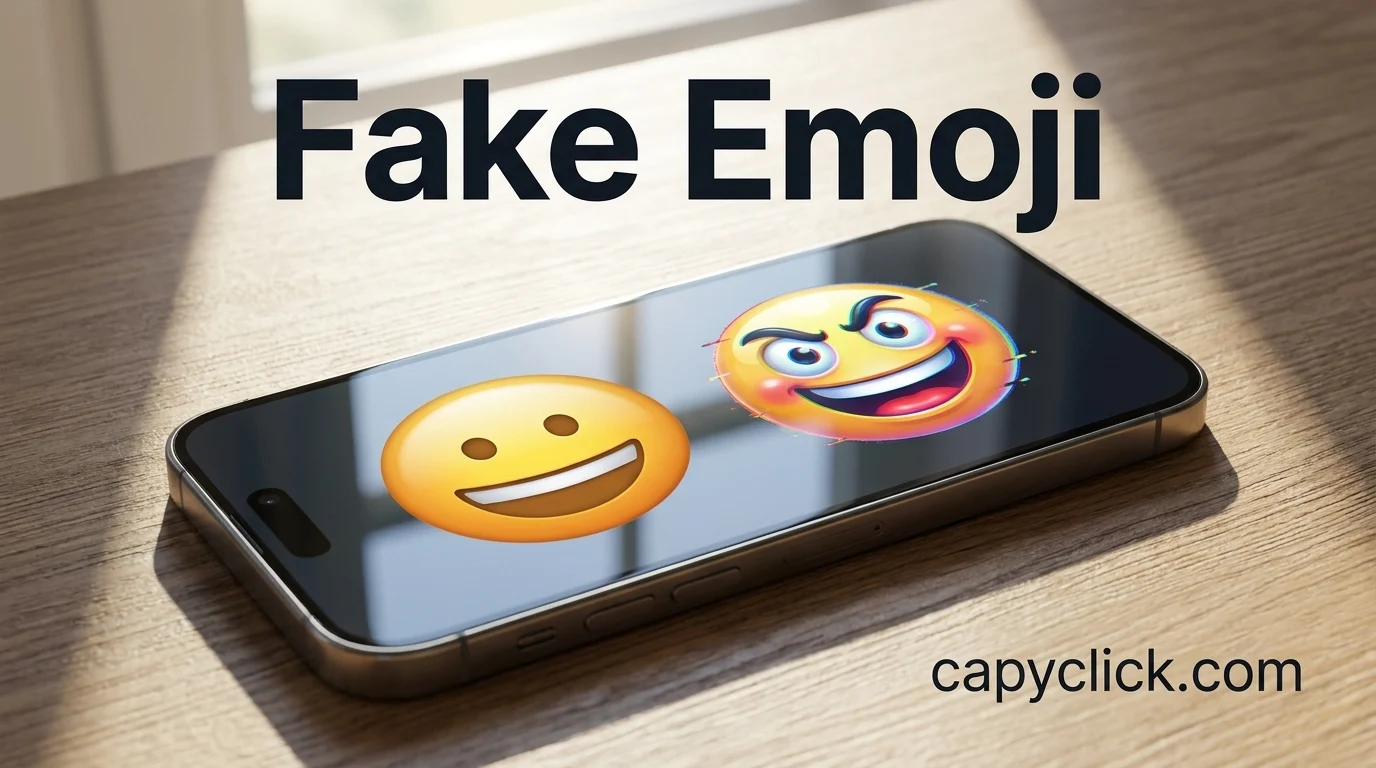
Have you ever seen an emoji online that looks real but does not appear on your phone when you try to find it? You may have come across a fake emoji. The term can describe an emoji-style image, edited emoji, unofficial design, or even a picture that looks like a standard Unicode emoji but is not actually one.
A fake emoji can be funny, creative, confusing, or misleading depending on where you see it. Some are created for memes and social media, while others are simply custom images designed to look like familiar emojis. Understanding the difference helps you know what you can copy and paste as text and what is only an image.
Quick Answer: What Is a Fake Emoji?
A fake emoji is usually an emoji-like symbol or image that is not an official Unicode emoji. It may be a custom graphic, edited emoji, sticker, meme, AI-generated image, or unofficial design made to resemble a real emoji.
Here is the simple difference:
| Type | What It Is | Can You Usually Copy as Text? |
|---|---|---|
| Official emoji | Unicode character supported by devices | Yes |
| Custom emoji | Created for a specific app or platform | Usually no |
| Emoji sticker | Image or sticker that looks like an emoji | No |
| Edited emoji | Modified version of an existing emoji | No |
| Fake emoji image | Unofficial emoji-style graphic | No |
| Emoji combination | Several real emojis used together | Yes |
The important point is that looking like an emoji does not necessarily make something an official emoji.
What Does “Fake Emoji” Actually Mean?
The phrase “fake emoji” does not describe one specific symbol.
Instead, people use it in several ways. Someone might call an unusual emoji fake because they cannot find it on their keyboard. Another person may use “fake emoji” to describe a custom picture that copies the appearance of a familiar emoji.
For example, imagine seeing a smiling face with three eyes. If you cannot find that character in your normal emoji keyboard, it may be a custom graphic rather than an official Unicode character.
The same thing happens with unusual animals, objects, faces, and expressions shared on social media.
Sometimes the image is intentionally designed to look official. Other times, the creator simply wants to make something funny or unique.
Is a Fake Emoji a Real Emoji?
Not necessarily.
The word emoji generally refers to pictographic characters that are encoded through Unicode and supported by operating systems, apps, and devices.
A fake emoji may look exactly like one, but it might simply be an image file.
This creates an important difference:
- A Unicode emoji is a character.
- An emoji image is a picture.
- A sticker is a graphic used by an app.
- A custom emoji is created for a particular platform or community.
- An edited emoji is a modified graphic based on an existing design.
So, if someone sends you a strange emoji-looking picture, it does not automatically mean that a new official emoji has been added.
How Can You Tell If an Emoji Is Fake?
There are several simple clues that can help.
1. You Cannot Find It on Your Emoji Keyboard
The easiest test is to search your device’s emoji keyboard.
If someone sends you an image of an unusual character but you cannot find the same symbol anywhere on your keyboard, it may be a custom graphic or sticker.
However, this is not perfect proof. Your operating system, app, or font may not support every Unicode character.
2. It Looks Completely Different Across Platforms
Official emojis can look different on Apple, Google, Microsoft, Samsung, and other platforms. The basic meaning remains recognizable even though the artwork changes.
A custom emoji may not behave this way.
If the symbol only exists as one particular picture, it is more likely to be an image or sticker.
3. It Has Extra Details That Look Edited
Some fake emoji designs combine several features that are not normally found together.
For example:
- A face with unusual eyes
- A smiling face holding an unexpected object
- A combination of multiple animals
- A character with exaggerated facial features
- A familiar emoji wearing unusual clothing
These are often created for memes, jokes, or social media posts.
4. It Cannot Be Copied as a Character
Try copying the symbol and pasting it into a plain-text field.
If it behaves like a picture rather than text, it is probably an image or sticker.
This distinction is especially useful when someone claims that an image is a “new emoji.”
Fake Emoji vs. Official Emoji
Understanding this comparison makes the topic much easier.
| Feature | Official Emoji | Fake or Custom Emoji |
|---|---|---|
| Unicode character | Yes | Usually no |
| Appears on standard emoji keyboard | Usually | Usually not |
| Can be copied as text | Yes | Usually no |
| Works across apps as text | Often | No |
| May look different by platform | Yes | Usually one fixed design |
| Can be edited freely | No as a character | Yes |
| Common in memes | Yes | Very common |
| Can be a sticker | No | Yes |
An official emoji has an underlying text character. A fake emoji image does not necessarily have one.
Why Do People Create Fake Emojis?
There are many reasons.
For Fun
People enjoy creating expressions that do not exist in standard emoji collections. A strange face can communicate a joke better than an ordinary smiley.
For Memes
Social media creators frequently modify familiar emojis to make humorous pictures.
A normal emoji may become funnier when its face, body, accessories, or expression is changed.
For Branding
Companies and online communities sometimes create custom emoji sets that match their identity.
These graphics may be used inside messaging platforms, websites, or community apps.
For Personal Expression
Sometimes a person simply wants an emoji that represents a specific feeling or situation.
A custom image gives them more freedom than the standard emoji keyboard.
Where Are Fake Emojis Commonly Used?
Fake and custom emoji-style graphics appear across many types of online content.
Social Media
Instagram, TikTok, Facebook, X, Pinterest, and other platforms often contain customized emoji graphics.
Creators may use them in posts, memes, stories, thumbnails, and comments.
Messaging Apps
Some messaging services support stickers and custom emoji.
These can look very similar to standard emojis even though they are actually images or platform-specific graphics.
Memes
Memes are one of the biggest sources of unusual emoji designs.
A creator may take an ordinary emoji and change its face or combine it with another image.
Websites and Blogs
Websites sometimes use PNG emoji images instead of Unicode characters.
This can be useful when a specific design is needed for a graphic or webpage.
Fake Emoji PNG: What Does It Mean?
You may also see the phrase fake emoji PNG when searching for emoji graphics.
A PNG is an image format. Therefore, a fake emoji PNG is usually an emoji-style picture rather than a Unicode character.
PNG emoji images are useful when you need:
- Transparent backgrounds
- Social media graphics
- Blog illustrations
- Posters
- Thumbnails
- Digital designs
- Memes
- Presentations
Because it is an image, you cannot normally type it into a message as if it were a standard Unicode emoji.
Fake Emoji vs. Custom Emoji
These terms are closely related, but they are not always identical.
A custom emoji is intentionally created for a particular purpose or platform. Calling it “fake” may simply mean that it is not part of the standard Unicode emoji collection.
For example, a company might design its own smiling character for a private messaging system. It is custom, but it is not necessarily intended to deceive anyone.
The word “fake” is more appropriate when someone mistakenly presents an unofficial design as an official emoji.
Can Fake Emojis Work on Every Phone?
Usually, no.
If the graphic is an image, it can generally be viewed on devices that support that image format. But it will not behave like a normal text emoji.
Official emoji characters can also have compatibility issues when a device or operating system is too old to support a newer character.
This is why you may sometimes see:
□
or another empty box instead of an emoji.
That does not automatically mean the emoji is fake. It can simply mean the device does not support that character.
Why Do Emojis Look Different on Different Devices?
This is another common source of confusion.
Unicode defines characters and their meanings, but different companies create their own visual designs for those characters.
For example, the same emoji character may have different artwork on:
- iPhone
- Android
- Windows
- Samsung devices
- Google services
- Different messaging platforms
The basic character can remain the same even though the artwork changes.
This means that different-looking does not automatically mean fake.
Common Mistakes People Make About Fake Emojis
Mistake 1: Assuming Every Strange Emoji Is Fake
An unfamiliar symbol may simply be a legitimate Unicode emoji that your device does not support.
Mistake 2: Confusing Stickers With Emojis
A sticker may look exactly like an emoji but still be an image.
Mistake 3: Believing Every Viral Emoji Is Official
A graphic can become extremely popular on social media without ever becoming an official Unicode emoji.
Mistake 4: Thinking Different Designs Mean Different Emojis
The same Unicode emoji can have different artwork on different platforms.
Mistake 5: Copying an Image and Expecting Text
Copying an emoji picture does not turn it into a Unicode character.
How to Use Fake Emoji Images
If you have found a custom emoji graphic that you like, there are many legitimate ways to use it.
You can add it to:
- Instagram posts
- Story designs
- YouTube thumbnails
- Blog images
- Digital invitations
- Memes
- Presentations
- Personal artwork
- Chat stickers
Before using an image publicly, however, check whether its creator has given permission for reuse. Not every emoji-style graphic found online is automatically free to copy.
How to Find the Real Emoji Version
If you see an emoji online and want to know whether it is official, start by identifying what the symbol represents.
Then search for that concept in your device’s emoji keyboard.
You can also check whether the character can be copied and pasted as ordinary text.
If it works as text across compatible applications, it is more likely to be an actual Unicode character.
If it only appears as a picture, it is likely an image, sticker, or custom design.
Fake Emoji Examples
Here are some simple examples of things people might describe as fake emojis:
| Example | Likely Type |
|---|---|
| A normal smiley face character | Official emoji |
| A smiley with three eyes created in Photoshop | Custom image |
| A large cartoon sticker of a crying face | Sticker |
| A company-specific reaction icon | Custom emoji |
| Two real emojis placed together | Emoji combination |
| An edited heart with wings | Custom graphic |
| A meme using a standard emoji | Meme graphic |
The exact classification depends on how the symbol was created and distributed.
Are Fake Emojis Safe to Use?
Generally, an ordinary custom emoji image is not dangerous simply because it is unofficial.
The bigger concern is where the file comes from.
When downloading graphics, be careful with unfamiliar websites, suspicious files, and links that ask you to install software or provide personal information.
For normal social media use, a trusted image source or a graphic you created yourself is usually the simplest approach.
Practical Tips for Using Emoji Graphics
Keep these tips in mind when working with fake or custom emoji images:
- Check whether it is text or an image.
- Do not assume every viral emoji is official.
- Remember that official emojis can look different across platforms.
- Use PNG files when you need transparent backgrounds.
- Check image usage rights before publishing someone else’s graphic.
- Use official Unicode characters when you need copy-and-paste text.
- Use custom graphics when you need a specific visual style.
- Do not download suspicious files just to get an emoji image.
Why “Fake Emoji” Can Be Confusing
The biggest problem is that “fake emoji” is an informal phrase.
It can mean an edited emoji, a custom emoji, a sticker, an emoji-style PNG, or an unofficial design.
That is why two people may use the phrase differently.
If someone says, “This is a fake emoji,” they might simply mean that the symbol is not available as a standard character. They may not be saying that the graphic is fraudulent or harmful.
Understanding the context is important.
FAQs: About Fake Emoji
1. What is a fake emoji?
A fake emoji is usually an unofficial emoji-style image, sticker, edited graphic, or custom symbol that is not a standard Unicode emoji character.
2. How do I know if an emoji is real?
Check whether it exists as a character on your device and whether it can be copied and pasted as normal text. Also remember that unsupported Unicode emojis may not display correctly.
3. Can I copy a fake emoji?
If it is an image, you can copy or save the image where permitted, but you usually cannot copy it as a standard text character.
4. Is a custom emoji the same as a fake emoji?
Not exactly. A custom emoji is intentionally created for a platform, community, or purpose. People may casually call it “fake” because it is not part of the standard Unicode emoji set.
5. Why does an emoji look different on my phone?
Different platforms create their own artwork for Unicode emoji characters. The same character can therefore have different visual appearances.
6. Can fake emojis be used on Instagram?
Yes. Custom emoji-style graphics can be used in posts, Stories, designs, memes, and other visual content. Whether an image can be reused depends on its usage rights.
7. What is a fake emoji PNG?
A fake emoji PNG is generally an emoji-style image saved in PNG format. It is a picture rather than a standard Unicode emoji character.
8. Does a viral emoji automatically become an official emoji?
No. A graphic can become popular online without being an official Unicode emoji. Popularity alone does not make an image a standard emoji character.
Conclusion
A fake emoji is usually an unofficial emoji-style graphic rather than a standard Unicode character. It can be an edited emoji, custom image, sticker, meme graphic, or PNG that looks like an ordinary emoji. The easiest way to understand the difference is to ask whether the symbol exists as text or only as an image.
Knowing this difference can save you from confusion when you see unusual emojis online. If you need something you can type and copy across compatible platforms, use an official Unicode emoji. If you need a unique visual for a meme, post, design, or website, a custom emoji image can offer much more creative freedom.

I am Leah Rosel, a passionate writer at CapyClick. I enjoy creating creative, stylish, funny, and meaningful captions that help people express themselves and make every social media post memorable.