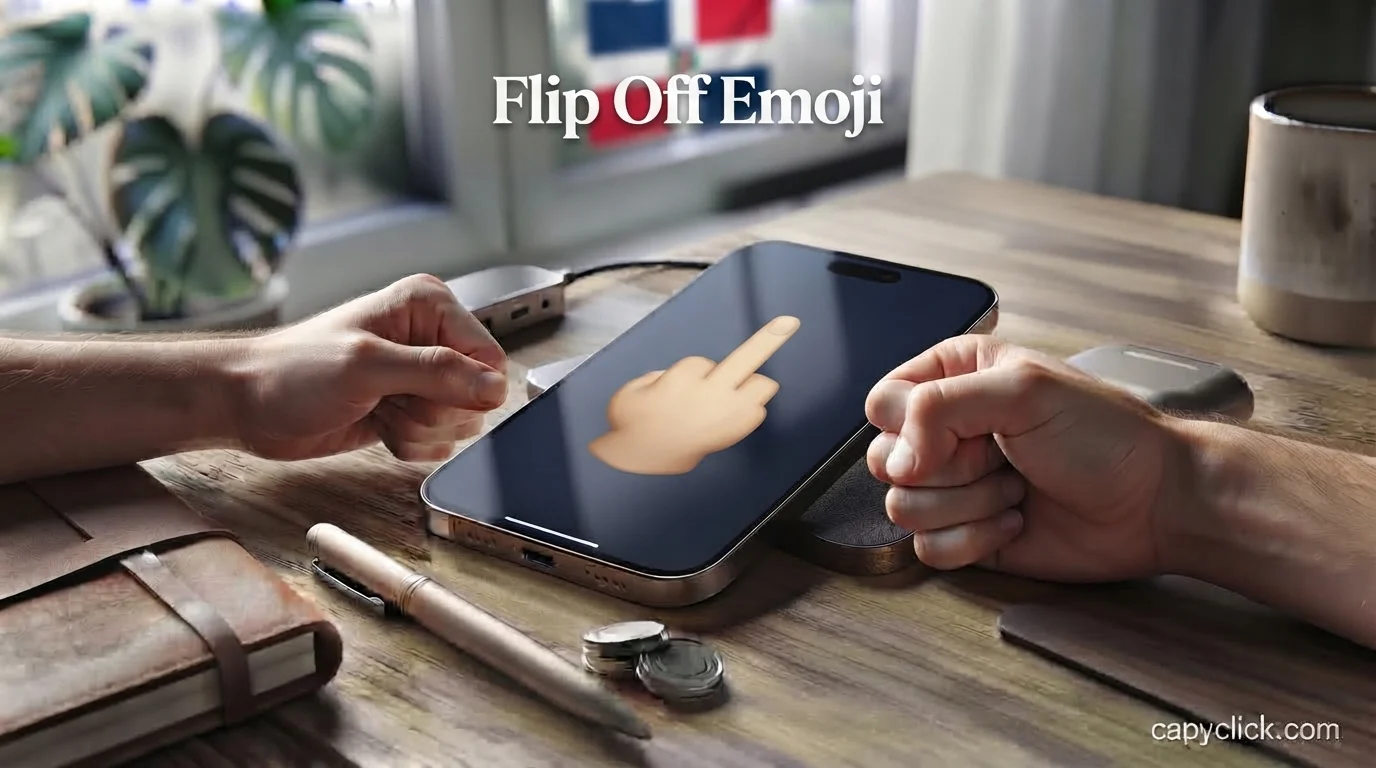
The flip off emoji 🖕 represents a raised middle finger and is commonly used to express anger, annoyance, disrespect, defiance, or strong disagreement. It is often called the middle finger emoji or flipping the bird emoji. Because the gesture is widely considered offensive, its meaning can feel much stronger than many other hand emojis. The exact tone depends on the conversation, relationship, and context.
Quick Answer: What Does the Flip Off Emoji Mean?
The 🖕 flip off emoji usually represents the middle-finger gesture. People commonly use it to show:
- Anger or frustration
- Disrespect
- Defiance
- Strong disagreement
- “Get lost” or “go away”
- A joking or sarcastic reaction between friends
- Rebellion or attitude
It can be playful in some private conversations, but it can also be genuinely insulting. Before using it, consider who will receive it and how they might interpret the gesture.
What Is the Flip Off Emoji?
The 🖕 emoji depicts a hand with the middle finger raised while the other fingers are folded down. It represents the same gesture that people commonly call flipping someone off, giving the middle finger, or flipping the bird.
Its official Unicode name is Middle Finger.
Although many people search for it using terms such as “flip off emoji,” “flipping off emoji,” or “middle finger emoji,” these phrases generally refer to the same symbol: 🖕.
The emoji is available across many modern devices and platforms, although its exact artwork can vary.
What Does 🖕 Mean in Text?
The meaning of 🖕 depends on the words around it.
Anger
One of its clearest meanings is anger.
For example:
“I’m seriously done with this 🖕”
Here, the emoji adds a strong emotional reaction.
Disrespect
Someone may use 🖕 to deliberately show disrespect toward another person.
For example:
“You really said that? 🖕”
In this context, it can be an insulting response.
Defiance
The emoji can also express a rebellious attitude.
For example:
“I do what I want 🖕”
Here, the gesture communicates resistance rather than simply anger.
Frustration
People sometimes use it when something goes badly.
“My internet stopped working again 🖕”
In a casual conversation, this may be directed at the situation rather than another person.
Humor Between Friends
Close friends may use 🖕 jokingly without intending serious hostility.
For example:
“You ate the last slice? 🖕😂”
The laughing emoji changes the tone and can make the gesture feel more playful.
Still, humor depends on the relationship. What one friend finds funny could offend someone else.
Why Do People Call It the Flip Off Emoji?
“Flip off” is a common English phrase meaning to make the middle-finger gesture toward someone.
Other expressions include:
- Give someone the middle finger
- Flip someone off
- Flip the bird
- Give someone the finger
- Show the middle finger
Therefore, searches for flip off emoji usually lead people to 🖕.
The phrase is informal, while Middle Finger is the official Unicode name.
Flip Off Emoji vs. Other Angry Emojis
The 🖕 emoji is much more direct than many other emojis used to express anger.
| Emoji | Common Meaning | Strength |
|---|---|---|
| 🖕 | Middle finger, insult, defiance | Very strong |
| 😡 | Anger | Strong |
| 😠 | Annoyance or anger | Moderate |
| 🤬 | Swearing or extreme frustration | Strong |
| 🙄 | Eye-rolling or irritation | Mild to moderate |
| 😤 | Frustration or determination | Moderate |
For example, 😡 says “I’m angry,” while 🖕 can communicate a much more direct insult or rejection.
This difference matters when choosing an emoji for a message.
Is the Flip Off Emoji Offensive?
Yes, it can be highly offensive.
The middle-finger gesture is commonly understood as an insulting or obscene gesture in many cultures and situations. However, the exact social meaning can vary by country, community, relationship, and context.
A message containing 🖕 may be interpreted as:
- Rude
- Aggressive
- Insulting
- Defiant
- Funny
- Sarcastic
- Playful
The recipient’s interpretation is especially important.
For example, a close friend may understand:
“You 😂🖕”
as friendly teasing.
The same emoji sent to a teacher, customer, manager, stranger, or professional contact could be interpreted very differently.
Is 🖕 Always a Serious Insult?
No.
The emoji does not always indicate genuine hatred or serious anger.
People sometimes use it as exaggerated humor. Online conversations often use dramatic expressions for comic effect.
For example:
“Monday morning 🖕☕”
This might simply mean that someone dislikes Monday mornings.
Likewise:
“My alarm at 6 AM 🖕😂”
could be a humorous complaint rather than an actual insult toward a person.
The surrounding text and other emojis provide important clues.
Flip Off Emoji Meaning From a Girl or Guy
If someone sends you 🖕, their gender does not automatically determine what it means.
A girl, guy, friend, partner, coworker, or stranger can use the emoji in many different ways.
Consider the complete message.
“Haha, you got me 🖕😂”
This may be playful.
“Don’t talk to me 🖕”
This is much more likely to communicate anger or rejection.
Rather than focusing on who sent it, focus on the words, situation, and relationship.
Flip Off Emoji With Different Skin Tones
The Middle Finger emoji supports skin-tone modifiers.
Common versions include:
- 🖕🏻
- 🖕🏼
- 🖕🏽
- 🖕🏾
- 🖕🏿
These versions show the same gesture with different skin tones.
The basic message remains the same: the raised middle-finger gesture.
The visual appearance may differ slightly depending on the device or platform.
How the Flip Off Emoji Looks on Different Devices
Emoji designs are not identical everywhere.
The 🖕 emoji may look somewhat different on:
- iPhone
- Android
- Windows
- macOS
- Social media platforms
- Messaging applications
The hand shape, shading, and overall artwork can change, but the basic middle-finger gesture remains recognizable.
This is normal for emojis because different platforms create their own visual designs.
How to Use the Flip Off Emoji in a Message
Because 🖕 is a strong gesture, context matters more than with most ordinary emojis.
For Frustration
“This stupid traffic 🖕”
For Playful Teasing
“You actually believed me 😂🖕”
For Defiance
“Nobody is going to tell me what to do 🖕”
For a Strong Reaction
“Seriously? 🖕”
For a Funny Situation
“My alarm clock every morning 🖕😂”
These examples show that the same emoji can move from serious to humorous depending on the surrounding words.
Flip Off Emoji Copy and Paste
If you are looking for the emoji itself, you can copy it here:
🖕
You can paste it into compatible:
- Text messages
- WhatsApp chats
- Instagram captions
- TikTok comments
- Facebook posts
- Discord messages
- Snapchat
- X posts
You can also combine it with other emojis to change the tone.
Examples:
- 🖕😂 — joking or sarcastic
- 🖕😡 — anger
- 🖕🙄 — annoyance
- 🖕🔥 — rebellious attitude
- 🖕💀 — exaggerated humor
- 🖕😤 — frustration
Remember that adding another emoji does not guarantee that the message will be perceived as friendly.
When Should You Avoid the Flip Off Emoji?
There are many situations where using 🖕 is not a good idea.
Avoid it when communicating with:
- Employers
- Teachers
- Customers
- Clients
- Professional contacts
- People you do not know well
- Official organizations
- Someone who may already be upset
Even if you intended it as a joke, the recipient may not understand your intention.
For professional communication, words such as “I disagree,” “I’m frustrated,” or “I don’t appreciate that” are much clearer and safer.
Common Mistakes With the Flip Off Emoji
Mistake 1: Thinking It Always Means Anger
The emoji can be humorous, sarcastic, or playful. Context matters.
Mistake 2: Using It With Strangers
A joke between friends does not necessarily work with strangers.
Mistake 3: Confusing It With Other Hand Emojis
The 🖕 emoji is very different from:
- 👍 Thumbs Up
- 👎 Thumbs Down
- ✌️ Victory Hand
- 🤞 Crossed Fingers
- 🤟 Love-You Gesture
- 🤘 Sign of the Horns
Mistake 4: Assuming Emojis Have One Universal Meaning
Emoji interpretation can vary between people and cultures. A person’s communication style also matters.
Mistake 5: Using It in Formal Communication
Even if you are frustrated, 🖕 is rarely appropriate in a professional setting.
Practical Tips for Using 🖕
Before sending the flip off emoji, ask yourself three simple questions:
Who am I sending it to?
A close friend may understand your humor, while a stranger may see an insult.
What am I trying to say?
If you mean “I’m annoyed,” 😤 or 😒 may communicate that without the same level of hostility.
Could the message be misunderstood?
If the answer is yes, add words that explain your intention or choose a less aggressive emoji.
A little context can make a major difference.
Frequently Asked Questions
What is the flip off emoji?
The flip off emoji is 🖕, officially called the Middle Finger emoji. It represents the raised middle-finger gesture.
What does 🖕 mean from someone?
It commonly means anger, disrespect, defiance, rejection, or frustration. Among close friends, it can also be used jokingly.
Is 🖕 a bad emoji?
It is considered offensive or rude in many situations because it represents an insulting gesture. Whether it is appropriate depends on the context and relationship.
What is another name for the flip off emoji?
Common names include middle finger emoji, flipping off emoji, flipping the bird emoji, and giving the finger emoji.
Can 🖕 be used as a joke?
Yes. Friends sometimes use it as playful teasing or exaggerated humor. However, not everyone will interpret it that way.
What does 🖕😂 mean?
The combination often suggests that the middle-finger gesture is being used jokingly, sarcastically, or humorously. Context still matters.
Can I use the flip off emoji professionally?
It is generally best to avoid it in professional communication because it can easily be interpreted as disrespectful or hostile.
How do I copy the flip off emoji?
Simply copy 🖕 and paste it into an app or platform that supports emojis.
Conclusion
The flip off emoji 🖕 is a digital version of the middle-finger gesture. It can communicate anger, disrespect, frustration, rebellion, or strong disagreement, while friends may sometimes use it as exaggerated humor or playful teasing.
Because it is a strong and potentially offensive gesture, context is especially important. Think about the person receiving it, the words around it, and the situation before using 🖕, particularly in professional or unfamiliar conversations.

I am Leah Rosel, a passionate writer at CapyClick. I enjoy creating creative, stylish, funny, and meaningful captions that help people express themselves and make every social media post memorable.