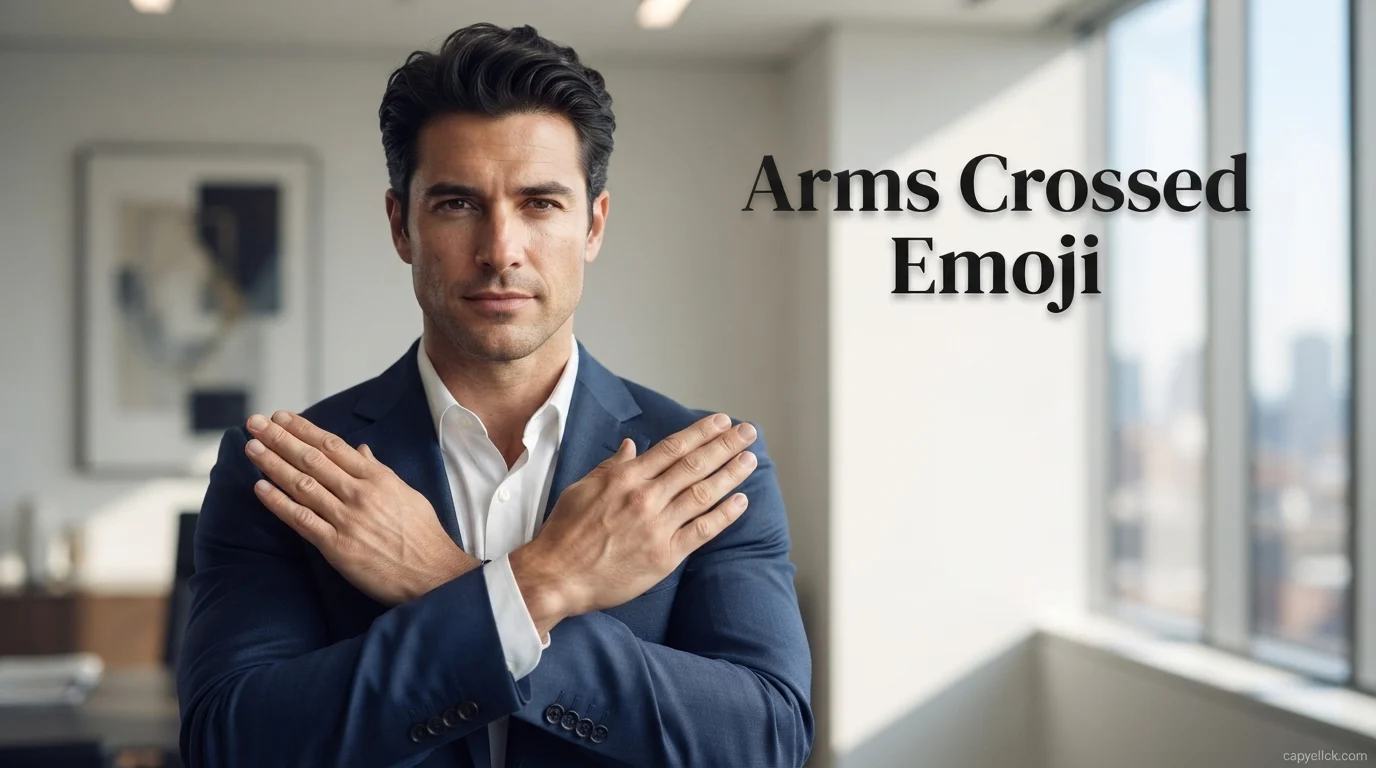
The arms crossed emoji 🙅 usually shows a person making an X with their arms, and it commonly means no, not allowed, stop, disagreement, or refusal. It can also express rejection, boundaries, or a playful “absolutely not” feeling. Depending on the conversation, the emoji may sound serious, funny, dramatic, or friendly.
People often search for the arms crossed emoji when they want to copy it, understand its meaning, find different versions, or use it in social media captions and messages. This guide explains what 🙅 means, how to use it, what its variations mean, and which emojis can be used with it.
Quick Answer: What Does the Arms Crossed Emoji 🙅 Mean?
The arms crossed emoji 🙅 represents a person crossing their arms in front of their body to form an X. It generally communicates no, refusal, rejection, disagreement, prohibition, or “stop.”
Common meanings include:
- No 🙅
- Not allowed 🚫
- I disagree 🙅
- Stop right there 🙅
- Absolutely not 🙅♀️
- I refuse 🙅♂️
- Don’t do that 🙅
- Setting a boundary 🙅
- Playful rejection 😄🙅
- Strong disapproval 🙅
The exact meaning depends on the words and situation around the emoji.
What Is the Arms Crossed Emoji?
The arms crossed emoji is commonly represented by 🙅, officially associated with the gesture of a person indicating “no.”
The person’s arms are positioned across the front of the body, creating an X-like gesture. This physical gesture is widely understood as a way to reject something, say no, or indicate that something is not permitted.
The emoji can appear in several gender and appearance variations, including:
- 🙅 Person Gesturing No
- 🙅♀️ Woman Gesturing No
- 🙅♂️ Man Gesturing No
- 🙅🏻 Light skin tone
- 🙅🏼 Medium-light skin tone
- 🙅🏽 Medium skin tone
- 🙅🏾 Medium-dark skin tone
- 🙅🏿 Dark skin tone
The visual appearance can vary between Apple, Google, Microsoft, Samsung, and other platforms.
What Does 🙅 Mean in Texting?
In texting, 🙅 most often means “no” or “I don’t want that.”
For example:
Friend: Want to go out tonight?
Reply: 🙅 I’m staying home.
Here, the emoji makes the refusal clear without needing a long explanation.
It can also soften a rejection. Instead of simply writing “No,” someone might write:
Nope 🙅😂
The laughing emoji makes the message sound more playful.
Common Texting Meanings
| Message | Meaning of 🙅 |
|---|---|
| Not happening 🙅 | Strong refusal |
| No way 🙅 | Strong disagreement |
| Don’t do that 🙅 | Stop |
| I’m not going 🙅 | Refusal |
| That’s not okay 🙅 | Disapproval |
| Nope 🙅😂 | Playful rejection |
| Absolutely not 🙅 | Firm refusal |
| No thanks 🙅 | Polite rejection |
Arms Crossed Emoji Meaning in Different Situations
An emoji does not always have one fixed meaning. The same symbol can communicate different emotions depending on the conversation.
1. Saying No
The simplest use of 🙅 is to say “no.”
Examples:
- Nope 🙅
- No, thank you 🙅
- Not today 🙅
- Definitely not 🙅
- No way! 🙅
This is probably the most direct use of the emoji.
2. Showing Disagreement
You can use 🙅 when you disagree with someone’s statement or suggestion.
Examples:
- I don’t agree with that 🙅
- That’s not how it works 🙅
- Sorry, but no 🙅
- I see your point, but I’m not convinced 🙅
The emoji adds a visual sign of disagreement.
3. Setting a Boundary
The arms crossed emoji can also communicate a personal boundary.
For example:
- Don’t cross that line 🙅
- That’s something I won’t accept 🙅
- My answer is no 🙅
- Some things are simply off limits 🙅
In these cases, the emoji can make the message feel firm.
4. Saying Something Is Not Allowed
The emoji can be used when something is forbidden or against the rules.
Examples:
- Phones during the exam 🙅📱
- No cheating 🙅
- No spoilers 🙅🚫
- Outside food? 🙅
For formal warnings, however, words or dedicated symbols such as 🚫 may communicate the rule more clearly.
5. Playful Rejection
Sometimes 🙅 is not serious at all.
Someone might use it jokingly when refusing to share food, accept a suggestion, or admit something.
Examples:
- You can have one bite.
One bite? 🙅😂 - Are you ready to wake up at 6 AM?
Absolutely not 🙅🤣
Here, the surrounding emojis and wording make the tone humorous.
What Does the Arms Crossed Emoji Mean From a Girl or Guy?
The basic meaning of 🙅 does not automatically change based on whether a girl or guy sends it.
If someone sends:
No 🙅
they are generally communicating rejection, refusal, or disagreement.
However, the exact emotional tone depends on the conversation. A person might use 🙅 seriously, jokingly, dramatically, or casually.
For example:
“You’re coming with us, right?”
“No chance 🙅😂”
This probably sounds playful.
But:
“Please don’t contact me again 🙅”
has a much more serious tone because of the words surrounding the emoji.
The context matters more than the sender’s gender.
Arms Crossed Emoji Copy and Paste
If you are looking for an arms crossed emoji to copy and paste, here are several options:
| Emoji | Description | Copy |
|---|---|---|
| 🙅 | Person Gesturing No | 🙅 |
| 🙅♀️ | Woman Gesturing No | 🙅♀️ |
| 🙅♂️ | Man Gesturing No | 🙅♂️ |
| 🙅🏻 | Light skin tone | 🙅🏻 |
| 🙅🏼 | Medium-light skin tone | 🙅🏼 |
| 🙅🏽 | Medium skin tone | 🙅🏽 |
| 🙅🏾 | Medium-dark skin tone | 🙅🏾 |
| 🙅🏿 | Dark skin tone | 🙅🏿 |
You can copy any of these symbols and paste them into messages, captions, comments, bios, or posts.
Arms Crossed Emoji for Instagram
The arms crossed emoji works well for Instagram captions when you want to express confidence, boundaries, humor, or a strong “no” attitude.
Short Captions
- No explanation needed 🙅
- Not today 🙅
- Absolutely not 🙅😂
- Rules are rules 🙅
- My answer is no 🙅
- Hard pass 🙅
- Nope, not happening 🙅
- Respect the boundaries 🙅
- I said no 🙅
- Zero interest 🙅😌
Funny Captions
- Wake up early on vacation? 🙅😂
- Sharing my fries? Never 🙅🍟
- Monday morning? 🙅😭
- Another meeting? 🙅😂
- Giving up dessert? 🙅🍰
- Going to bed early? 🙅🤣
- Leaving the party early? 🙅🎉
These captions work especially well when the image or situation already makes the joke clear.
Arms Crossed Emoji Combinations
Combining 🙅 with other emojis can change the tone or make the meaning easier to understand.
| Combination | Possible meaning |
|---|---|
| 🙅🚫 | Definitely not allowed |
| 🙅😂 | Playful refusal |
| 🙅😒 | Annoyed disagreement |
| 🙅😤 | Strong refusal |
| 🙅❤️ | Loving but firm no |
| 🙅🔥 | Strong reaction |
| 🙅🙄 | Disbelief or rejection |
| 🙅🤦 | Frustrated reaction |
| 🙅❌ | Clear rejection |
| 🙅👍 | No, that’s not happening |
For example, 🙅😂 usually feels much lighter than 🙅😤.
Arms Crossed Emoji vs Similar Emojis
Several emojis can communicate “no,” rejection, or disagreement, but they do not all have exactly the same meaning.
| Emoji | Common meaning | Main difference |
|---|---|---|
| 🙅 | No or refusal | Uses a crossed-arm gesture |
| 🙅♀️ | Woman saying no | Female-presenting variation |
| 🙅♂️ | Man saying no | Male-presenting variation |
| 🚫 | Prohibited | More like an official restriction |
| ❌ | Wrong or no | Direct visual rejection |
| 👎 | Dislike or disapproval | Shows a negative opinion |
| ✋ | Stop or wait | Often asks someone to pause |
| ❌🙅 | Strong rejection | Combines two negative signals |
Choosing the right emoji depends on what you want to communicate.
If you mean “No, I don’t agree,” 🙅 can work well.
If you mean “This is prohibited,” 🚫 may be clearer.
If you mean “This is wrong,” ❌ may be more direct.
Arms Crossed Emoji on Different Devices
Emoji designs are created by individual platform providers, so the arms crossed emoji can look slightly different depending on the device.
For example, the facial expression, skin tone, clothing, hairstyle, and arm design may vary.
These visual differences usually do not change the basic meaning. A person seeing 🙅 on another device will generally understand the gesture as communicating “no” or rejection.
This is one reason context remains important when using emojis.
How to Type the Arms Crossed Emoji
You can find the emoji through the emoji keyboard on most modern devices.
On iPhone
- Open a messaging or social media app.
- Tap the text field.
- Open the emoji keyboard.
- Search for “no” or browse the people and gestures section.
- Select 🙅.
On Android
- Open the keyboard.
- Tap the emoji icon.
- Use the emoji search function.
- Search for “no” or a related gesture.
- Tap the emoji you want.
On Windows
Press Windows + . to open the emoji panel. You can then search through the available emoji and select the appropriate person gesture.
On Mac
Press Control + Command + Space to open the character and emoji viewer, then search for the relevant emoji.
You can also simply copy 🙅 from this page.
Common Mistakes When Using the Arms Crossed Emoji
Assuming It Always Means Anger
🙅 does not automatically mean someone is angry. It can simply mean “no,” “not interested,” or “that’s not allowed.”
Using It for Every Negative Message
Not every negative statement needs 🙅. Sometimes 👎, ❌, 😕, or 🚫 may communicate the intended meaning more naturally.
Ignoring Context
The same emoji can sound friendly in one message and serious in another.
“No dessert for me 🙅😂” sounds playful.
“Please don’t contact me again 🙅” communicates a much firmer boundary.
Thinking It Always Means Rejection in Love
If someone sends 🙅 during a romantic conversation, it does not automatically mean they are rejecting the relationship. Read the complete message and consider the surrounding context.
Overusing Emojis
Several repeated negative emojis can make a simple message look overly dramatic.
For example, 🙅🙅🙅🙅🙅❌🚫😤 may be unnecessary when one emoji would be enough.
Practical Tips for Using 🙅
Use these simple tips to make your messages clearer:
- Use 🙅 when you want to express a visual “no.”
- Add 😂 or 🤣 when the refusal is meant as a joke.
- Add 😤 when you want to show stronger frustration.
- Use 🚫 when something is prohibited.
- Use ❤️ when a firm refusal is meant in a warm or playful way.
- Use 🙅♀️ or 🙅♂️ when you specifically want a gendered version.
- Keep your surrounding words clear when the message could be misunderstood.
- Avoid relying on an emoji alone for serious boundaries or important instructions.
FAQs: About the Arms Crossed Emoji
What does the arms crossed emoji 🙅 mean?
The arms crossed emoji usually means no, refusal, disagreement, rejection, or “stop.” It can also represent something that is not allowed.
What is the official name of 🙅?
The emoji is commonly known as Person Gesturing No. It shows a person making an X-like gesture with their arms.
What does 🙅 mean from a girl?
Its basic meaning is the same regardless of who sends it. It can mean no, disagreement, refusal, or playful rejection. The surrounding conversation determines the tone.
What does 🙅 mean from a guy?
A guy using 🙅 can be saying no, rejecting an idea, disagreeing, or jokingly refusing something. The emoji itself does not have a special male-only meaning.
How can I copy the arms crossed emoji?
You can copy this symbol directly: 🙅. You can also choose gender or skin-tone variations such as 🙅♀️, 🙅♂️, or the available skin-tone versions.
Is 🙅 a rude emoji?
Not necessarily. It can be casual, funny, polite, firm, or serious depending on the message. The words around it usually determine how strong it feels.
What is the difference between 🙅 and 🚫?
🙅 represents a person gesturing “no,” while 🚫 is a prohibition symbol commonly used to mean something is forbidden or not permitted.
What emojis go well with 🙅?
Popular combinations include 🙅😂 for playful refusal, 🙅🚫 for prohibition, 🙅😤 for strong disagreement, and 🙅❌ for clear rejection.
Conclusion
The arms crossed emoji 🙅 is a simple but expressive way to communicate “no,” refusal, disagreement, rejection, or a clear boundary. It can be serious when used with firm words, but it can also be funny and playful when combined with emojis such as 😂 or 🤣. Its meaning depends heavily on the conversation and the other symbols around it.
if you need a quick reply, an Instagram caption, a funny reaction, or a way to say “absolutely not,” 🙅 can make your message more expressive. You can copy the emoji directly, choose a gender or skin-tone variation, and combine it with other emojis to match the tone you want.

I am Leah Rosel, a passionate writer at CapyClick. I enjoy creating creative, stylish, funny, and meaningful captions that help people express themselves and make every social media post memorable.